Conveyor Belt Cleaning Brushes: Why Does Residue Remain After the Brush?
Diagnose dirty bands, profiled-belt recesses, damp brush loading and escaped residue before choosing a conveyor cleaning brush and collection layout.
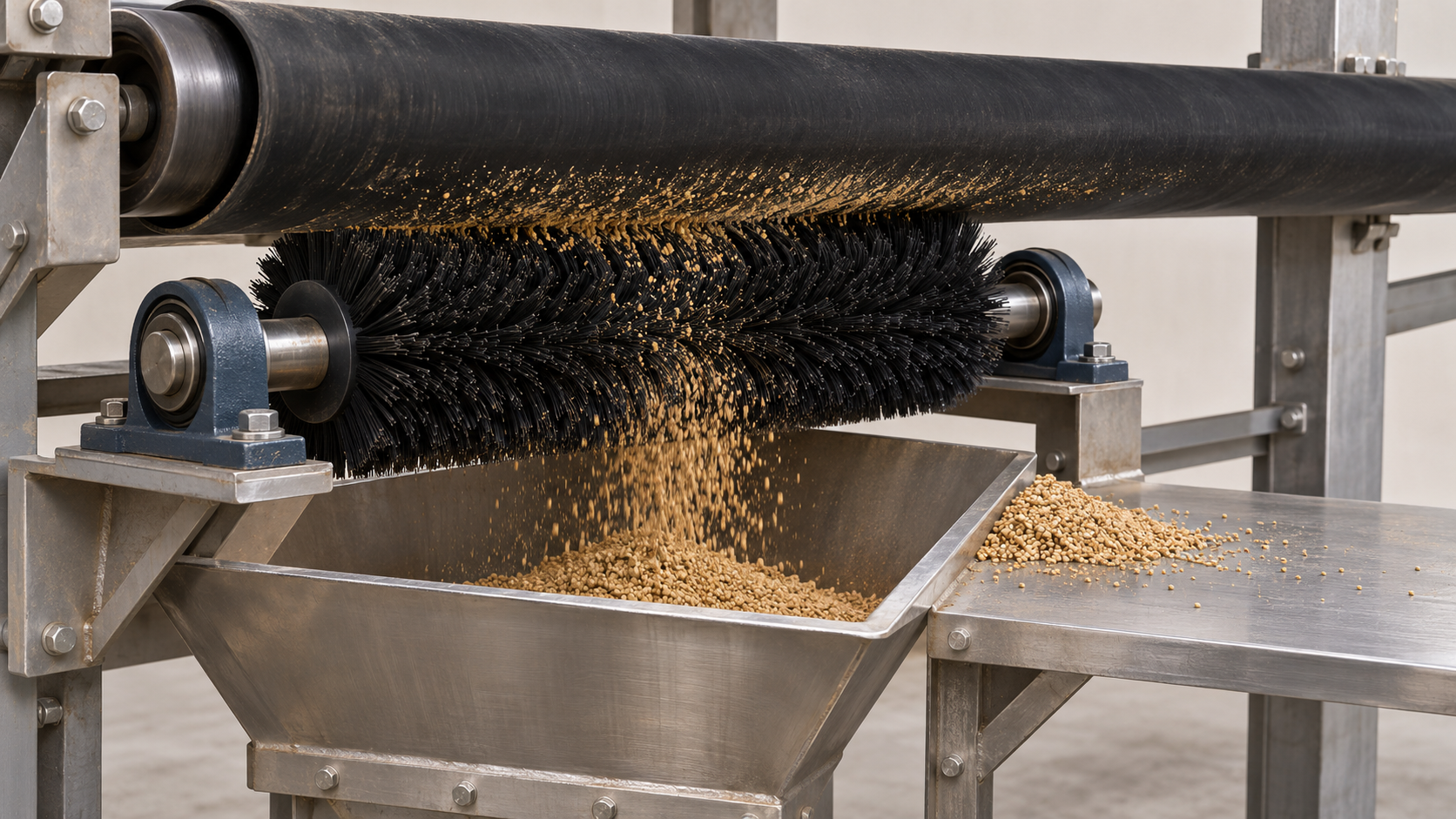
A conveyor cleaning brush must reach the required belt area, release the actual deposit and send the removed material into a suitable collection path. If one of those conditions fails, a clean central stripe is only a partial result. Before buying a firmer replacement, locate what remains on the belt and what has merely moved onto nearby structure.
Follow the material through three places: the return belt before the brush, the belt immediately after brushing, and the collector and downstream structure. That comparison distinguishes missed contact, ineffective removal and failed collection. Each points toward a different change, so “use a stronger brush” is not yet a useful specification.
Is the dirty band outside the brush contact or still dirty inside it?
A continuous dirty strip near one belt edge may indicate that the active brush face does not cover the required area throughout tracking. A stripe within the nominal face may instead indicate uneven contact, local brush condition or a deposit the present arrangement cannot remove. Width alone does not tell those situations apart.
Map the belt edges and the dirty band relative to the stationary cleaner. Include the observed tracking range, belt profile, splices and repaired areas. The useful width is the active brush face in its installed position, not the total shaft length or the distance between bearings.
Consider a planning example with a 600 mm belt, a centred 480 mm residue band and a centred 560 mm brush face. At that one position, the nominal face extends 40 mm beyond each edge of the dirty band: (560 − 480) ÷ 2. That is a geometric margin, not a permissible tracking value. The belt can move relative to the cleaner, and the real contact may not use the entire nominal face.
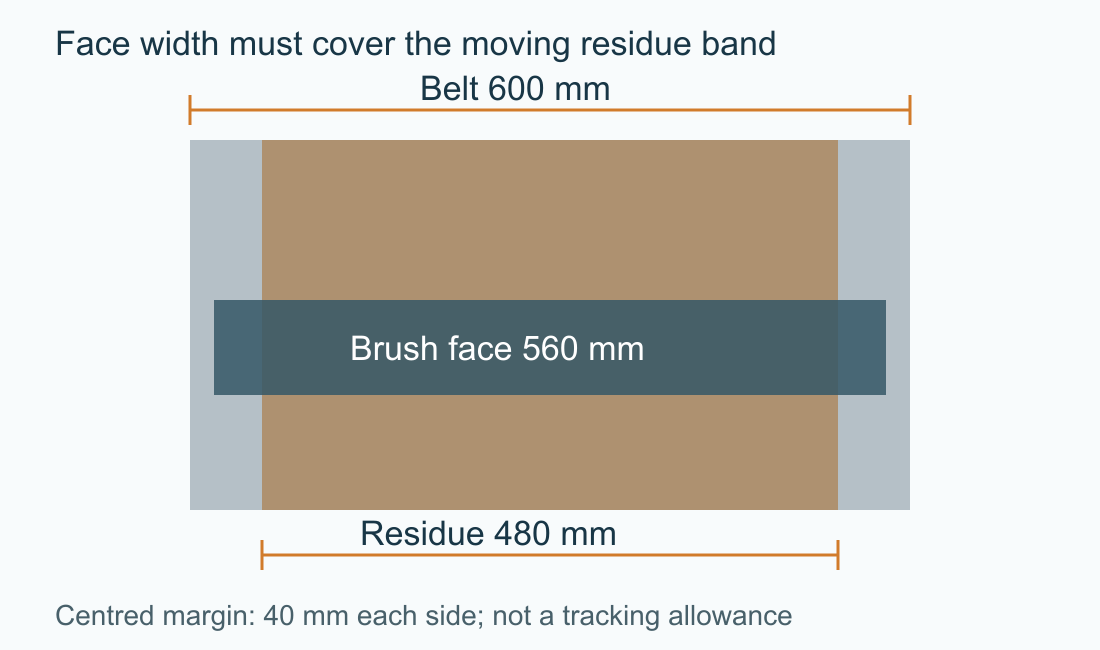
Assumed dimensions for a coverage calculation. The 40 mm margin is measured from the dirty-band edge to the brush-face edge when centred; it is not a belt-tracking specification.
If the dirty band shifts beyond the active contact at one tracking extreme, resolve the permitted cleaner position or working width before changing filament grade. If the band stays within verified contact and still carries material, investigate the deposit and contact mechanism. A wider roller and a firmer roller answer different failures.
What does an open-pitch spiral brush actually change?
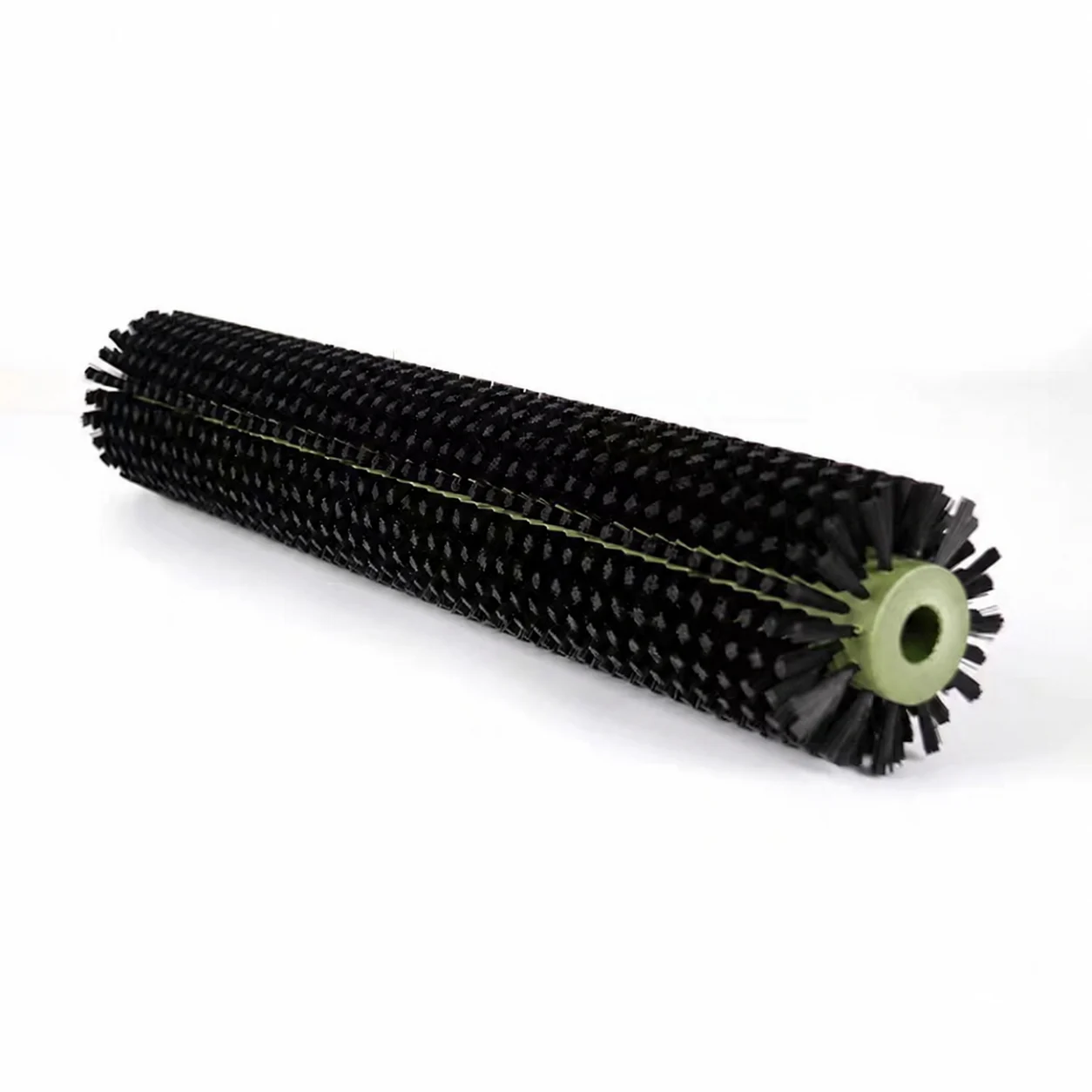
The published SB-RL-0012 nylon spiral roller lists a 120 mm outside diameter, 40 mm core diameter, 35 mm coil pitch and 0.50 mm nylon fill. The nylon is ordinary fill, not abrasive-filled nylon. Working length and shaft ends are configured to the machine.
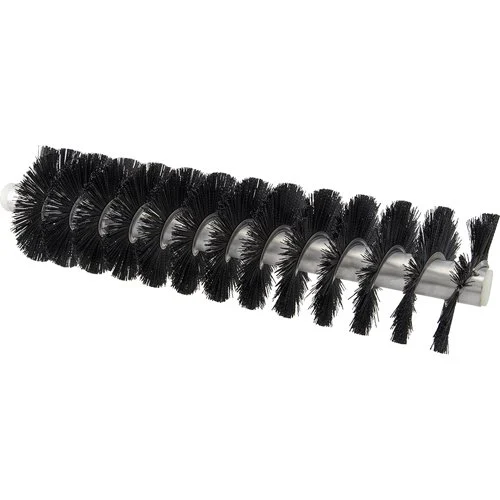
Actual SB-RL-0012 product image. The open helical arrangement is visible; it does not establish that a particular damp deposit will leave the brush or enter the collector.
Pitch is the axial advance between corresponding points on neighbouring turns. It is not the clear space between their edges, because the wound strip has its own width. The contact distribution also changes as the brush rotates and the belt travels. A stationary photograph showing open spaces cannot by itself establish either complete coverage or an inevitable uncleaned stripe.
The roller fill-layout guide explains that geometry in more detail. For this purchase, the question is whether the proposed layout reaches the required belt features and remains usable with the actual deposit. Do not turn an open appearance into a promise of self-cleaning.
Why are ribbed or chevron belts a different task from flat belts?
A flat belt mainly presents a broad surface. Ribs, flights, grooves and chevrons add shoulders and recesses that change how the brush enters and leaves contact. Material can remain beside a raised feature even when its top looks clean. The feature geometry also affects what the bristles and mounting can clear.
Martin Engineering identifies brush cleaners as an option for fines and residue on profiled belts, including ribbed and chevron constructions. Its product page distinguishes spiral and strip arrangements. That is evidence for considering profile access and construction together, not permission to transfer its motor, filament or installation limits to a different roller. Martin brush-cleaner overview
For a chevron belt carrying loose fines, inspect the valleys beside the raised pattern and the pattern ends. If only the ridge tops clean, the trial has not demonstrated recess access. Compare the belt section and actual contact path with the proposed brush geometry. Increasing engagement without the machine supplier’s permitted arrangement can change the contact at the high points without resolving the sheltered areas.
Splices and repairs belong in the same review. A candidate that behaves acceptably on an uninterrupted belt surface has not necessarily been evaluated at those discontinuities. Identify them in the enquiry and follow the belt and cleaner requirements for the intended contact arrangement.
Why can a dry-fines demonstration fail on damp production material?
Moisture changes the deposit being removed. Loose particles that fall readily may become cohesive or adhere to the belt when damp. Material can also pack into the fill, changing the working surface during the run. The brush that initially removes residue may later carry it around or put some of it back onto the belt.
For a line that alternates between dry fines and damp material, compare those states separately. Observe the belt, brush condition and collector after comparable portions of the intended task. A short dry demonstration cannot establish the damp-duty result. Neither can a clean brush photographed before the run prove that its open spaces remain clear in use.
If damp material accumulates between rows while the belt result deteriorates, investigate the layout, deposit state and the authorised brush-cleaning method together. Martin’s description of different cleaner constructions illustrates that shedding behaviour is a design consideration; its specific product claim is not a guarantee for SB-RL-0012. A candidate may be suitable for the dry duty and still need a different arrangement for the wet one.
Where does the material go after it leaves the belt?
Removal and collection are separate events. Detached material can fall into the intended hopper, strike a support, remain on the brush or escape beyond the collector opening. A belt that looks better while the next support collects a new pile has not delivered a complete cleaning solution.
Show the brush, return belt and collection opening in a side view. Mark obstructions between the release area and the collector, including supports and guards that belong to the actual machine. Use observed residue locations to guide the review; do not invent a release trajectory from a generic rotation arrow.
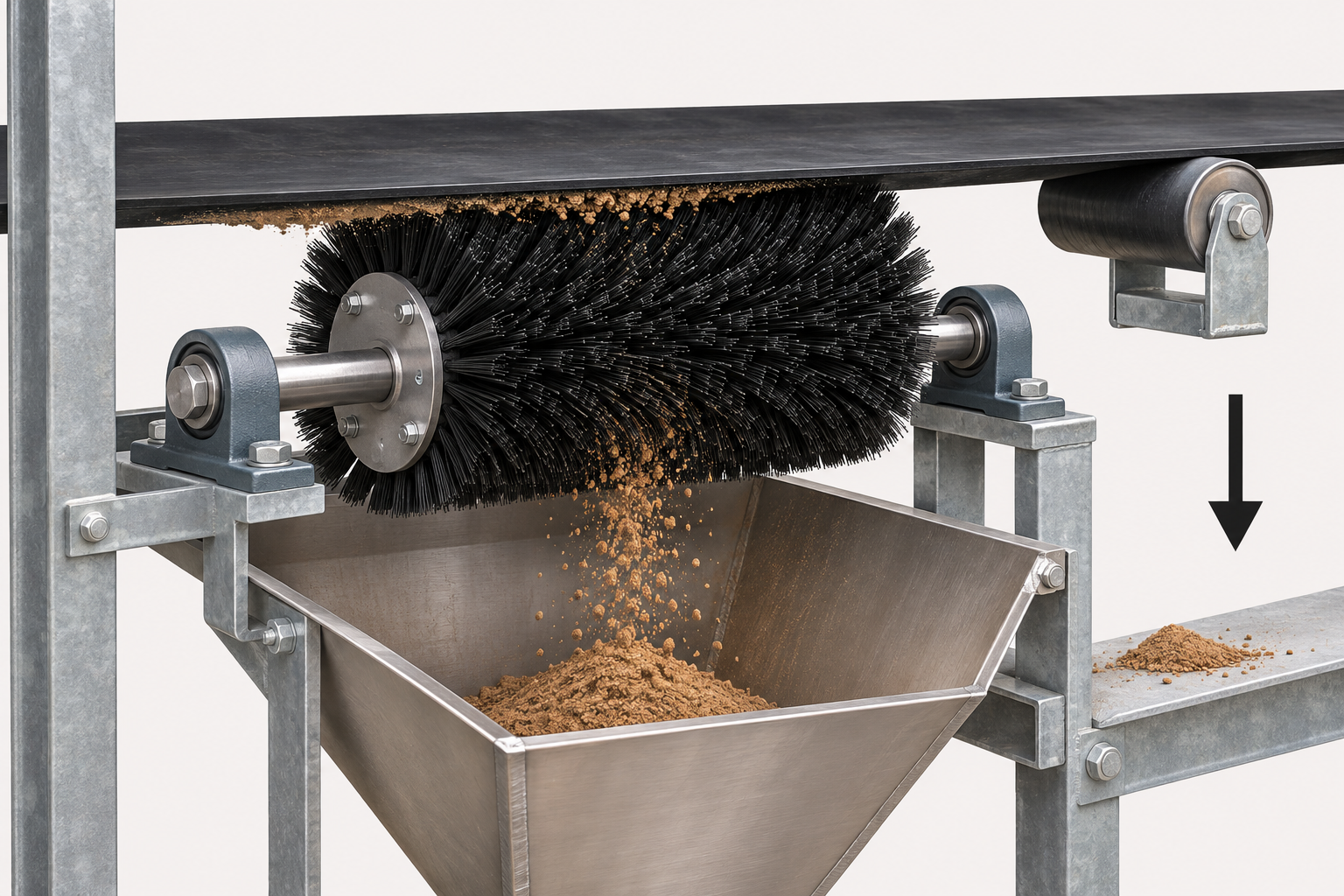
Contact-and-collection layout illustration: examine the relationship between the return belt, brush and residue collector.
In the 600 mm belt example, suppose the belt’s target band becomes acceptably clean but material accumulates on a ledge outside an offset tray. The next action concerns the collection route or cleaner location within the permitted design. A harder filament has not been shown to address that failure. After an authorised layout change, examine the belt and collection result together again.
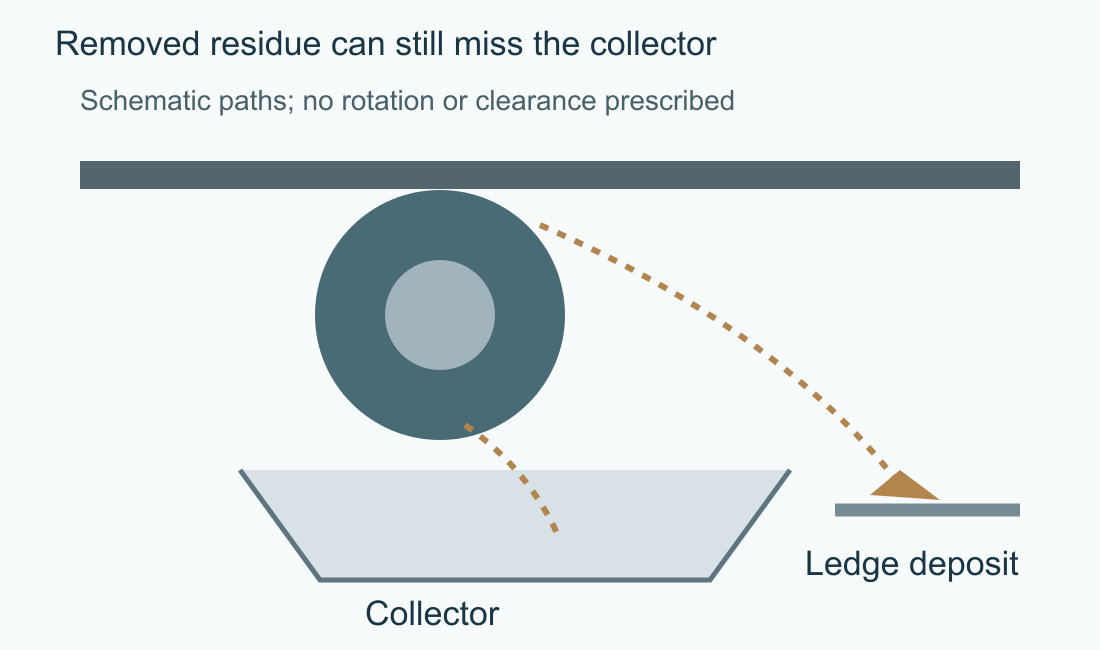
Two possible residue routes. Their shapes locate the investigation and do not specify a rotation direction or a measured flight path.
Can the brush be too close even when residue remains?
More contact is not automatically more effective cleaning. Flexible filaments need an appropriate working presentation, and the belt must remain supported and protected within the machine’s design. A brush can have substantial visible bending while still missing a sheltered feature or failing to release sticky material.
This article does not set a universal contact depth, direction or speed. Those depend on the belt, cleaner, drive and intended duty. Flexco, for example, treats its motorised brush cleaner as a defined system with its own mounting and adjustment provisions. An aftermarket roller must be assessed within the relevant machine arrangement, not set from another cleaner’s catalogue. Flexco motorised brush cleaner
If residue remains despite heavy visible bending, stop treating further adjustment as the default answer. Verify the intended contact, the brush condition and the deposit location under the authorised inspection procedure. If the obstruction is a rib shoulder or the problem is material packed into the fill, added contact may leave the underlying mechanism unchanged.
What should I compare when the brush works at first and then deteriorates?
Compare the incoming material state, belt tracking, brush condition and collection build-up between the satisfactory and unsatisfactory periods. A changing result can come from wear, contamination or changed operating conditions. Time alone does not distinguish them.
If a clean brush gives the expected result but the same brush loses effectiveness as damp residue accumulates, investigate loading and the cleaning method before declaring the original filament too soft. If the brush remains clean but one edge becomes dirty as the belt changes position, investigate coverage. If belt cleanliness remains steady while the collector overfills or a discharge route blocks, the limitation is downstream.
The roller result-drift guide explains how to use a known reference and observed changes without attributing every decline to wear. For belt cleaning, preserve the residue state and collection condition in that comparison; they can change independently of the roller.
How do I judge a candidate without accepting a partial improvement?
Use the site’s required belt condition and identify unacceptable changes to the belt, splice and surface features. Examine the full required width and relevant profile locations. Keep material type, moisture, loading and observation period comparable when comparing candidates, or explicitly identify the change.
Judge four outcomes separately: contact coverage, removal from the target areas, belt condition and collection. A good centre does not compensate for a dirty edge. A clean belt does not make a pile outside the hopper acceptable. A candidate that succeeds on dry material but clogs on damp material has a defined limited scope, not universal approval.
Do not obtain missing dimensions or observations by approaching moving machinery. Use the site’s isolation and inspection procedures and available operating records. The permitted machine arrangement is a prerequisite for the comparison; the goal is to understand the mechanism, not to improvise a new installation from an article.
What information makes the replacement enquiry useful?
Supply a belt plan showing the required cleaning width and tracking positions, plus a side view showing the contact and collection route. Identify the belt profile, material to remove, moisture states, splices and relevant repairs. Add the exact roller geometry and interface information from the shaft-drawing guide, keeping active face length separate from assembly length.
State the problem in physical terms: residue outside contact at one tracking position, deposits retained beside ribs, fill loading during damp duty, or material released outside the collector. This lets the proposed change address a known limitation. It also makes clear when a new brush is not the first necessary purchase.
A useful final choice is a construction and layout that clean the required belt areas while preserving the belt and directing removed material to the intended destination. If one condition remains unresolved, name it. The resulting enquiry is more actionable than a request for a generally stronger conveyor brush.
Related buying guides
Industrial Roller Brush Replacement: Do You Need the Whole Roller, a Sleeve or New Fill?
Replacing Sanding Brush Strips: Which Dimensions Must Match the Existing Head?
Produce Washing Brush Rollers: Can One Specification Clean Two Crops Without Marking Them?
Flat Glass Washer Brushes: Which Surface Is Marked, and Is the Brush Really the Cause?
How Do You Choose a Sanding Brush for a Profile Without Damaging Its Edges?