
Industrial Roller Brush Replacement: Do You Need the Whole Roller, a Sleeve or New Fill?
Define which roller parts need replacing. Compare complete assemblies, coil sleeves and tufted sleeves by support condition, torque transfer, retention and task.
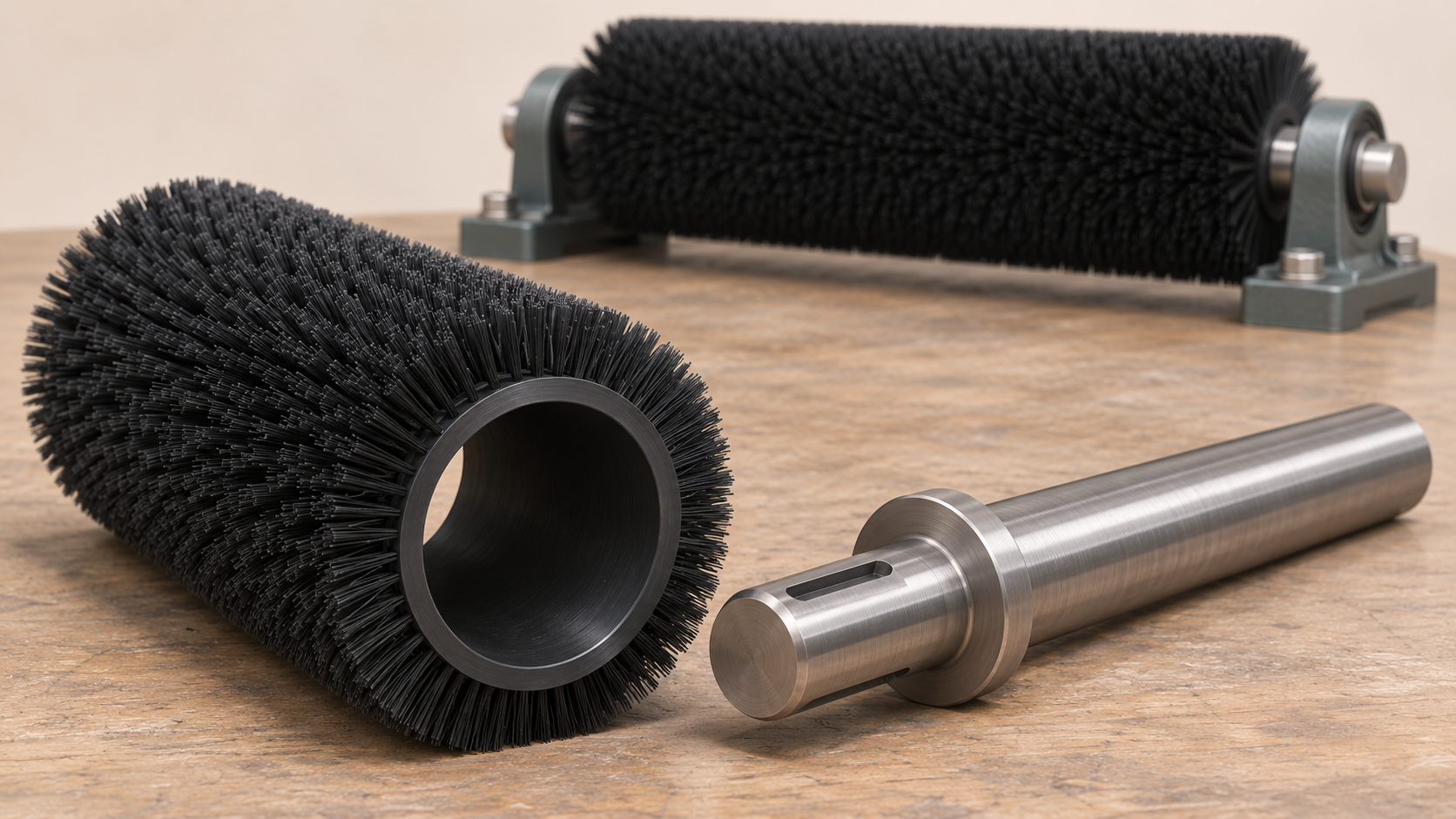
Buy the complete roller when the repair requires a new shaft or supporting assembly. Buy a sleeve or refill only when the retained components remain suitable and the replacement matches their interfaces. Buy individual elements only when the head is designed for those renewable parts. A matching brush diameter does not settle the choice: the working fill, supporting core, shaft, drive and retainers perform different jobs.
The most useful first question is therefore “which parts of this installed roller are being replaced?” An apparently inexpensive sleeve can leave a damaged support unresolved. A complete roller can also arrive without bearings or a drive component if “complete” was never defined. Establish the physical scope before comparing prices, then evaluate whether the renewed brushing surface still performs the required task.
What is actually inside a complete roller-brush assembly?
A roller station can include the brushing fill, a core or carrier, a shaft, bearing interfaces, axial locating parts and a drive connection. Some of those may belong to the brush supplier's assembly; others may stay on the machine. The term “roller brush” is used for several of these supply boundaries, so the noun alone is not a bill of materials.
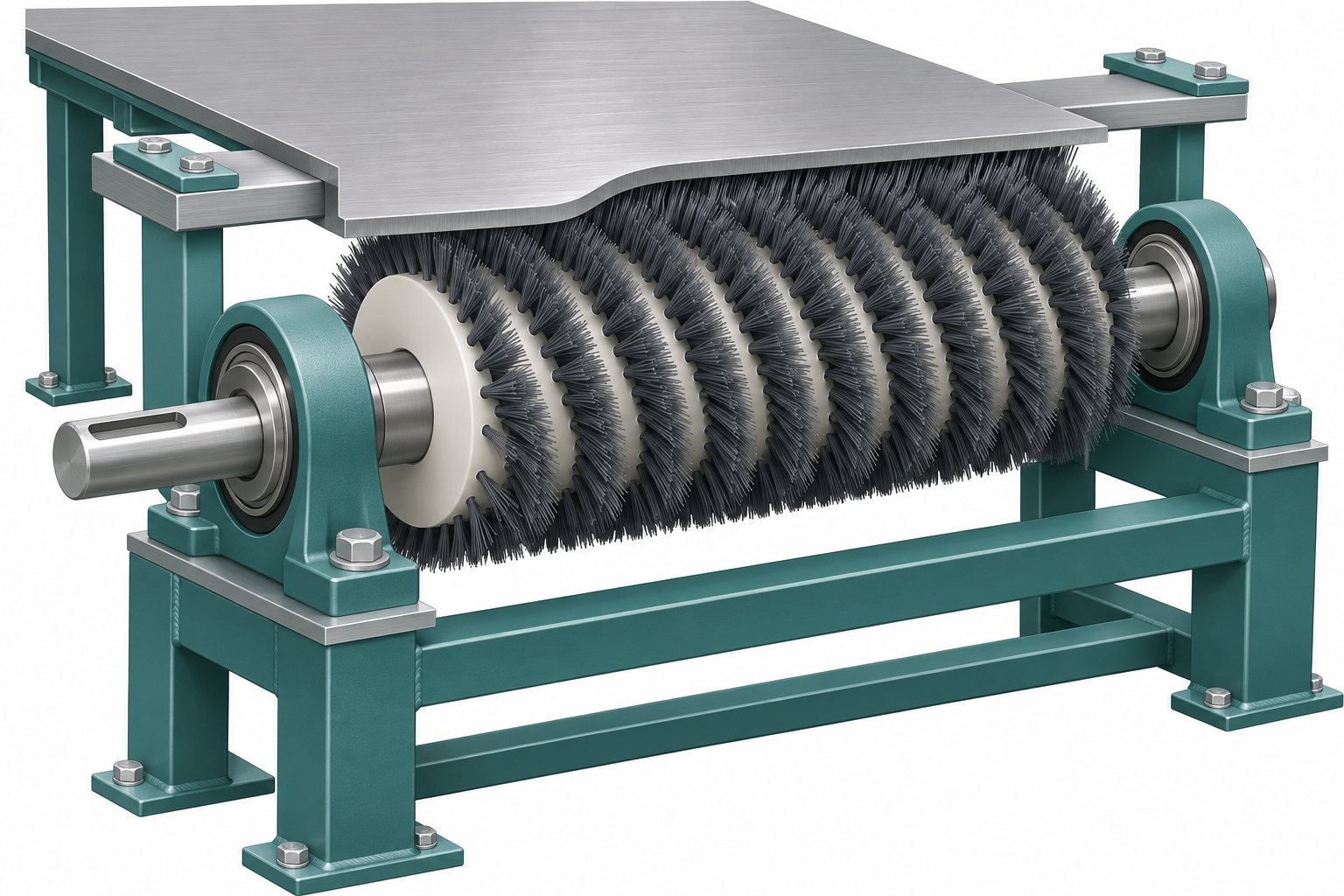
Assembly relationships: the brushing layer, core, shaft and supporting station are separate objects. The cutaway is a general component illustration, not an installation drawing for a listed product.
On a line where the complete shaft-mounted unit is exchanged during maintenance, the purchase may need the roller with specified shaft ends and assembled checks. Bearings, couplings, collars and guards should be listed as included or retained according to the actual machine. A shaft-end photograph is useful for identification, but it cannot provide the bearing fit or drive dimensions by itself.
On another machine, the shaft and carrier stay in service while a brushing sleeve is renewed. That can be a suitable scope if the retained support and retaining arrangement are sound and the renewal procedure fits the construction. It is not established merely by seeing a hollow center in a catalog photograph.
A third head may use replaceable rings or strip elements. Osborn's brush-roll range includes self-assembly systems with specified sections and adapters. That demonstrates a particular modular design, not a rule that every cylindrical brush can be dismantled into interchangeable segments.
When does a sleeve-only purchase make sense?
A sleeve is a candidate when it provides the worn working layer while the shaft or carrier can be reused under the equipment's maintenance requirements. The retained component must still provide the intended support, location and drive. If its interface is damaged or its condition is unresolved, the sleeve quote covers only part of the repair.
The SB-SC-0011 outward coil sleeve gives a concrete example. Its listing describes 300 mm axial length, 80 mm brush outside diameter, 40 mm coil inside diameter, a 5 × 5 mm metal channel and 0.30 mm Nylon PA66 fill. Those values describe a brushing component for a supported roller.
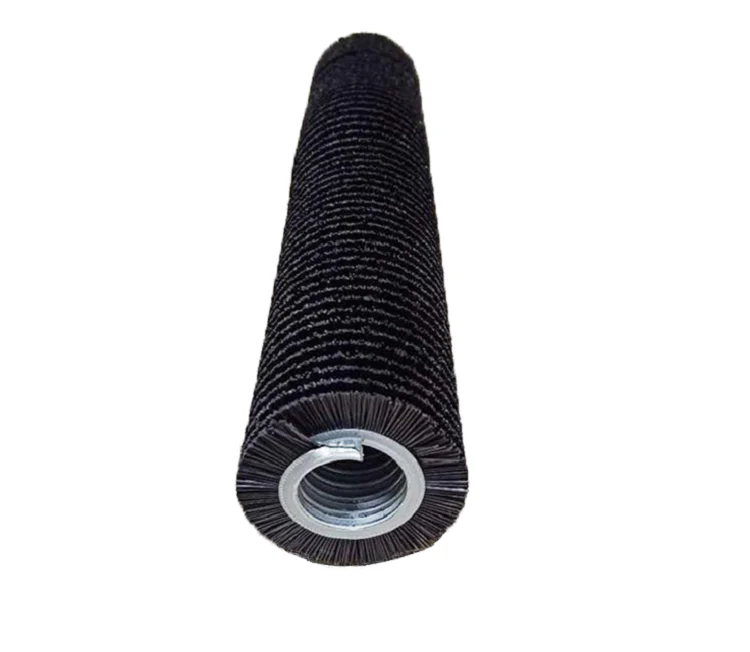
SB-SC-0011: the coil support opening and channel termination both matter when the sleeve is fitted to a retained carrier.
The 40 mm coil opening is not a complete shaft connection. It identifies the opening associated with the coil support, while the carrier, shaft connection and retaining parts remain separate design questions. The channel termination visible at the near end can also affect how the sleeve approaches an end feature. Ask for the end geometry instead of assuming the opening is an unobstructed cylinder along its entire assembly path.
For a cleaning roller whose carrier is accepted for reuse, the useful order can be one defined sleeve, with the retained carrier and end retainers explicitly named. If inspection rejects that carrier, either add its repair or replacement to the scope, or compare a complete assembly. Keeping the original sleeve-only price on the comparison sheet would no longer represent the same repair.
How are torque transfer and axial retention different?
The drive must make the brushing member rotate as intended, while axial retention keeps it in the required position along the shaft. These are different functions. A shoulder can locate an end axially without establishing how torque reaches the sleeve. A keyed connection can transmit torque without, by itself, specifying every axial retaining feature.
The actual assembly may use keys, specified clamping, adapters or another designed connection. Do not select a method from a generic sketch. Obtain the supplied construction and its mating details, including how the sleeve is located and retained, and which components are required for the intended load and operating conditions.
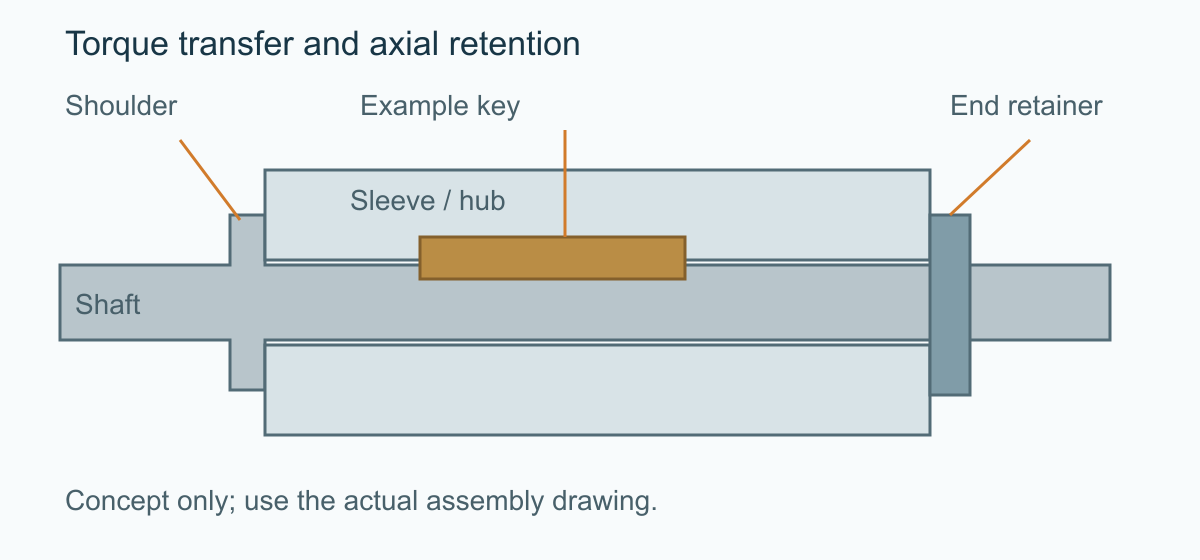
Functional distinction: this generic keyed example separates rotational drive from axial location. The actual fit, key and retaining design must come from the assembly drawing.
This matters when a buyer receives only a bore diameter. A plain bore size does not establish its tolerance, the shaft fit, the torque-transfer method or the end retention. Similarly, a coil inside diameter does not define a shaft keyway. If the supplier quotes a sleeve without those interfaces, the missing information affects whether it can become a working replacement.
For a multi-section head, include the sequence and location of the sections and any spacers or adapters. A correct count of rings can still produce the wrong working face if incompatible sections or end components are mixed. Only a design intended for such renewal should be ordered as a set of separate elements.
Is a helical tufted roller the same as a wound coil?
No. “Helical” describes a path around the cylinder, not one manufacturing method. A tufted roller has separate bundles anchored in a core. A wound-strip roller carries fill in a channel arranged around a support. Both can look spiral from a distance, but their roots, gaps, support and replacement units differ.
The SB-RL-0005 helical tufted sleeve has separate nylon tufts in helical rows on a pale core. Its reference dimensions are 500 mm brush-face length, 150 mm brush outside diameter, 90 mm core diameter and 30 mm mounting bore, with 30 mm free fill. Its plain bore fit and axial retention follow the shaft drawing.
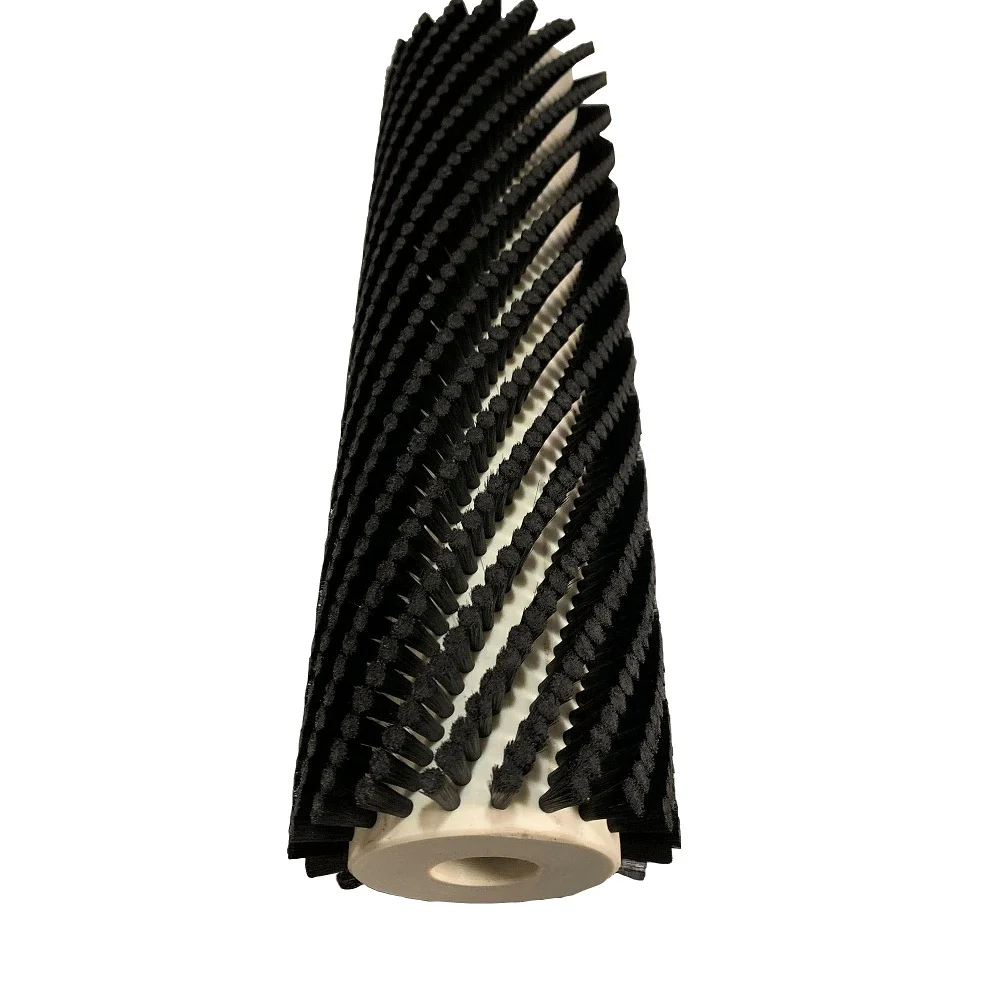
SB-RL-0005 is a planted-tuft construction. The spaces between bundles expose the core; it is not a continuous metal-channel coil.
The SB-SC-0011 coil and SB-RL-0005 tufted sleeve have different dimensions and construction. They illustrate different supply choices; they are not interchangeable candidates for one machine or a controlled performance comparison. A quote that substitutes one because both look cylindrical has not resolved the actual interface.
SIT's spiral-brush construction description likewise describes winding and support as parts of a constructed roller. Retain those details when ordering a coil. Use the outward-coil order guide for the coil/core boundary, end retention and axial allocation, and the fill-layout guide for contact along the workpiece path.
Which dimensions prevent a replacement from landing in the wrong place?
Working-face length and overall length answer different questions. The face is the axial span of the brushing region. Overall length can include shaft extensions, shoulders and retainers beyond that span. A replacement can match both headline lengths while shifting the brushing region toward one end.
Define the drive end, non-drive end and the location of the face relative to a clear axial reference. Include the bearing seats, shoulders and drive details that the supplied assembly must match. The roller shaft-drawing guide shows how an off-center face can be missed when a buyer assumes equal extension at each end.
Measure new-design dimensions separately from worn condition. A reduced brush diameter on the installed roller describes the used envelope; it does not necessarily identify the new diameter. A worn bearing seat or damaged bore should not silently become the manufacturing target either. Compare against the accepted drawing and mating components, using the condition review to decide what can remain in service.
For sleeve renewal, include the axial space available between the locating and retaining features. The nominal sleeve length alone does not prove that the end termination or retaining parts fit within that space. This is especially important when multiple sleeves, spacers or coil ends share the same shaft region.
Can the old shaft and core be reused after refilling?
Reuse is a condition decision about those components. Inspect them under the equipment's appropriate maintenance and isolation procedures, and obtain the relevant findings before approving a refill-only scope. The required checks depend on the construction and duty; this article does not assign a universal runout, balance or bearing-fit limit.
Osborn's rolling-mill service description describes documented inspection and work on retained roller components, including shaft, bearing and concentricity/balance considerations for its factory-assembled systems. The purchasing lesson is that renewed fill and retained-assembly condition are separate parts of refurbishment. It is not evidence that a particular roller has passed those checks.
If the fill is worn but the retained support is suitable, renewal can address the affected working layer. If an interface is rejected as well, compare a defined repair-plus-refill scope with a replacement assembly. If the surface result changed but the reason remains unclear, use the roller result-change guide before assuming the fill is the failed component. A like-for-like spare can still be planned without claiming it solves an unidentified fault.
Will a replacement that fits also clean or finish correctly?
Fit establishes that a component can be assembled as specified. It does not establish the desired surface result. An equivalent renewal should preserve the accepted fill material, size, layout and working envelope. A change from plain nylon to abrasive filament, wire or sanding elements creates a different contact and application question.
For a loose-residue cleaning task, evaluate the actual residue and substrate. If the new task contains bonded scale, do not assume the previous plain-nylon wiping configuration will handle it with more contact. If an abrasive or wire construction is proposed, evaluate removal and retained-surface requirements together, with the appropriate material and operating restrictions.
Sanding heads introduce their own renewal units. An abrasive strip and a support strip can work as a designed combination; buying one without matching the head and companion element may not reproduce the contact. Use the sanding replacement guide for that construction instead of treating every replaceable strip as the same component.
A useful comparison keeps the part material, starting residue, workpiece path and inspection locations comparable. If one candidate removes the deposit but damages a required finish, the combined task fails. If another preserves the finish but leaves the required residue, it also fails. Only then do comparable cost and supply terms describe alternatives that solve the same problem.
What should the quotation say is included?
Request a named repair scope: one specified assembly, one compatible sleeve, a defined refill service or a complete set of renewable elements. List the retained parts, supplied shaft and hardware, new working dimensions, face location and required assembled checks. Identify any inspection or assembly service included in the price.
For the sleeve scenario, the request can state that the accepted carrier and retainers remain, while the new coil sleeve must match the attached support and end drawings. For a rejected shaft interface, the request should include repair or a new shaft instead of repeating a sleeve-only line. For a modular head, specify the compatible set and arrangement, not just a total element count.
The final comparison is the cost and completeness of the same repair. That gives purchasing a concrete choice and maintenance a package that contains the parts the machine actually needs.
Related buying guides
Produce Washing Brush Rollers: Can One Specification Clean Two Crops Without Marking Them?
Flat Glass Washer Brushes: Which Surface Is Marked, and Is the Brush Really the Cause?
How Do You Choose a Sanding Brush for a Profile Without Damaging Its Edges?
Conveyor Belt Cleaning Brushes: Why Does Residue Remain After the Brush?