What Size Tube Brush Do I Need? Match the Bore, Entrance and Cleaning Route
Choose tube brush size by the actual bore, entrance, connector and route. Compare smooth, enhanced and curved tubes before requesting a sample.
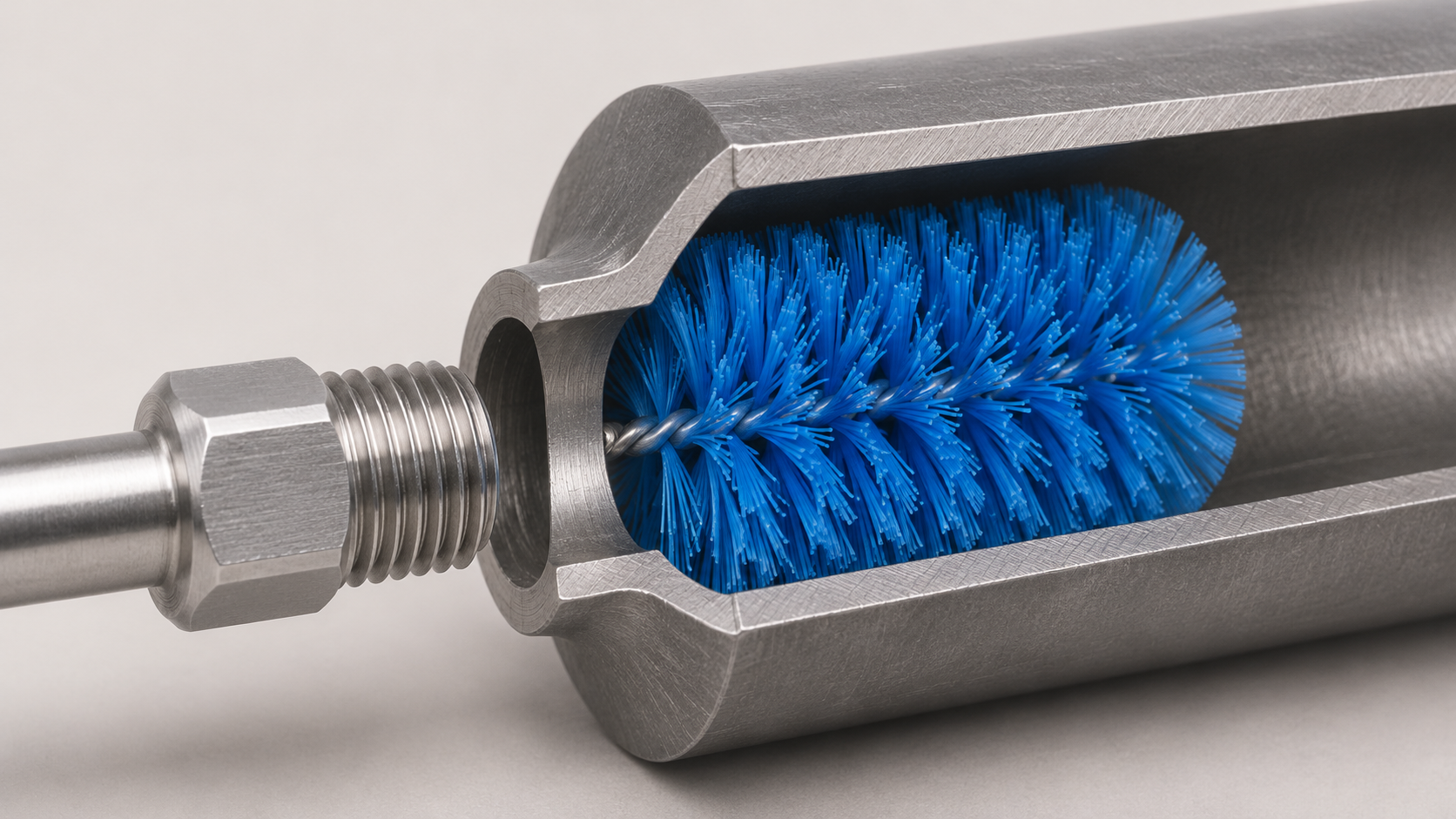
Choose a tube brush from the actual internal passage, then check whether the complete head and connection can reach the area that needs cleaning. The diameter printed on a brush listing is only one part of that decision. A brush can be the right size for the main tube and still encounter a smaller entrance, miss the recesses of an enhanced tube, or have a working head that cannot follow the available route.
For a maintenance buyer, the useful question is therefore more specific than “Which brush fits a 20 mm tube?” Ask what the equipment's tube dimension describes, what the inner surface looks like, where the brush enters and which cleaning rod or flexible shaft will carry it. These details separate a plausible catalogue candidate from a brush assembly that can actually be evaluated on the job.
What should I measure: tube outside diameter, inside diameter or the opening left by the deposit?
The brush works against the inside surface. Tube outside diameter includes the metal wall, so it cannot stand in for the bore. On an ordinary, clean, round tube of uniform wall thickness, inside diameter is outside diameter minus twice the wall thickness. That relationship becomes less useful if the tube has an internal liner, intentional ribs, distortion or deposits covering the surface you are trying to identify.
Start with the equipment drawing or an identified tube specification, then establish the relevant actual condition using the site's suitable inspection method. A tube end photograph can show a lip or heavy deposit, but perspective and the absence of a scale prevent it from establishing an accurate bore. A reading at an accessible mouth also does not prove that the entire tube has the same opening.
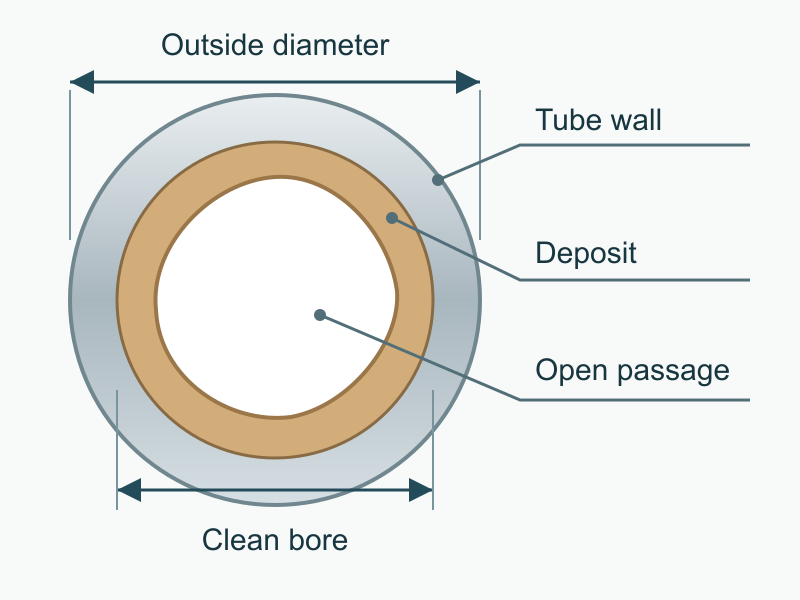
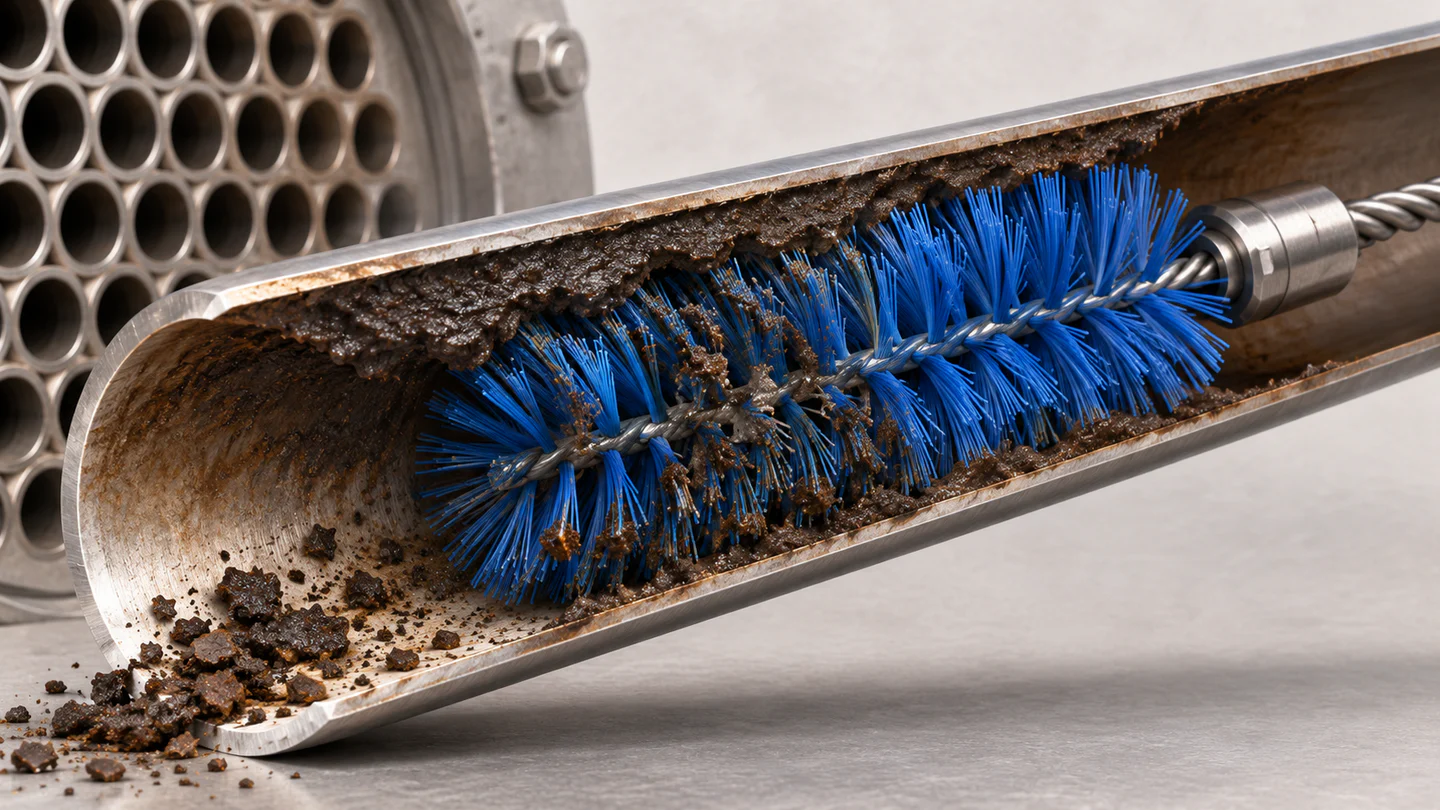
The tube wall, original bore and present passage are different boundaries. The deposit is schematic; its shape and thickness must come from the actual tube.
When a chiller's straight smooth tubes contain loose residue, the tube specification and actual access may be straightforward to establish. When an exchanger has a bonded layer, the remaining passage can be appreciably different from the clean bore. Ordering a smaller brush solely because it enters the dirty opening may leave the final wall contact unresolved. Ordering a larger one solely to reach the original wall may ignore an obstruction that the current cleaning method cannot pass.
Describe both facts to the supplier: the intended tube interior and the condition currently occupying it. If the passage is blocked, the first decision is how that blockage will be addressed with the appropriate equipment. It is not automatically a brush-diameter adjustment. TC Wilson's tube-cleaning selection guide likewise begins with tube ID and distinguishes tube form and deposit type before selecting a cleaning head.
Should the brush be the same diameter as the bore, smaller or larger?
There is no single allowance that can be copied across all tube brushes. The result depends on the particular head construction, filament material and diameter, how the fill is supported, the deposit and the permitted contact with the tube. A flexible nylon cleaning head and an abrasive head designed to work in an oversized condition are different products, even if both are called tube brushes.
Ask what the stated size means for the exact product. Some listings describe actual brush outside diameter; other families are sold by the bore size they are intended to serve. Do not subtract or add an allowance until that convention is clear. If a supplier proposes a head for your bore, have the proposed working diameter and construction identified together so that a repeat order preserves the same contact arrangement.
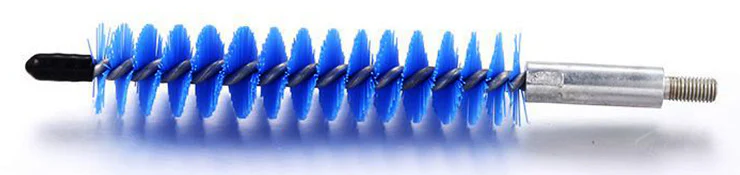
Spirvobrush SB-TB-0003 is a useful example of an explicitly described head. Its published reference has a 20 mm brush outside diameter, 100 mm fill length, 160 mm overall length and 0.40 mm nylon filaments, with a capped leading end and threaded sleeve. The 20 mm value identifies the brush envelope. It does not by itself assign an approved tube ID, and a catalogue photograph is not a ruler for measuring the supplied brush.
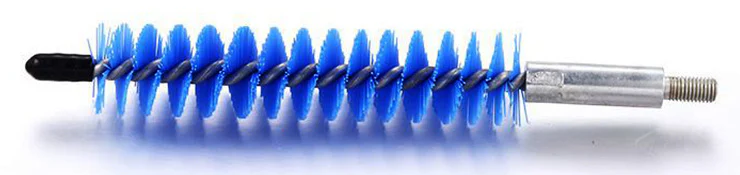
The blue fill forms the working envelope. The dark cap and metal sleeve have their own shapes and must be considered separately from the flexible bristles.
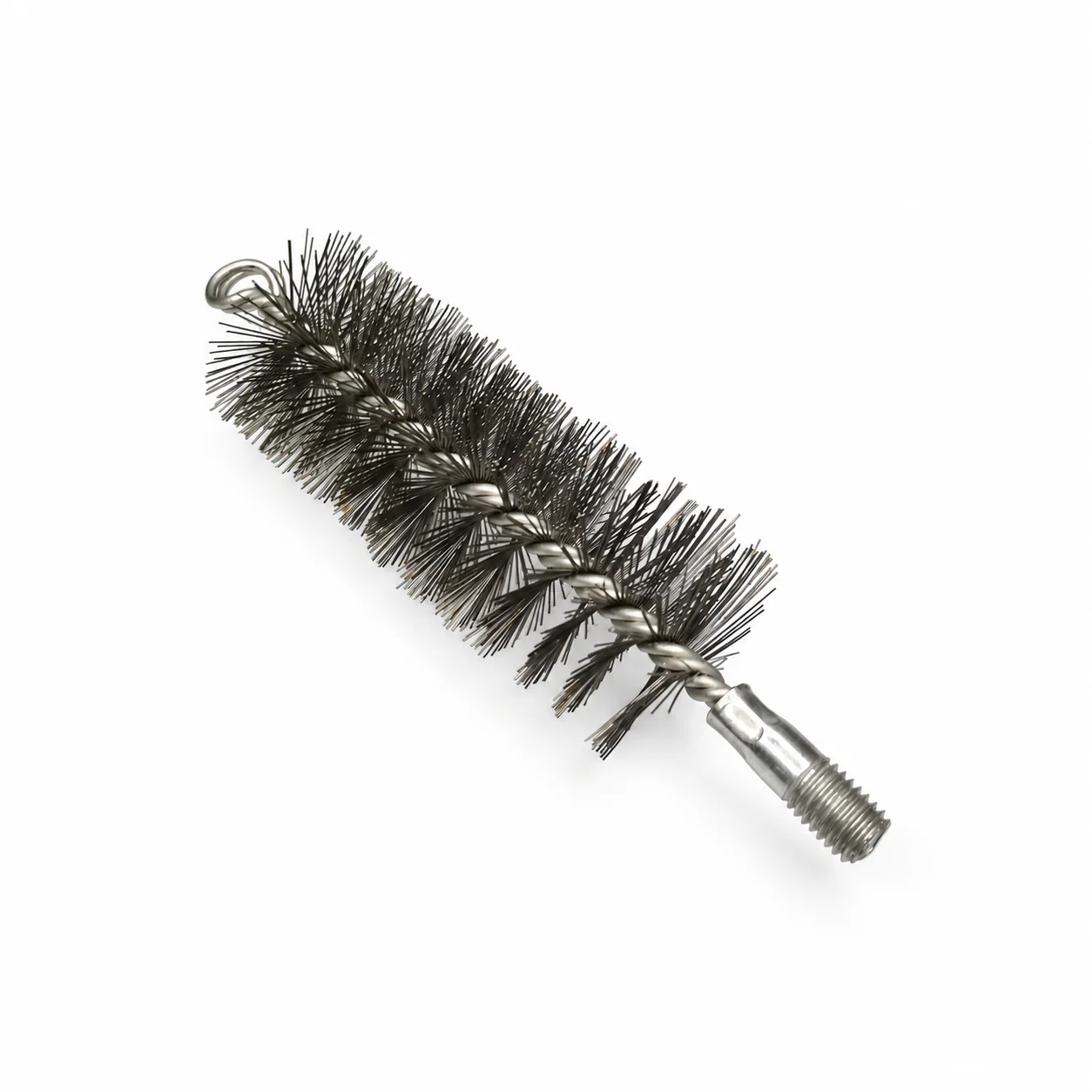
The same distinction matters when comparing materials. A smaller wire brush is not necessarily a gentler substitute for a larger nylon one, and equal outside diameter does not give equal contact. The deposit and surface selection guide explains the next decision: what must be removed and what the tube surface must retain. Use diameter to establish a candidate's geometry, then judge the complete candidate against that cleaning task.
Why can the right brush diameter still get stuck at the entrance?
The tube mouth is not always a continuation of the working bore. A recessed access hole, a sleeve, a smaller fitting or a projecting tube end may create a different entry envelope. Before comparing brush diameters, identify which parts of the assembly must cross that opening: the leading end, filled head, connector and sometimes part of the holder or shaft.
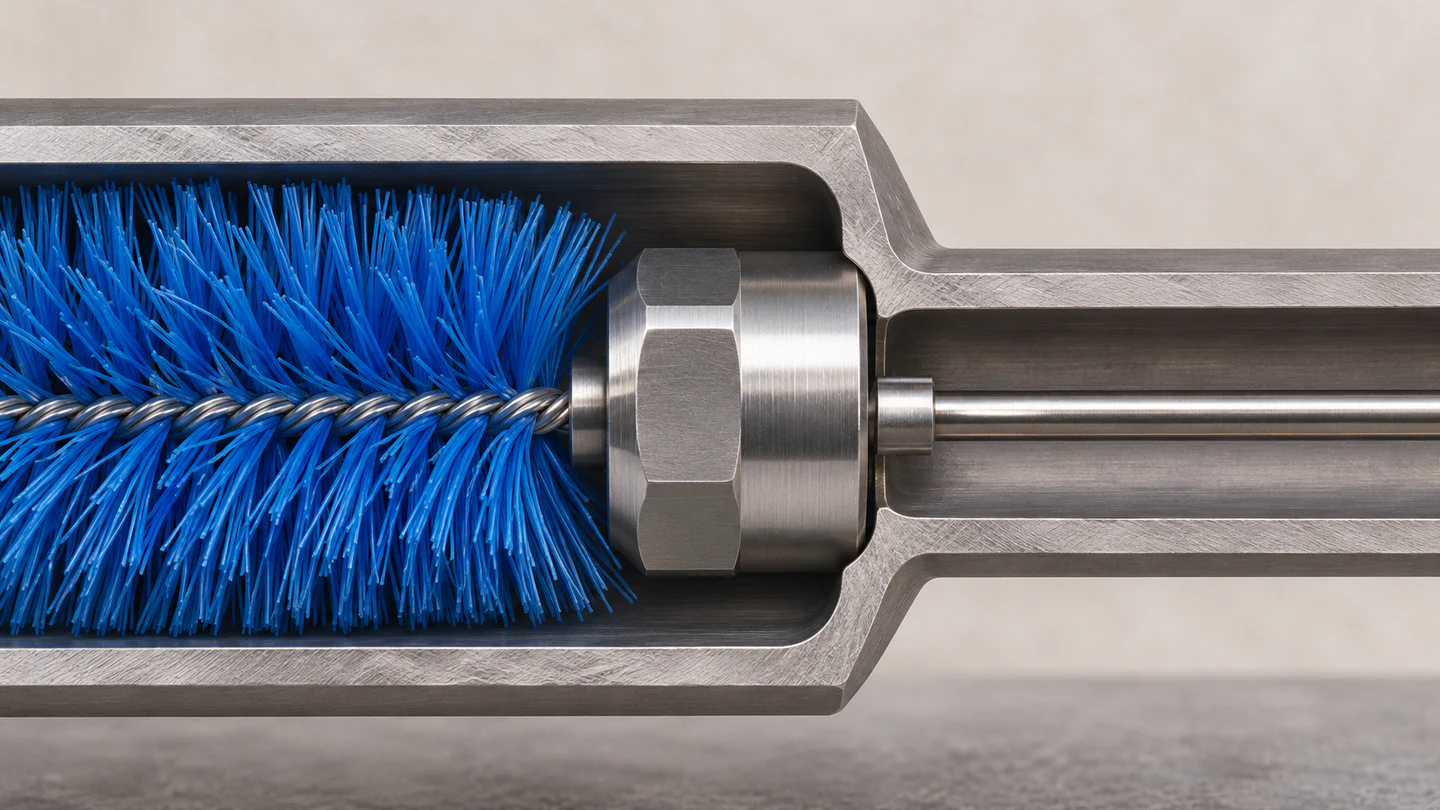
Bristles can deflect within the limits of their construction. A solid sleeve or cap cannot be assumed to compress in the same way. If a connector is larger than an opening it must pass, the assembly has a geometric obstruction regardless of whether the bristles could bend. A cleaner fit at the head does not repair that mismatch.
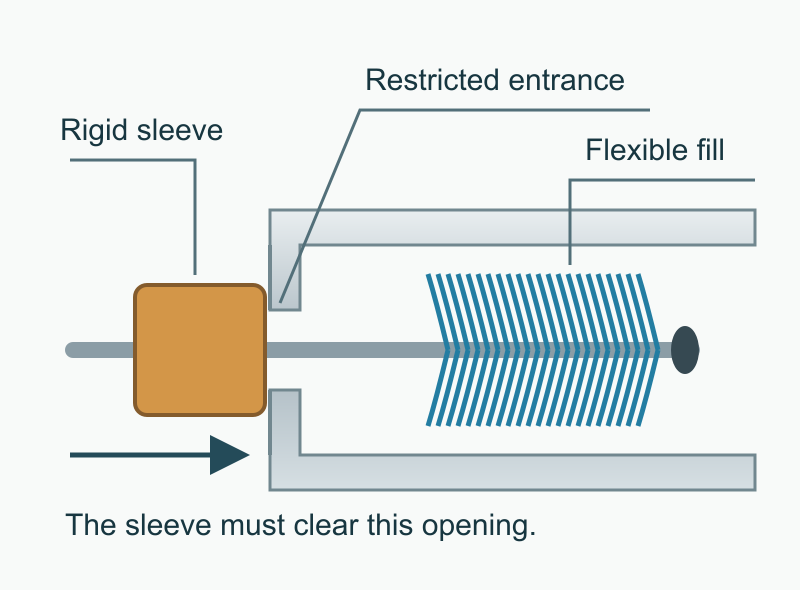
The critical opening is the one the component must actually cross. The orange connector cannot be treated like the blue flexible fill.
Consider a retained cleaning rod used behind a narrow access fitting. If the required travel carries the head's sleeve through that fitting, the sleeve needs its own clearance check. If the approved arrangement keeps the sleeve outside while the working section reaches the target, the drawing must show that relationship. Merely adding more rod length does not answer either question.
A capped tip can also matter near sensitive surfaces or internal steps. Its presence identifies a construction feature, not blanket protection against every contact. Ask for the leading-end dimensions and the shape of any exposed core if those are decisive. For the mating thread, seat and assembled length, use the head-and-rod connection guide; the SB-TB-0003 photograph alone does not supply a complete thread designation.
Do smooth tubes and internally enhanced tubes need the same brush?
A smooth tube presents a comparatively continuous cylindrical wall. An internally enhanced tube has raised and recessed features, often following a spiral. The visible opening and the bottoms of those recesses are not the same contact boundary. A brush that reaches the higher portions may leave deposits in the lower portions; selecting only from one nominal tube number hides that difference.
Manufacturers offer constructions intended to address those distinct surfaces. For example, TC Wilson explains dual-diameter brushes in relation to the high and low areas of internally enhanced tubes. That is a reason to request an appropriate head design, not a rule for turning an ordinary single-diameter brush into a dual-diameter product.
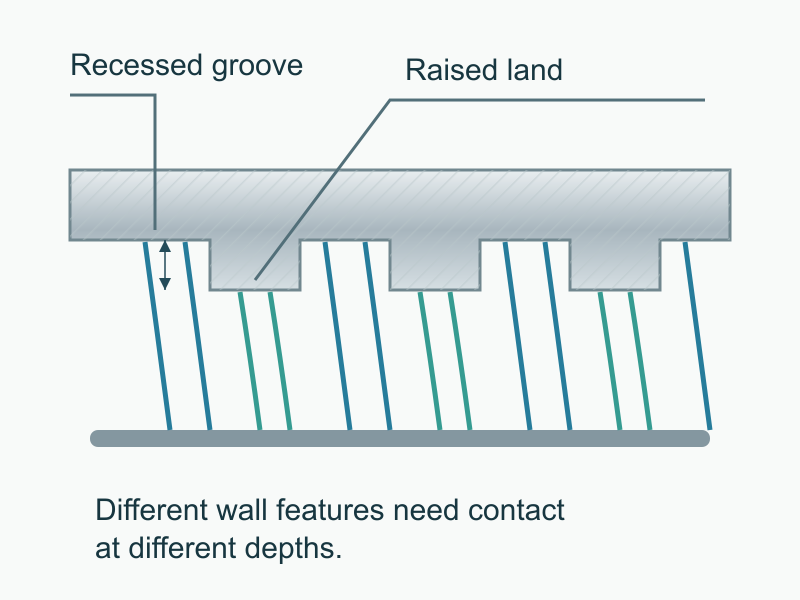
Enlarged inner-wall profile: the raised surface and recessed groove present different contact conditions.
For a chiller maintenance order, send the tube construction or a clear representative interior view with the tube identification. Ask which surfaces the proposed head is intended to contact and how its size is specified. If an old brush worked on a smooth-tube unit, do not assume that moving it to another unit of the same nominal size preserves the cleaning task.
The inspection must follow the same distinction. A bright-looking high surface does not show whether the recessed area is clear. Conversely, more contact with the recesses is useful only if the required tube surface is preserved. The article on choosing fill for the deposit takes that material-and-surface decision further.
Will the brush pass a bend and reach the entire cleaning area?
A straight through-tube and a U-tube present different routes. In a straight tube, entry, working length and the far end can often be shown along one axis. A U-tube returns toward the same tube sheet, so the tool must follow a curved passage if the intended cleaning method is to cover the bend and return leg. The brush head and its supporting assembly both matter.
A flexible shaft does not make every head flexible. The length of the working head, rigid end pieces, connection and the actual bend geometry determine which arrangement is worth evaluating. A long brush selected to cover more length in a straight bore may be a poor starting assumption for a restricted curve. Neither its nominal diameter nor the word “flexible” on a shaft listing establishes passage through your bend.
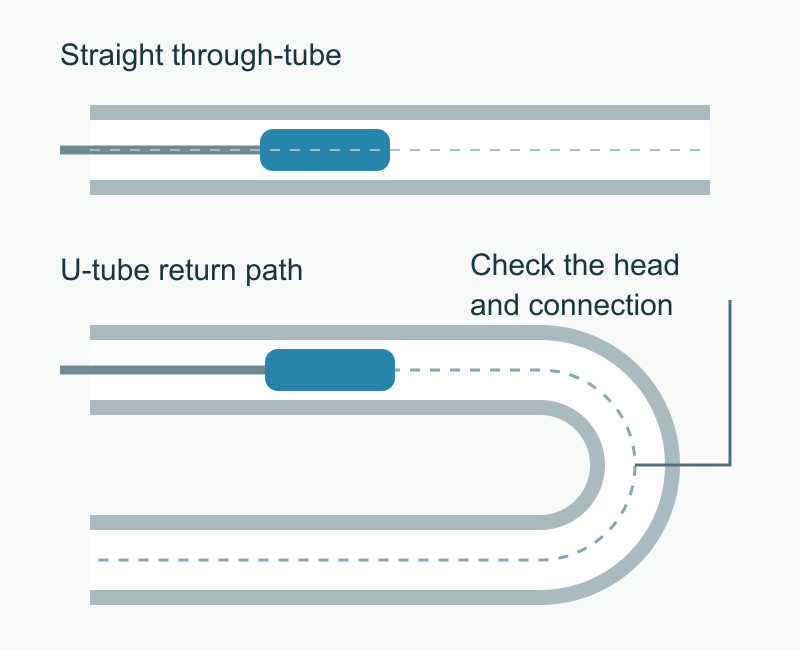
Both drawings show a cleaning route, not a prescribed operating method. The head and its connection must suit the route as an assembly.
Reach also differs from overall tool length. On SB-TB-0003, the 100 mm fill length is the bristled section; the remainder of the 160 mm overall length is not additional cleaning face. A target near a tube end needs to lie within the part of the filled head that can actually be presented to it. The rod, holder, grip and any entry fitting affect that position.
For deeper passages, provide the entry-to-target distance and the available approach space outside the tube. The assembly may be long enough on paper yet difficult to position because the equipment sits close to a wall or another component. That is an access issue to resolve with the equipment arrangement, not a justification to improvise an unsupported extension.
What should I send to get the right sample rather than another diameter guess?
A useful enquiry describes one identifiable cleaning job. For example: “We need a replacement head for these straight, smooth tubes. Here is the tube specification, the actual entrance view, the deposit condition and the existing rod connection. The required cleaning area extends to this location, and this internal surface must remain acceptable.” This gives the supplier physical constraints to answer instead of asking them to infer an entire application from a worn head.
Include the following items where they affect the choice:
Tube identification, actual bore information and whether the interior is smooth, enhanced, lined or coated.
Entry restrictions, steps, bends and the length that the head must reach, shown from an understandable datum.
Deposit condition and the surface that the cleaning operation must preserve.
Existing rod, shaft or holder identification, complete mating details and the components included in the request.
The proposed head's brush diameter, fill and overall lengths, leading-end construction and rigid connector envelope.
Evaluate the candidate on a representative accessible tube or suitable test piece under the equipment's approved procedure. The useful observations are specific: does it enter and withdraw as intended, does the target length receive cleaning, do recesses retain residue, and is the resulting surface acceptable? If access works but cleaning does not, the next question belongs to the deposit and contact construction. If the head cannot reach the area, changing material alone does not close the geometry problem.
Once that configuration has been accepted for the actual task, use the tube-cleaning purchase route to order the correct head or assembly. The repeatable purchase is a defined brush for a defined passage—not a diameter copied from the equipment's nameplate.