Flat Glass Washer Brushes: Which Surface Is Marked, and Is the Brush Really the Cause?
Map brush positions to glass surfaces and distinguish trapped grit, contact damage and drying streaks before choosing replacement washer rollers.
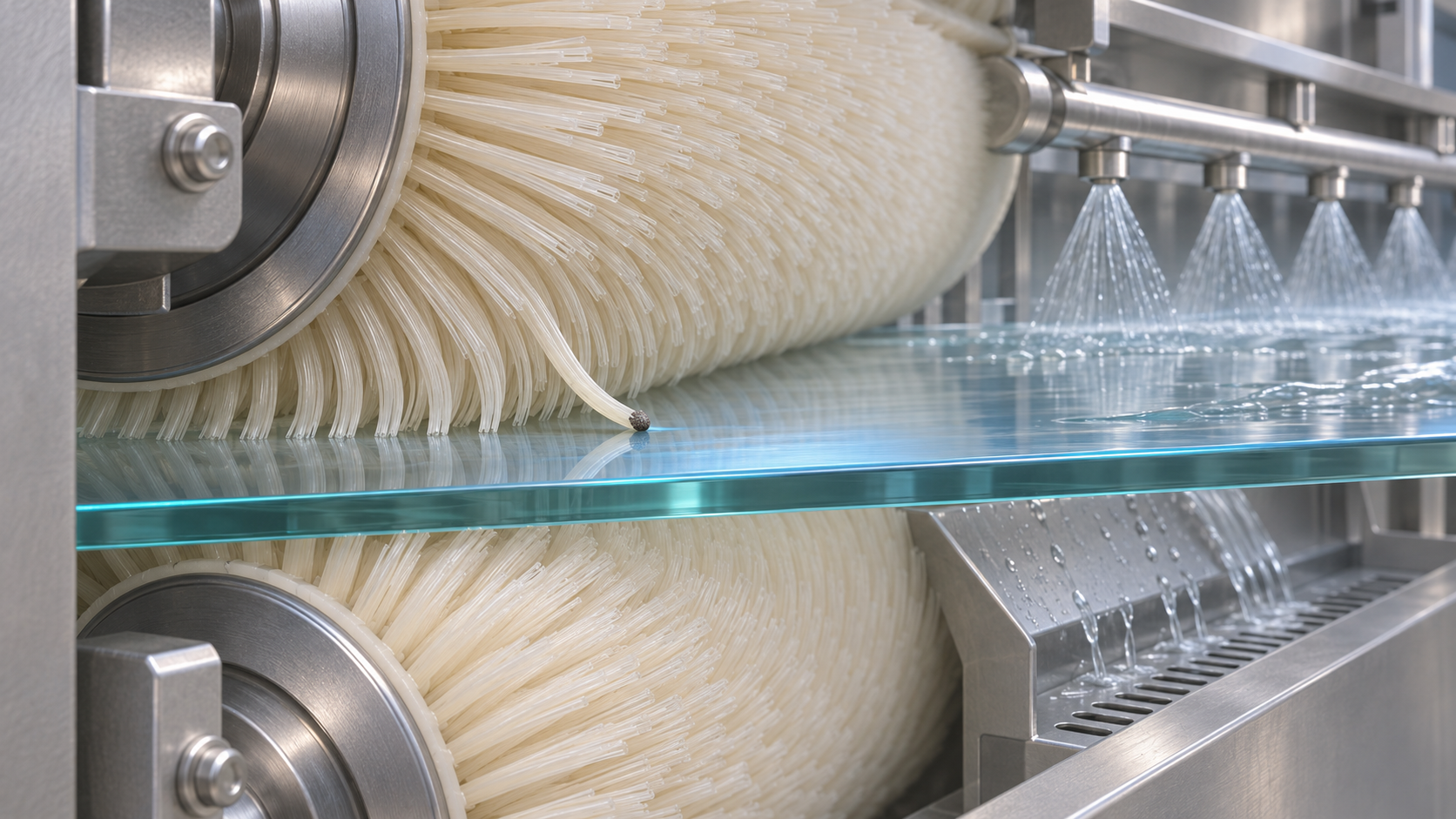
Choose a replacement glass-washer brush for the exact surface and machine position it will contact. Then distinguish incoming particles, brush contact and drying residue before changing the fill. A roller can fit the shaft and still be unsuitable for a coating; a streak can remain even when the brush itself is not the cause.
Start with the glass product’s current processing instructions, the washer configuration and the actual sheet orientation. “Soft nylon” is an incomplete construction description, while “low-E brush” does not identify every coating it can process. The purchasing decision is a defined brush for a defined contact duty, not a generic set for everything that passes through the machine.
Does the upper brush always touch the coated face?
Only if that is how the particular product is loaded. Label each brush position and show the actual glass orientation. A line may process uncoated glass, different coated products or a product with a protective film, and those surfaces should not be treated as one duty merely because they travel through the same washer.
For a simple position example, let three upper brushes be U1, U2 and U3, and three lower brushes L1, L2 and L3. If the coating faces upward, the upper group touches that surface and the lower group touches the opposite face. If the permitted loading orientation changes, the contact map changes. The labels identify locations; they do not grant permission to use a particular brush.
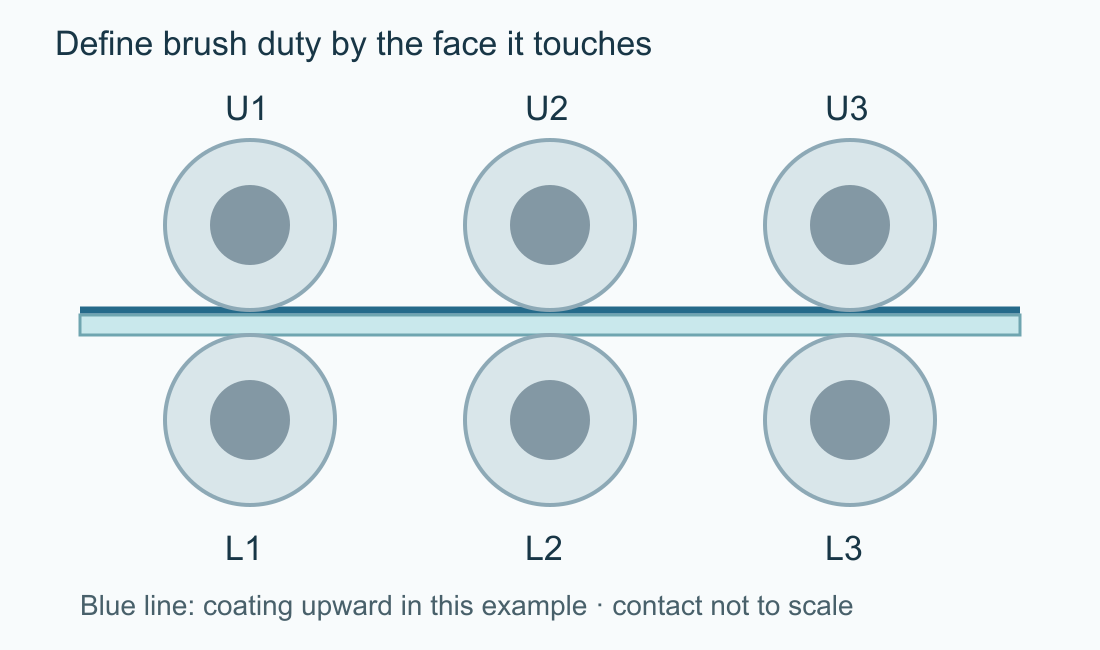
Position schematic for the stated example. The blue line identifies the coating face. Brush engagement and coating thickness are not drawn to an operating scale.
Include prewash and special stations separately. Two positions touching the same face may receive different amounts or types of contamination. Conversely, mechanically identical rollers can have different duties because one contacts a sensitive coating. This is why a complete-set quotation should retain position identities even when several components share a drawing.
Why can a soft brush still scratch glass?
The contact is not necessarily just polymer against glass. A hard particle caught between a filament and the surface can make an abrasive contact. The particle may arrive with the sheet, remain in the brush or enter through a contaminated process. Changing to a softer filament without addressing that source can leave the same failure mechanism in place.
AGC’s Luxclear processing guide calls for rinsing abrasive residues before the sheet reaches the washing brushes. It also calls attention to drying-unit condition and inspection after washing. These are instructions for that product family; they support separating particle removal, brushing and drying in the investigation, not borrowing a universal machine setting. AGC Luxclear processing guide, washing section
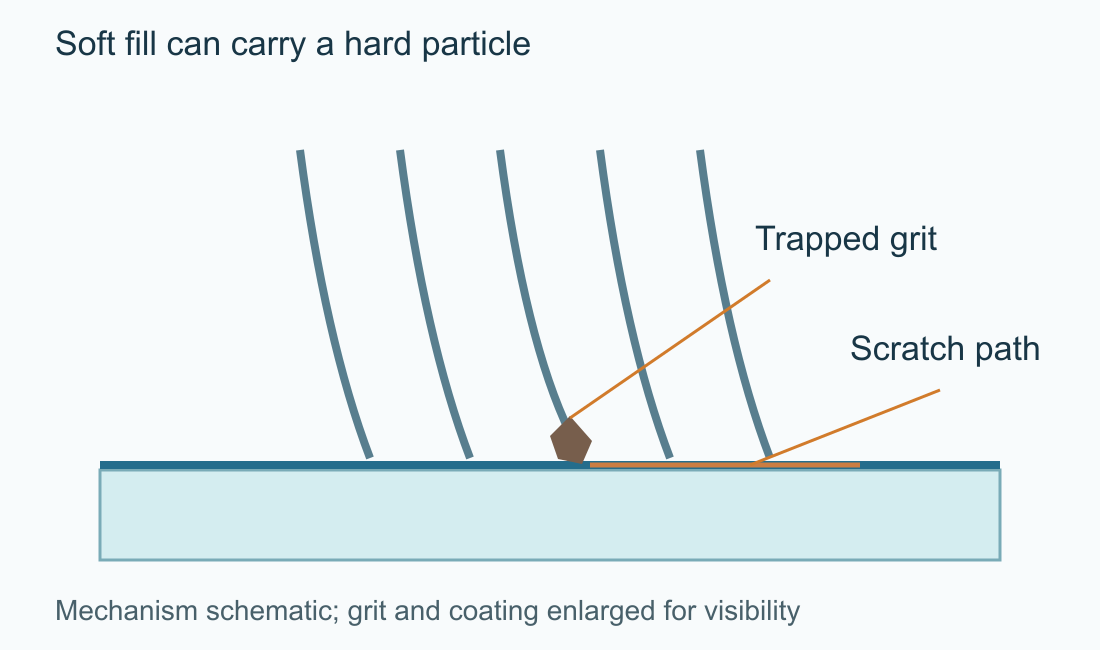
Particle-contact mechanism illustration: the particle and coating are enlarged to make the contact relationship visible.
Suppose marks become more frequent after edge processing begins sending a heavier residue load downstream. Compare the incoming sheet and pre-rinse condition with the earlier process. If the brush now contains grit, a different brush grade is not a substitute for removing the contamination source and restoring the intended cleaning condition. Inspect the relevant equipment under its maintenance procedure before trying another candidate.
What does an actual replacement roller specification tell me?
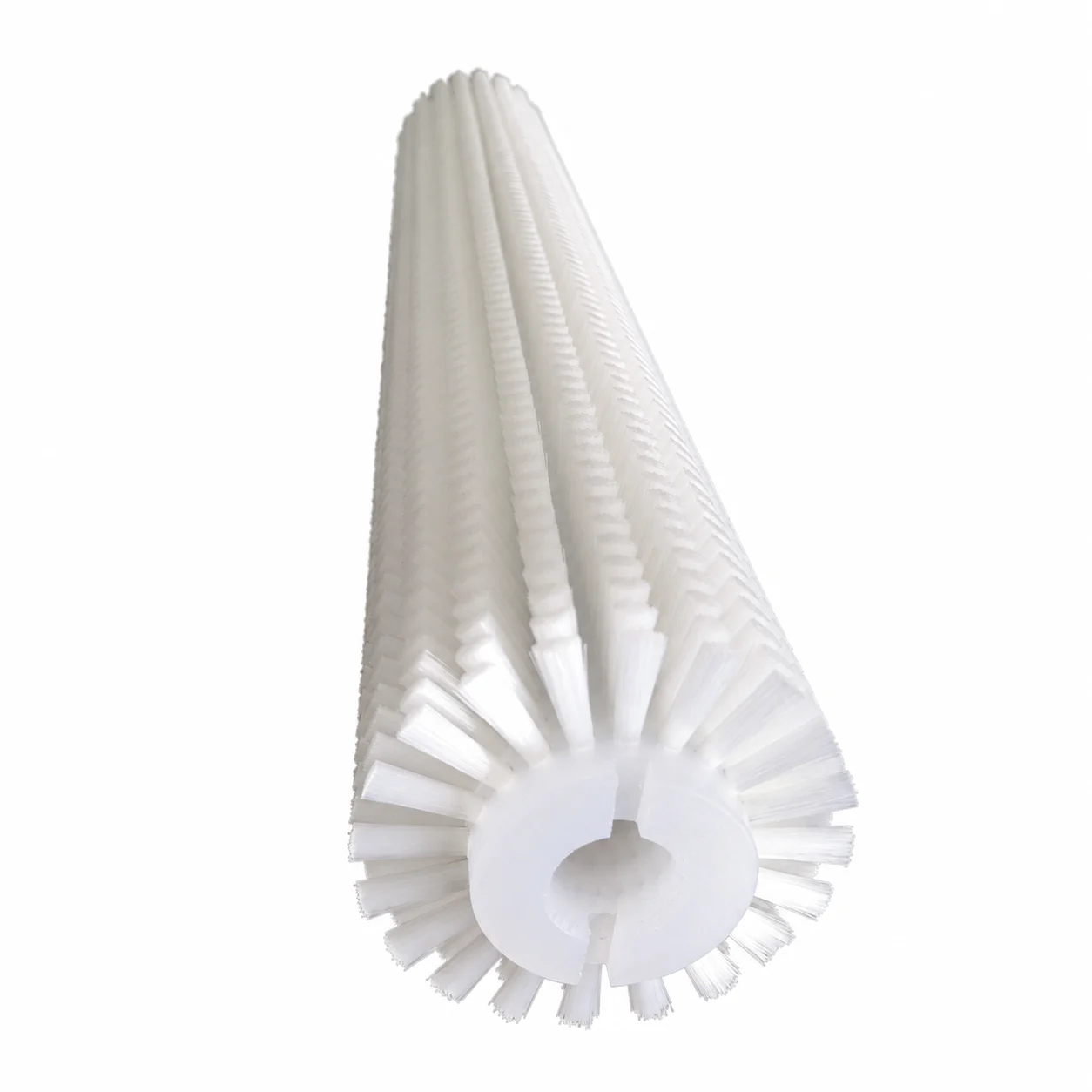
The published SB-RL-0013 white nylon tufted roller lists a 600 mm working face, 150 mm outside diameter, 90 mm core diameter, 40 mm keyed bore and 30 mm free fill. These dimensions identify a physical construction. They do not establish the filament diameter, exact polymer grade or compatibility with a named glass coating.
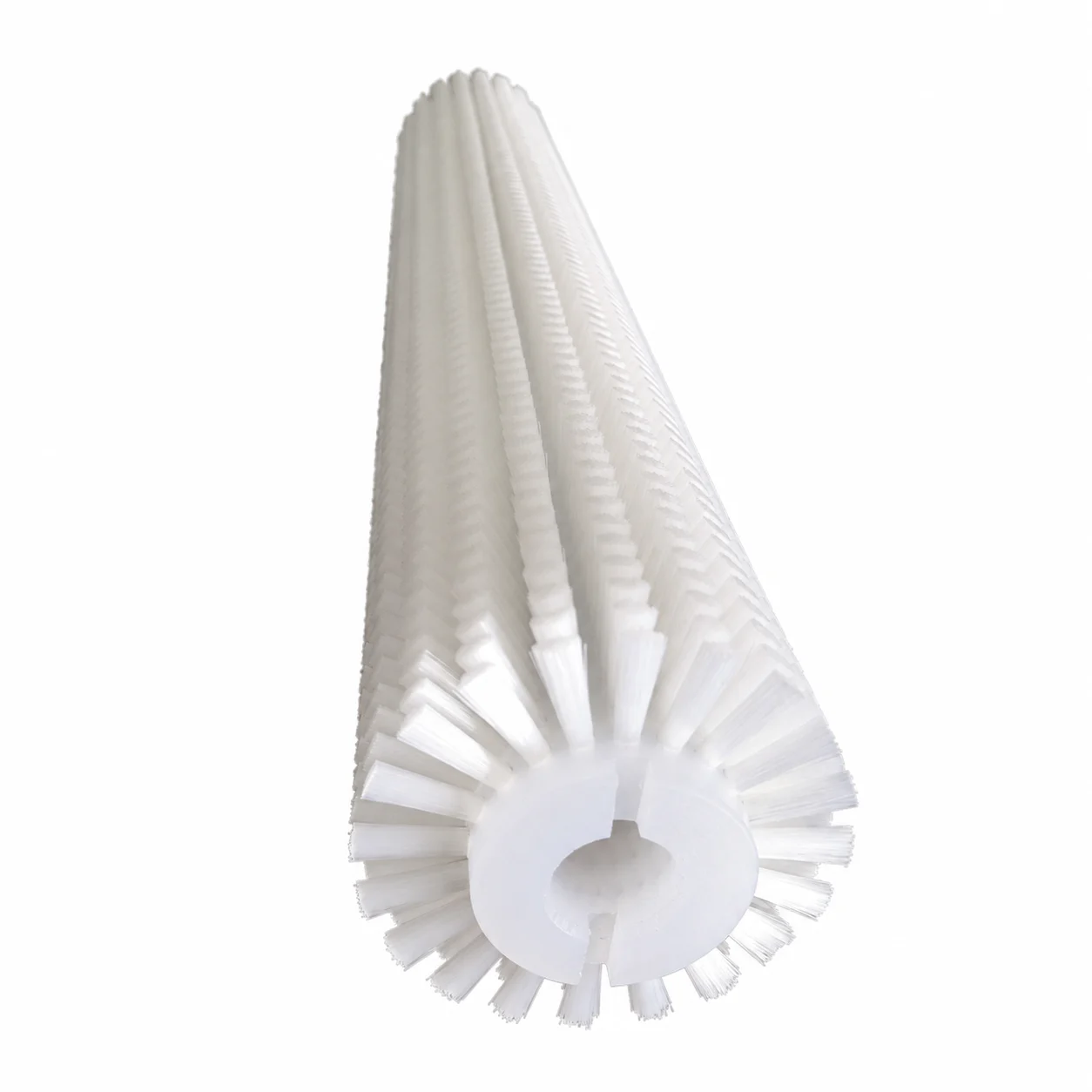
Actual product photograph. The mounting opening helps define the interface; the image does not prove scratch-free washing or coated-glass suitability.
The listed dimensions satisfy 90 + 2 × 30 = 150 mm. That is a geometry check, not an engagement setting. Working face length also differs from overall assembly length. Show the shaft shoulders, key, end retention and retained components in the shaft drawing when ordering an assembly.
Compare the proposed fill with the applicable glass instructions before treating this catalogue roller as an eligible candidate. Guardian’s May 2020 residential guide, for example, provides specific brush characteristics for ClimaGuard products and addresses brush condition and positioning. That demonstrates why the named product instructions matter; its dimensions should not be converted into a universal specification for all low-E glass. Guardian residential products guide, section 7
Which brush details matter beyond the word nylon?
Specify the polymer and filament dimensions, the free length, the fill arrangement and the finished roller geometry. A short filament and a long filament of the same material do not necessarily present the same compliance. The density and distribution of tufts also affect where contact can occur. Material name alone leaves the mechanical behaviour underdefined.
Condition matters alongside specification. A new roller and a worn roller can have different working envelopes. Local contamination, splayed fill or an uneven surface can alter contact across the sheet. A reduced worn diameter should not silently become the target outside diameter for the next order.
Avoid claiming coating eligibility from colour, a product-category name or a successful bare-glass run. An exact construction may be suitable for one product and remain untested or unsuitable for another. Obtain the current applicable instructions for the actual glass, including any protective-film condition, and combine them with the washer manufacturer’s permitted arrangement.
How do scratches differ from water streaks in the investigation?
A visible line is an observation, not a diagnosis. Note whether it is present before washing, after the wash section, or only after drying, using the inspection access and method permitted for the line. Examine its location, direction and repeatability. Do not perform an unapproved rubbing or chemical spot test on a sensitive coating to decide what it is.
If a line remains at a fixed machine-side location across several sheets, inspect the corresponding brush lane, transport contact and drying zone. If a mark follows the sheet’s incoming defect location, the source may be upstream. Neither pattern is proof by itself, but it narrows the next useful check.
If the sheet leaves brushing without the target residue but shows damp streaks after drying, investigate the rinse and blow-off conditions. A harder brush does not address incomplete water removal merely because the final sheet looks marked. Guardian’s washing section treats rinse-water blow-off as a separate operation, reinforcing the need to examine the downstream stage rather than attributing every line to filaments. Guardian guide, section 7.5
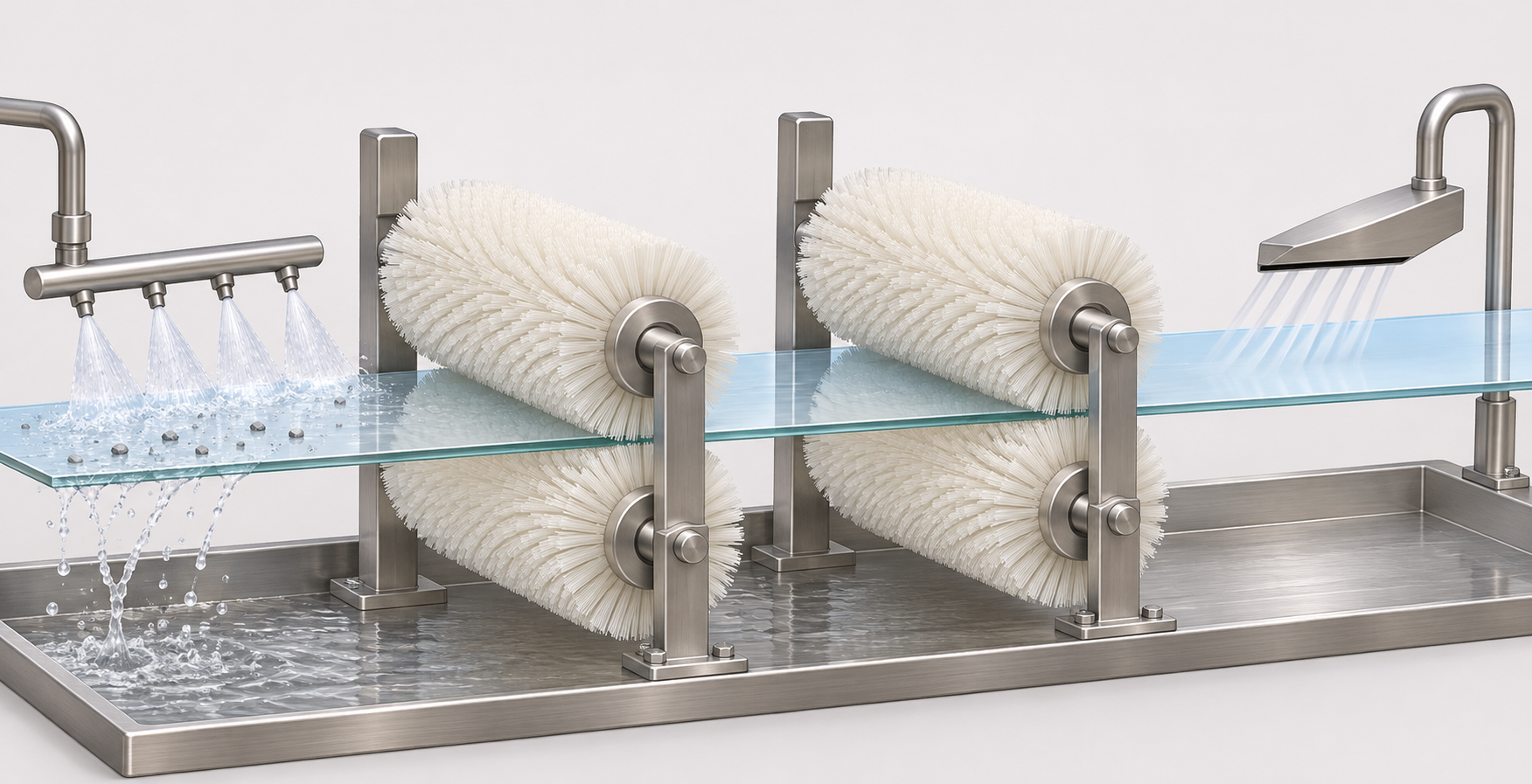
Process-location illustration, not an installation drawing. Pre-rinse is at the left, brush pairs in the middle and a drying nozzle at the right. Visible rays identify the drying location rather than a specified air-flow pattern.
What if only the coated side fails while the opposite face looks clean?
Keep the two surface results separate. If the coated face develops an unacceptable appearance change while the opposite face meets its requirement, the overall sheet has not passed. The difference should direct attention toward the affected contact positions, the product-specific requirements and the condition of that surface.
First verify the product identity and loading orientation. Then confirm that the intended brush construction and permitted settings are actually present at the relevant positions. A maintenance swap can preserve the shaft fit while moving a different fill into a sensitive duty. Check the position labels and the physical components rather than relying on a general box label.
If the current reference arrangement and a candidate both show the same defect, the comparison has not isolated the candidate as the cause. Review the common incoming, water, transport and drying conditions. If only the candidate shows the unacceptable change under a valid comparison, keep it out of that duty while investigating the mechanism. A bare-glass success cannot be used to override the coated-face failure.
How should a trial cover different sheet sizes and thicknesses?
Use the actual product and the relevant operating range. Sheet thickness affects how the washer is set up, while width changes which lanes of the brush are contacted. A narrow sample in the centre cannot establish that the outer working areas are clean and consistent. Include the sizes that expose the intended operating conditions.
Keep the initial surface state comparable. Inspect the same defined regions before and after the permitted washing sequence under consistent lighting. Where the glass producer specifies a particular inspection or acceptance method, use it. Do not invent a universal scratch limit or substitute an attractive photograph for the required assessment.
A trial substitution must also respect the washer’s design. Some systems require a defined group or replacement method; inserting one arbitrary roller can change the comparison. Keep water, transport, drying and allowable machine configuration consistent when comparing constructions, and identify any necessary changes. Otherwise the result is a changed-process comparison, not evidence about the brush alone.
Should I replace the whole set when one lane begins marking?
First locate the problem. A local dirty or damaged region, uneven setting, or a transport contact can produce a restricted mark. Ordering an entire different fill specification before finding that location can replace useful components while preserving the original cause.
Examine the installed roller condition and the relevant maintenance history. If the mark follows a particular working lane, compare that location with the incoming sheet path and nearby contacts. If performance changes across the full width, investigate common process changes and overall roller condition. Follow the machine’s replacement requirements once the needed scope is known; this article does not authorise partial replacement where a matched arrangement is required.
The roller result-drift guide gives a broader method for distinguishing wear from changed conditions. For glass, add the surface identity and product-specific handling requirements to that investigation. A generic wear conclusion is insufficient when the damaged surface is a coating with its own processing limits.
How do the findings become a useful purchase order?
Return to the position map. If a construction is suitable for L1–L3 but the coated upper duty remains unresolved, there are three defined lower-position requirements and three unresolved upper-position requirements. This is not evidence for six universally interchangeable brushes, nor permission to operate a partly substituted machine.
When the same exact construction has been established for all relevant positions, it can be grouped commercially while retaining its position and surface references. If the fill differs, keep the variants distinguishable through packing and maintenance storage. Label the actual specification, not simply upper or lower, because the surface duty can change with the permitted loading plan.
The final enquiry should connect the roller drawing, exact fill, contact surface and identified failure mechanism. If particles are the cause, restore particle control before judging the replacement. If drying is the cause, address that stage. If the construction is unsuitable for the coating, select an eligible candidate and compare it on the named product. That sequence makes the brush purchase answer the problem actually found on the sheet.
Related buying guides
Industrial Roller Brush Replacement: Do You Need the Whole Roller, a Sleeve or New Fill?
Replacing Sanding Brush Strips: Which Dimensions Must Match the Existing Head?
Produce Washing Brush Rollers: Can One Specification Clean Two Crops Without Marking Them?
How Do You Choose a Sanding Brush for a Profile Without Damaging Its Edges?
Conveyor Belt Cleaning Brushes: Why Does Residue Remain After the Brush?
Roller Brush Fill Patterns: Why a Narrow Part Can See Different Contact from a Wide Panel