
Power Brush Reorders: Compare Useful Work, Condition and the Reason for Replacement
Reorder power brushes using accepted work and the reason for withdrawal. Separate repeat actions, changed tasks and construction differences before comparing life.
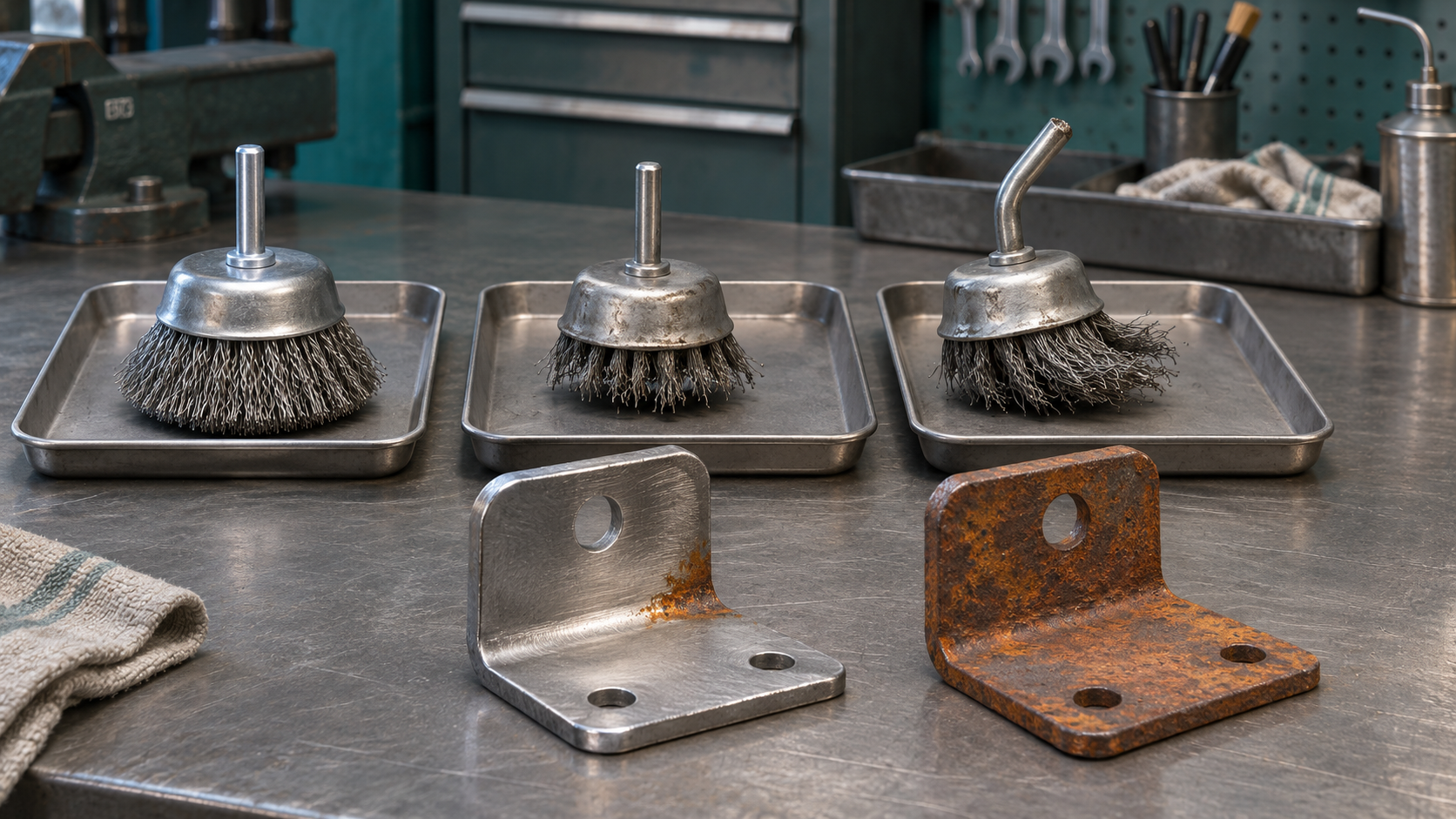
Reorder a power brush from the job it successfully completes and the condition that ends its use. “This cup lasted two weeks” is incomplete without knowing the work, accepted output and reason it was removed. A lightly used brush taken off at the end of a job and a continuously used brush withdrawn for damage do not provide comparable life observations. Their calendar dates should not decide the next specification.
A useful reorder decision can be simpler than a full lifetime study. If the accepted construction still cleans the required area and preserves the part, repeat that configuration. If the deposit, access or surface requirement has changed, revisit the task trial. If the brush is damaged or outside its permitted condition, follow its instructions regardless of how much work remains.
Was the brush worn out, damaged, or simply no longer needed for the job?
Separate the reason for removal from the amount of work observed. A job can finish while the brush remains eligible for that application. That ends the observation period, not necessarily the brush's usable life. A brush can also leave service because its condition fails the applicable instructions, even if the last cleaned part looked acceptable.
Norton's power-wire-brush guidance calls for inspecting damage and deterioration and matching the brush to the tool requirements. It does not establish one replacement interval in days. Use the actual product instructions and observed condition instead of assigning a universal calendar life.
A third situation is loss of the required cleaning result without an obvious damage finding. That calls for a task and contact review. The incoming residue may be different, access may have changed, or the brush may no longer provide the required action. “No longer cleans this part” is useful information, but it does not by itself tell purchasing to choose coarser wire.
Record the observation in ordinary, specific terms: the job ended; a defined condition required withdrawal; the shoulder remained dirty; or the material assignment became uncertain. These describe different next steps. Combining all of them into “used up” makes supplier and construction comparisons misleading.
What changed when cleaning began to take more effort?
Compare the present task with the one for which the brush was selected. On a carbon-steel fabrication, loose rust on the open face and adherent residue beside a shoulder create different work. If the mix shifts toward the difficult region, elapsed time per part can increase even when the brush has not changed.
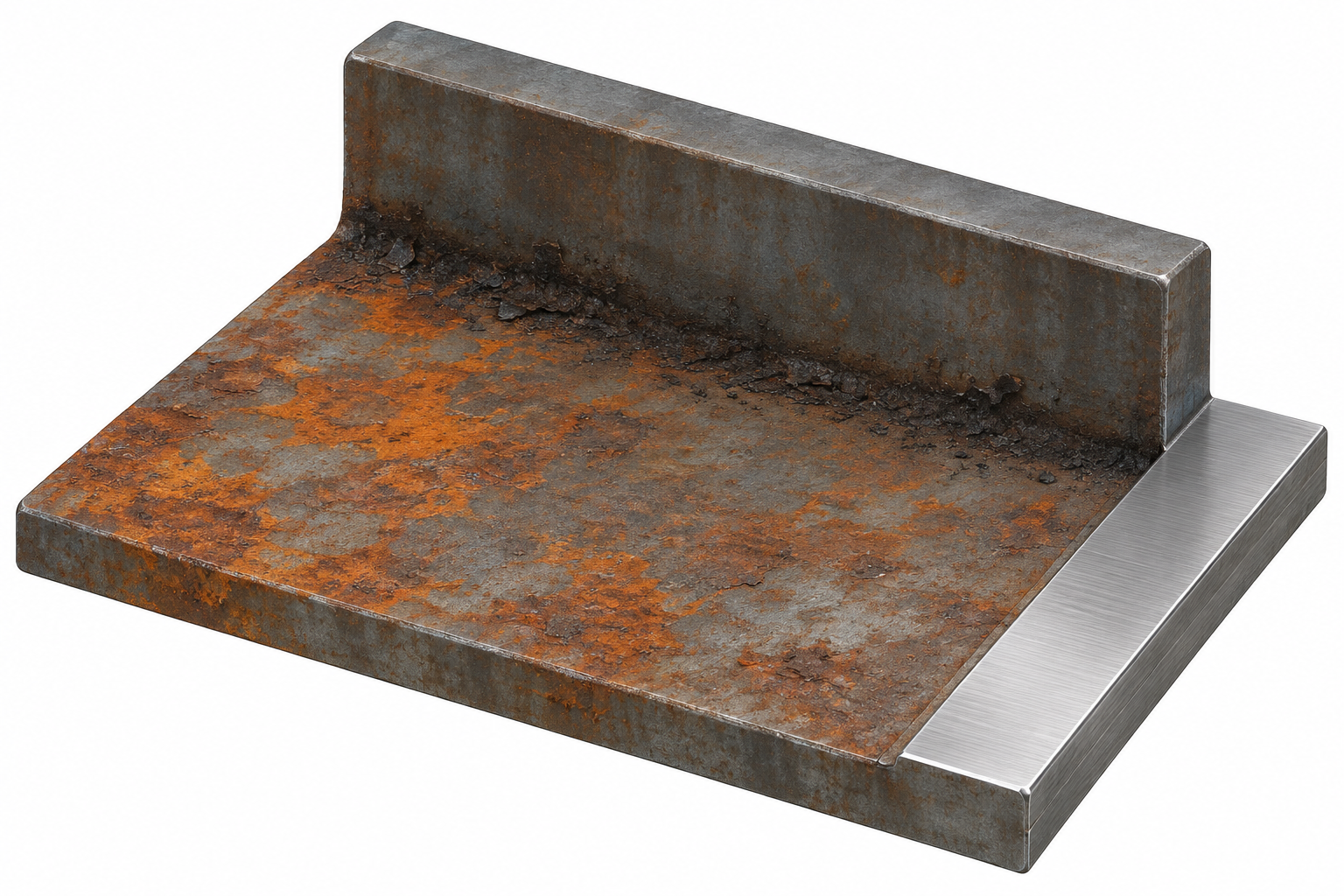
The work mix matters: a batch dominated by the open face is not the same cleaning duty as one dominated by the shoulder, especially when the locating land must remain intact.
Check the required result as well. A new coating-preparation requirement, an added protected feature or an expanded cleaning area changes the accepted task. Comparing the previous output with the new output without acknowledging that difference can make a suitable brush appear to have suddenly lost life.
Also examine the contact behavior. Weiler's wire-brush life discussion identifies wire diameter, density and free length as relevant variables and describes how excessive pressure can overflex wire and contribute to premature breakage. A need to push harder is a reason to investigate construction, condition and task, not a reliable measure of remaining life.
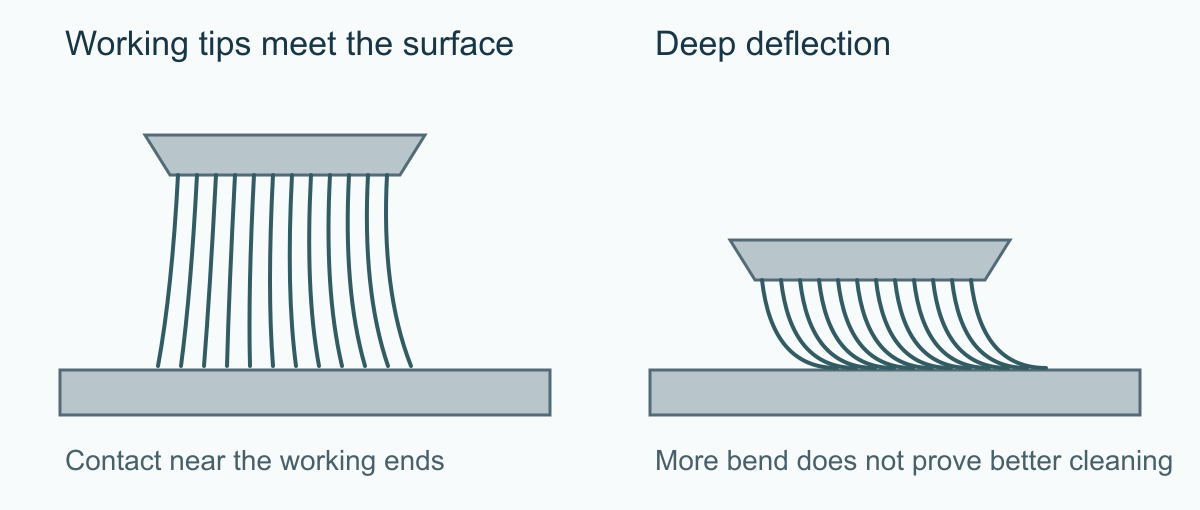
The useful action occurs at the wire ends. More deflection can change contact without restoring the required result; it is not a life-extension rule.
If the problem is access, replacing the same head cannot move a shoulder out of the way. If the deposit is different, the old trial may no longer represent it. If a fresh equivalent brush restores the result under comparable permitted conditions, that supports replacement for the current task. Preserve the comparison's scope rather than turning it into a universal service-life number.
What counts as useful output: a stroke, a face or an accepted part?
Choose the unit the production requirement actually accepts. A brushing action is an activity; a cleaned face is a task; a complete part may require several tasks and retained features. These quantities are related, but they are not interchangeable.
Suppose a plate needs both faces cleaned and a locating feature preserved. Finishing face one does not complete the plate. Repeating face two because residue remains adds work, but it does not create another saleable unit. If the locating feature fails after both faces are clean, the part has still not met the combined requirement.
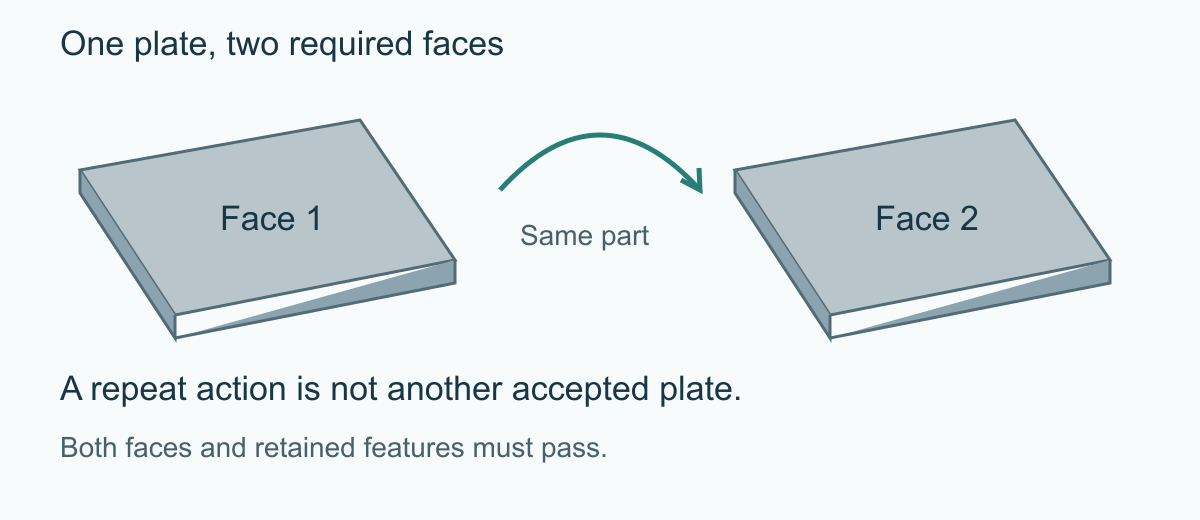
One plate can require two face tasks and additional checks. Repeating a face does not create another accepted plate.
For long fabricated sections, a defined accepted length may be more useful than counting parts of unequal size. For a sheet-cleaning task, a defined surface area can be appropriate if deposit and finish requirements remain comparable. Select the unit that represents the actual work and keep its definition stable during the comparison.
Do not pool unrelated tasks merely to produce a larger denominator. A brush that performs flat-face cleaning and intermittent corner work should have enough task context to explain that mix. Otherwise, a later shift in job allocation can appear as a change in brush performance.
How do repeat actions change a simple output calculation?
Consider an illustrative block of 40 identical plates, each requiring two faces. The planned work is 40 × 2 = 80 face tasks. If six faces receive one repeat cleaning action each, the activity count becomes 86 face-cleaning actions. At the end of the applicable inspection, suppose 37 complete plates are accepted and three remain on hold.
The useful output in that example is 37 accepted plates. It is not 86 accepted items, because the action count includes repeated work and separate faces. The three held plates are neither automatically scrap nor automatically acceptable. Their eventual status follows their inspection and disposition, not the arithmetic.
The example also does not establish output per brush. If several brushes were issued, some remained unused, or an issued brush performed another task, a purchase quantity is not the number of brushes consumed on these plates. Connect the work to the items actually used before forming that ratio.
Keep repeats visible when comparing processes. A candidate that appears to finish many actions may be generating more repeated work rather than more accepted output. Conversely, a slower-looking process may complete the required part without repetition. Comparable accepted output and total work together explain the trade-off; a single activity counter cannot.
This worked example separates the counting units. A lifetime claim needs a defined end condition and a comparable observation scope in addition to the output count.
Why is “50 mm cup, 6 mm shank” an incomplete repeat order?
Those dimensions identify only part of the construction. The SB-PW-0004 short twist-knot cup lists a 50 mm outside diameter, 6 mm straight shank, 65 mm overall length, 0.50 mm individual wire and 15 mm fill length.
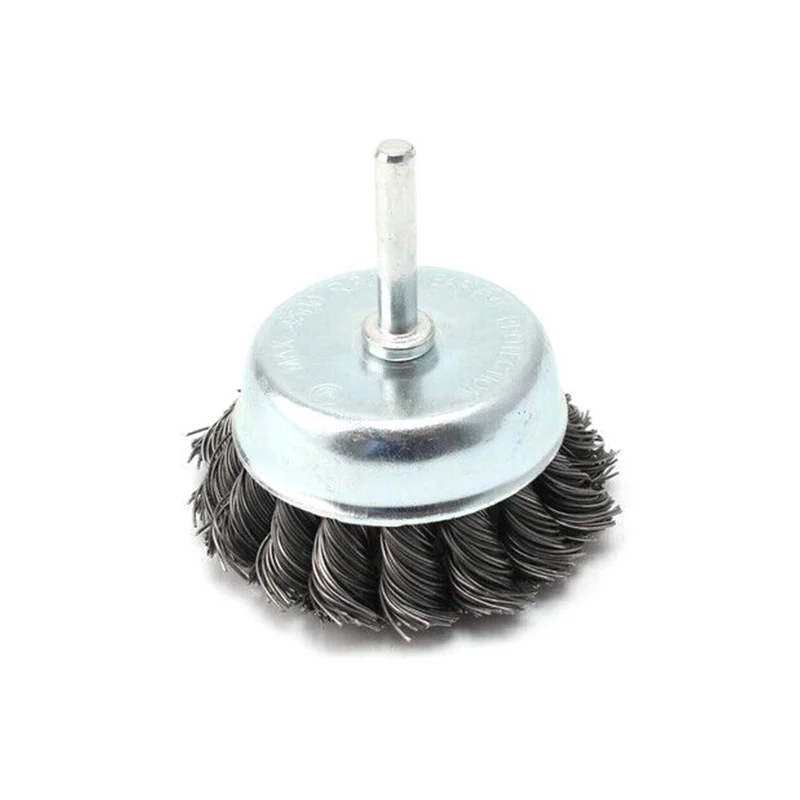
SB-PW-0004: short knot construction is part of the item identity, not an optional description after the diameter.
The SB-PW-0006 crimped cup also lists 50 mm, 6 mm and 65 mm for those envelope/interface dimensions, but its individual wire is 0.30 mm and its fill length is 20 mm. The wire arrangement differs as well.
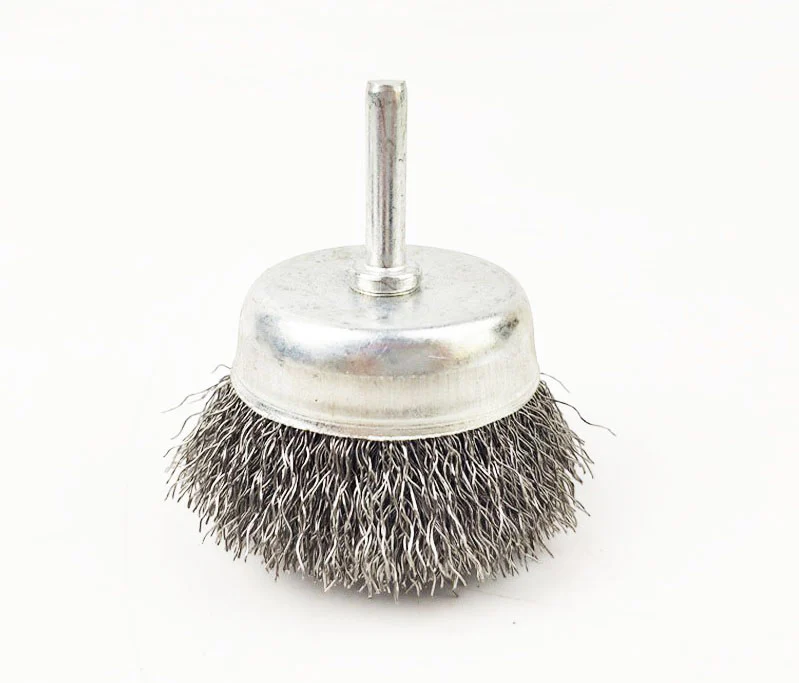
SB-PW-0006: matching diameter and shank do not preserve wire diameter, free length or construction.
Substituting one for the other changes multiple contact variables. A lower unit price does not establish equivalent work or retained-surface quality. If the accepted task depended on flexible contact, the stiffer-looking construction is not automatically an upgrade; if supported contact was important, a longer crimped fill is not automatically an equal replacement.
Use the new-item specification for the reorder. A used brush's shortened fill describes its condition, not the required new manufacturing length. Identify the exact reference, material, individual wire diameter, construction, free length, outside size and connection. Confirm that the supplied rating and permitted-use information belong to that exact configuration; the two product pages do not provide numerical maximum speeds.
How do you keep task and material identity through a shift change?
Associate the issued brush with its package or job reference and the intended task. Keep the approved configuration, material assignment and relevant tool information identifiable. Do not modify the rotating brush to add a tracking mark; use an appropriate external record or storage identification.
This matters particularly when similar-looking brushes are used on different metals. PFERD's INOX-TOTAL guidance discusses contamination from contact with steel and prior use on other materials. A used brush of uncertain history cannot simply inherit the eligibility of an unopened, specified brush for a controlled stainless task.
Separate condition and assignment. A brush may look physically intact but be unsuitable for the next material because its prior use is incompatible or unknown. Another may be correctly assigned but damaged. Neither question is answered by the other's pass result.
At receipt, confirm the delivered construction and documentation before mixing it into the accepted stock. If a new lot or substitute differs, keep it identifiable while the difference is resolved. Otherwise, output attributed to one configuration can quietly include another, making future comparisons unreliable.
When is a cheaper substitute worth evaluating?
Consider a substitute when its complete offer addresses the same task: suitable contact geometry, compatible interface and permitted conditions, required removal and retained-surface result. Changes to wire material, diameter, trim, knot arrangement or mounting deserve attention because they can alter the contact even if the product fits the same storage bin.
Evaluate the candidate on comparable deposits and features using the power-brush task trial. If the part or process has also changed, describe that new combination rather than presenting the comparison as a price-only swap. Wheel and end-brush duties need their own evaluated scope; a cup result does not support claims about those forms.
Once comparable output and cost information exist, use cost per accepted part. Include the relevant purchase, repeat work and process scope consistently. Do not divide one supplier's fully observed end-of-use output by another's unfinished observation period and call the result a life ranking.
The next purchase should express a practical choice: repeat the accepted construction for the unchanged task, evaluate a named substitute against that task, or reselect the brush because the deposit, geometry or required finish has changed. Calendar dates can locate the history, but the useful work and physical reason for replacement explain the decision.