
Brush Cost per Accepted Part: How Much Longer Must the Expensive Brush Last?
Compare brush purchase and changeover costs using accepted output. Calculate the candidate break-even point and distinguish rejected parts, incomplete trials and useful life.
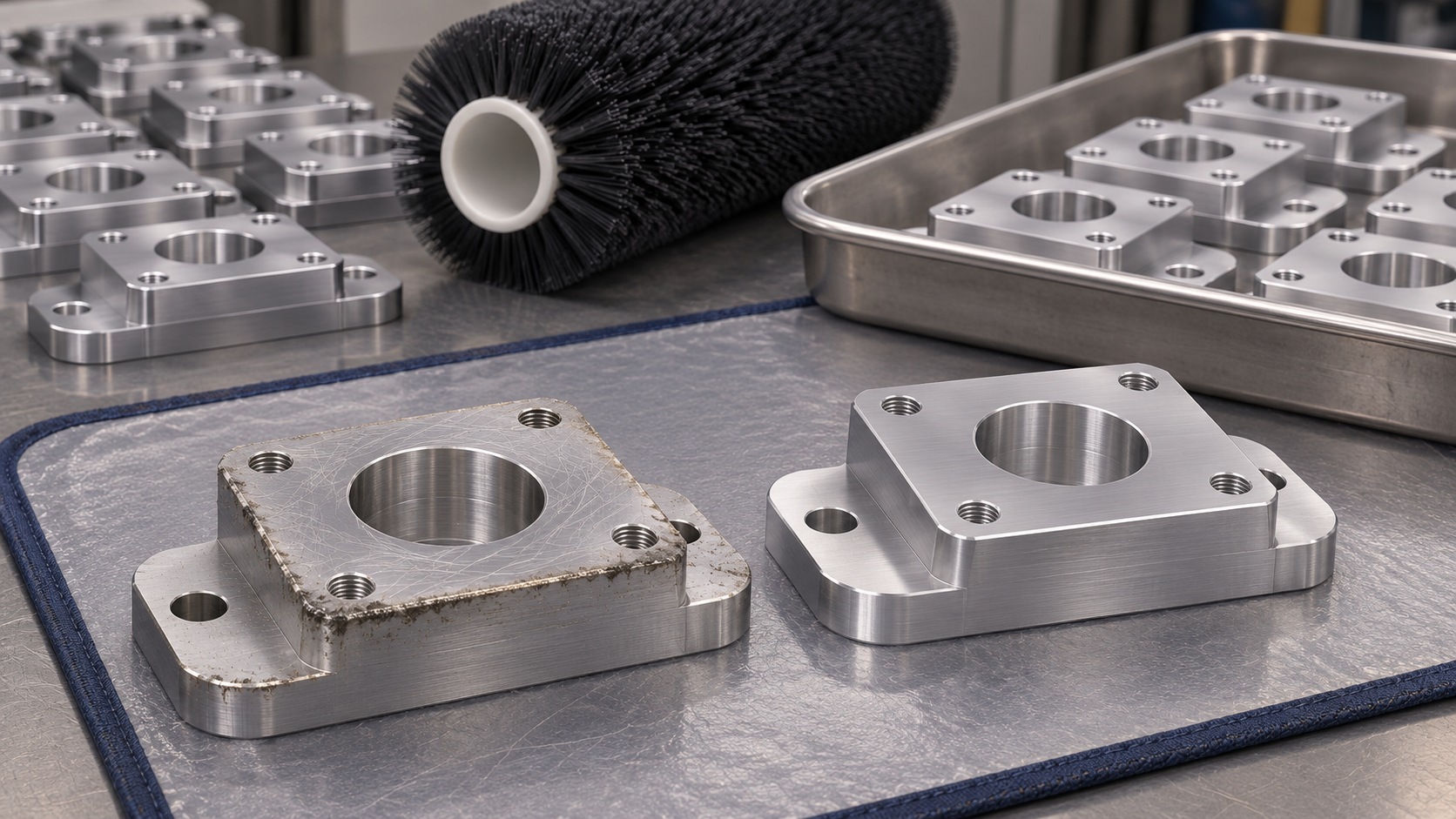
Divide a comparable brush-use cost by accepted output, then calculate the output the alternative must achieve. A higher purchase price can be worthwhile, but a longer-life claim is not the evidence. The comparison needs the same production task, quality definition and reason for removing the brush from service.
The useful result is a threshold for a controlled comparison: how many acceptable parts must the candidate produce before its defined cost becomes competitive? It is not a prediction of life, a permitted operating setting or a reason to accept damaged workpieces.
Are the two prices for the same replacement unit?
A hollow sleeve, a sleeve on a reusable shaft and a complete roller assembly have different supply scopes. If the shaft remains in service, its original purchase cost does not automatically recur every time the sleeve is replaced. If the new candidate requires an adapter, ignoring that adapter makes the first purchase appear cheaper than it is.
The SB-RL-0003 nylon tufted sleeve illustrates the component distinction. Its reference has a 400 mm brush face, 100 mm brush outside diameter, 60 mm core outside diameter, 25 mm mounting bore and 20 mm free fill. The hollow core accepts a separately defined shaft fit and retention arrangement; the listed dimensions do not supply a complete installed assembly or a service-life figure.
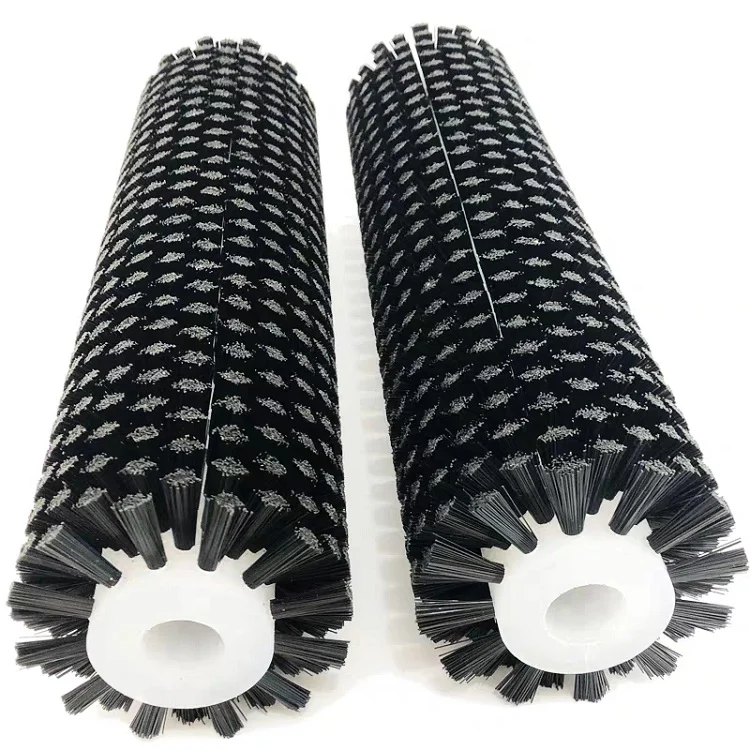
The open cores identify replaceable sleeves. Confirm the shaft, retention parts and any adapters before assigning a cost to one change.
For a strip-based roller, the consumed unit may be one strip set while the core remains. For a cartridge-style station, a complete preassembled unit may reduce installation work but cost more per purchase. Compare the usable replacement scope that the machine needs, rather than treating every item called a brush as the same unit.
State how reusable equipment is allocated over the comparison. It can be a separate initial investment or an agreed share of use cost, but it should not disappear from one option or be charged twice to the other. Resolve the scope through the quotation comparison guide before calculating output economics.
Which changeover costs belong in the calculation?
Include costs that are attributable to the comparison and use a consistent basis. Brush purchase is one item. Removal, fitting, setup and the defined verification associated with a change can add cost even when the new brush itself is inexpensive.
A sleeve that requires dismantling a retained assembly may have a different changeover task from a prepared cartridge. A brush that fits the existing arrangement may avoid an adapter change. These are reasons to understand the actual work, not assumptions that every cartridge is faster or every sleeve is cheaper to run.
Separate paid labour, consumables and any justified production-loss treatment so the same event is not counted twice. A maintenance activity performed during an already planned stop does not automatically create an additional full stop cost. Conversely, leaving an attributable interruption out of only one candidate makes the comparison inconsistent.
The responsible production and finance teams can define the site-specific cost basis. Keep the model limited and explicit if some costs are not available. A transparent partial comparison is more useful than a precise-looking total assembled from unrelated estimates.
How many accepted parts does the higher-priced candidate need?
Consider a purchasing comparison with the following assumed costs. Both configurations meet the same fit and surface requirements, and each cycle consumes one brush.
Defined cycle input | Reference A | Candidate B |
|---|---|---|
Brush purchase, USD | 60 | 95 |
Attributable changeover, USD | 20 | 25 |
Total defined cycle cost, USD | 80 | 120 |
Accepted output to the same retirement rule | 400 | Unknown |
A's cost is (60 + 20) / 400 = 0.20 USD per accepted part. B reaches equality at 120 / 0.20 = 600 accepted parts. Under these fixed assumptions, it must exceed 600 to have a lower cost; 601 is the first whole-part count above the threshold.
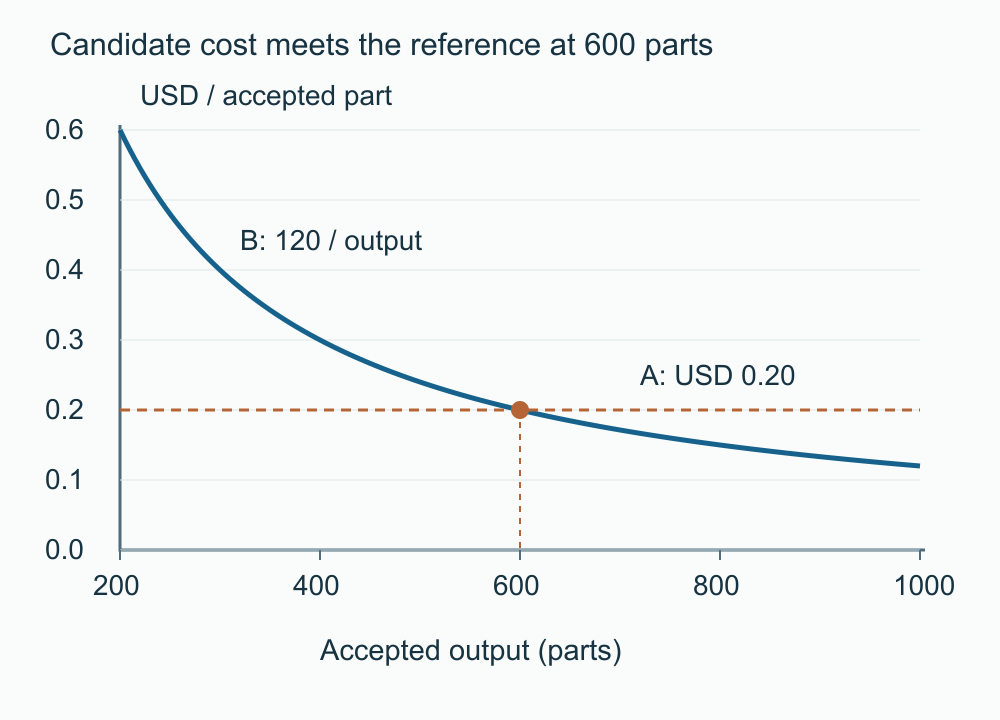
Cost sensitivity calculated from the example: the candidate uses a fixed USD 120 cycle cost and the reference line is USD 0.20 per accepted part.
At 400 accepted parts, B costs USD 0.30 each; at 600 it costs USD 0.20; at 800 it costs USD 0.15. These are three possible output levels in the same cost model.
The example excludes freight, taxes, inspection, rework, disposal and other unlisted costs. Add relevant items on the same basis for both candidates. If a cost varies with output or a different task changes the reference, recalculate; the 600-part threshold is not a permanent product property.
Should rejected or reworked pieces count as brush output?
Use the output definition that matches the economic question. For cost per accepted part, a rejected piece does not become accepted output simply because it passed through the brushing station. Otherwise a brush that processes many poor parts can appear economical.
For illustration, a run of 480 processed parts with 400 accepted and 80 rejected still has 400 accepted parts in the denominator. Using the example's USD 80 cost, dividing by all 480 gives about USD 0.167, while dividing by the 400 accepted gives USD 0.20. The lower number answers a different question.
Reworked pieces require a clear counting rule. A part that passes through the brush twice should not be counted as two accepted products. If it is ultimately accepted, count the accepted product according to the agreed definition and include attributable rework cost where it belongs. Keep first-pass performance visible when that matters to production.
In a loose-particle cleaning task, the accepted region must actually meet the residue requirement. For coated parts, the cleaning result cannot hide an unacceptable surface change. In a mixed part family, a successful easy part should not dominate the denominator while a required difficult geometry fails.

Workpiece inspection illustration: check both remaining residue and surface marks when deciding which pieces count as accepted output.
When is a brush's useful life finished?
Define the retirement criterion around the job and applicable equipment requirements before comparing candidates. Visible filament remaining on the core is not, by itself, evidence that the brush still produces acceptable work. Equally, a cosmetic appearance change does not establish a particular replacement interval.
For a cleaning station, the limiting observation may be residue in a required region. For a surface-sensitive part, it may be unacceptable marking. A mounting or damage condition can also prevent continued use regardless of the appearance of the fill. The relevant technical owner defines the permitted use and stop criteria.
Keep the task comparable as the run proceeds. Material, incoming residue, part orientation or process changes can alter the work being asked of the brush. If a candidate handles an easier input than the reference, a longer output count may not demonstrate an economic improvement for the original job.
Use the exact configured brush, machine limits and approved operating plan. Do not lengthen a trial by increasing engagement or otherwise changing operation beyond the accepted scope simply to cross an economic threshold. The cost model evaluates an acceptable process; it does not authorize a different one.
What if the trial stops while the brush is still usable?
A planned stop is different from a life-ending observation. Suppose a candidate has produced 500 accepted parts when the allotted trial period ends, with the required checks still satisfactory. That establishes output so far under those conditions. It does not establish a maximum life of 500, and it does not prove that the brush will reach 600.
Now consider a different conditional run stopped at 500 because the agreed quality limit is reached. The count is numerically the same, but its meaning differs: this run reached the defined retirement condition. Do not average these two observations as if both were completed brush lives.
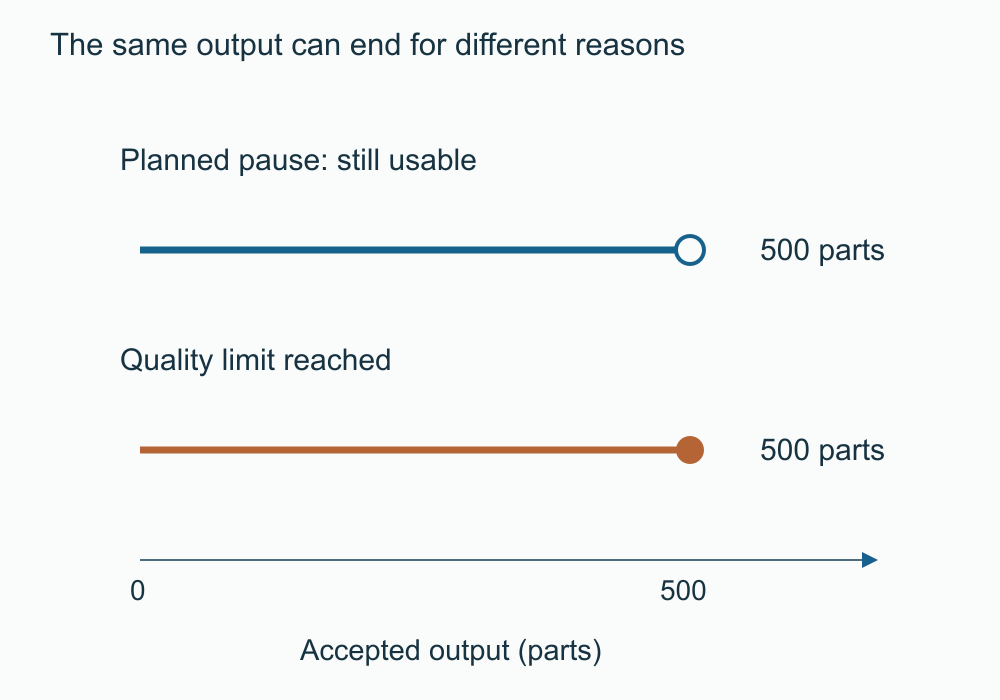
Hypothetical timelines: the open endpoint is an incomplete observation; the closed endpoint identifies the stated retirement event.
Where an incomplete trial remains relevant, continue under the approved plan or use comparable completed usage records. If conditions change before restarting, identify that change. A still-serviceable brush left on a shelf does not accumulate accepted output merely because calendar time passes.
Is one run just above break-even enough to change the bulk order?
It can establish what happened in that run, but it does not automatically establish a guaranteed interval or the variation the purchasing plan must tolerate. A result barely above a threshold can be sensitive to cost assumptions, counting errors or changes in incoming work.
Compare the evidence with the order's consequence. A routine interchangeable replacement for a stable task may need a different evidence scope from a large commitment serving several finishes or materials. The number and representativeness of runs should follow that scope, not a universal sample count invented for every brush.
Keep batch identity and the relevant workpiece cases with the accepted result. If the candidate performs well on general cleaning but damages a coated variant, a bulk approval covering both would exceed the evidence. The choice may be a limited purchase for the successful task, a revised candidate for the other task or retention of the existing brush there.
What should the buyer request after calculating the threshold?
Request comparable component and changeover scope, an agreed accepted-output definition, the actual reference basis, and candidate evidence under the same quality and retirement rules. Include the workpiece regions that determine acceptance so the trial measures something the business can use.
For the worked example, the unresolved question is whether B can exceed 600 accepted parts under the stated USD 120 cycle cost while satisfying the task. The appropriate next purchase is the quantity justified for that evaluation or for the scope already demonstrated, not a bulk order supported only by a lifespan claim.
If the economics are favourable but the supplied construction changes, return to the substitution review. The final decision should reproduce the configuration and task behind the accepted output, with its cost basis clear enough to recalculate when either changes.