
Which Wire Brush Material Avoids Contamination on My Workpiece?
Distinguish brass from brass-coated steel, inspect other contacting brush parts and preserve dedicated tool history. Match material restrictions and surface results.
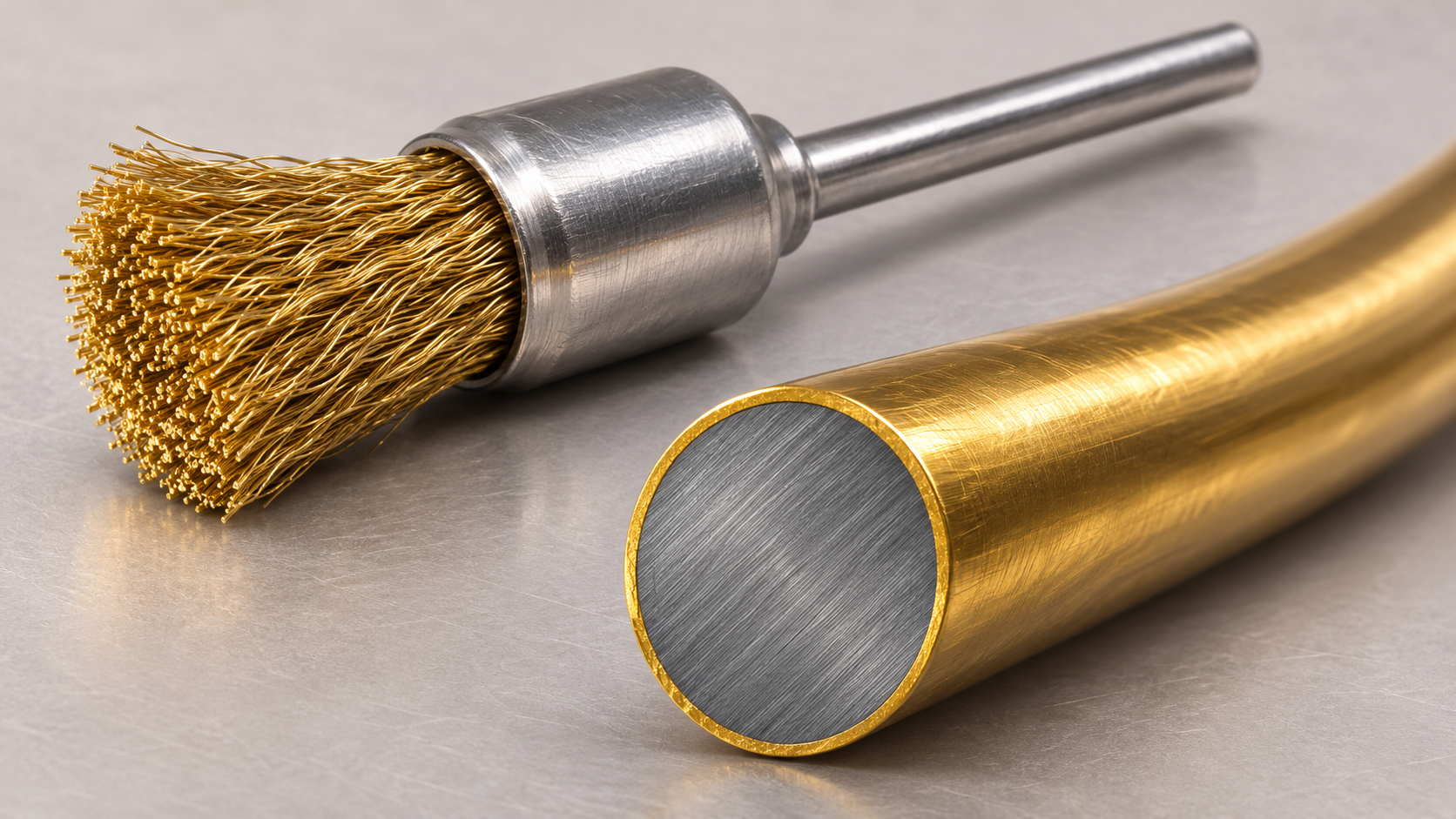
Specify the filament's base material, any coating and the other brush parts that can contact the workpiece. Then compare that construction with the contamination restrictions of the actual process. A gold-coloured wire is not necessarily solid brass, and stainless filaments do not establish that the entire brush is stainless or that a used brush has a suitable history.
The right choice depends on what the next operation and the finished component require. Stainless fabrication, a copper-restricted finishing process and detail cleaning inside a small recess present different questions. Cleaning effectiveness matters, but it cannot substitute for a material requirement that the process explicitly imposes.
Is gold-coloured wire brass, or brass-coated steel?
Those descriptions identify different constructions. Solid brass wire is brass through its cross-section. Brass-coated steel has a steel substrate with a brass coating. Colour alone cannot distinguish them reliably, especially in a photograph with reflected light or on a used brush carrying residue.
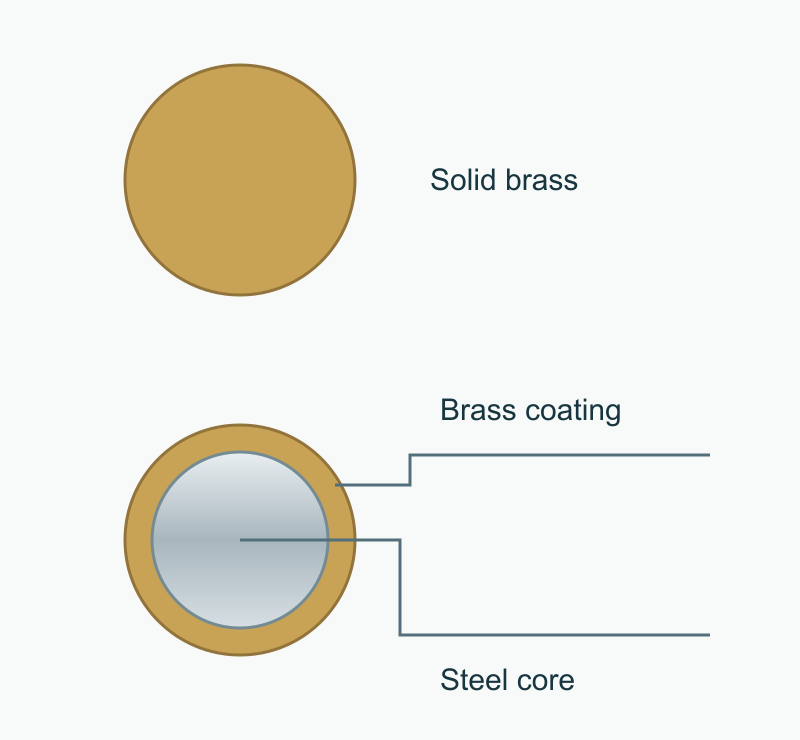
The coating and the underlying wire are separate material fields. The coating thickness is exaggerated for visibility and is not a product measurement.
Spirvobrush SB-PW-0005 is explicitly described as brass-coated steel wire. Its reference has an 8 mm flared working diameter, 10 mm fill length, 45 mm overall length, 2.35 mm shank and 0.10 mm wire. The material identity comes from that specification, not from the gold tone.
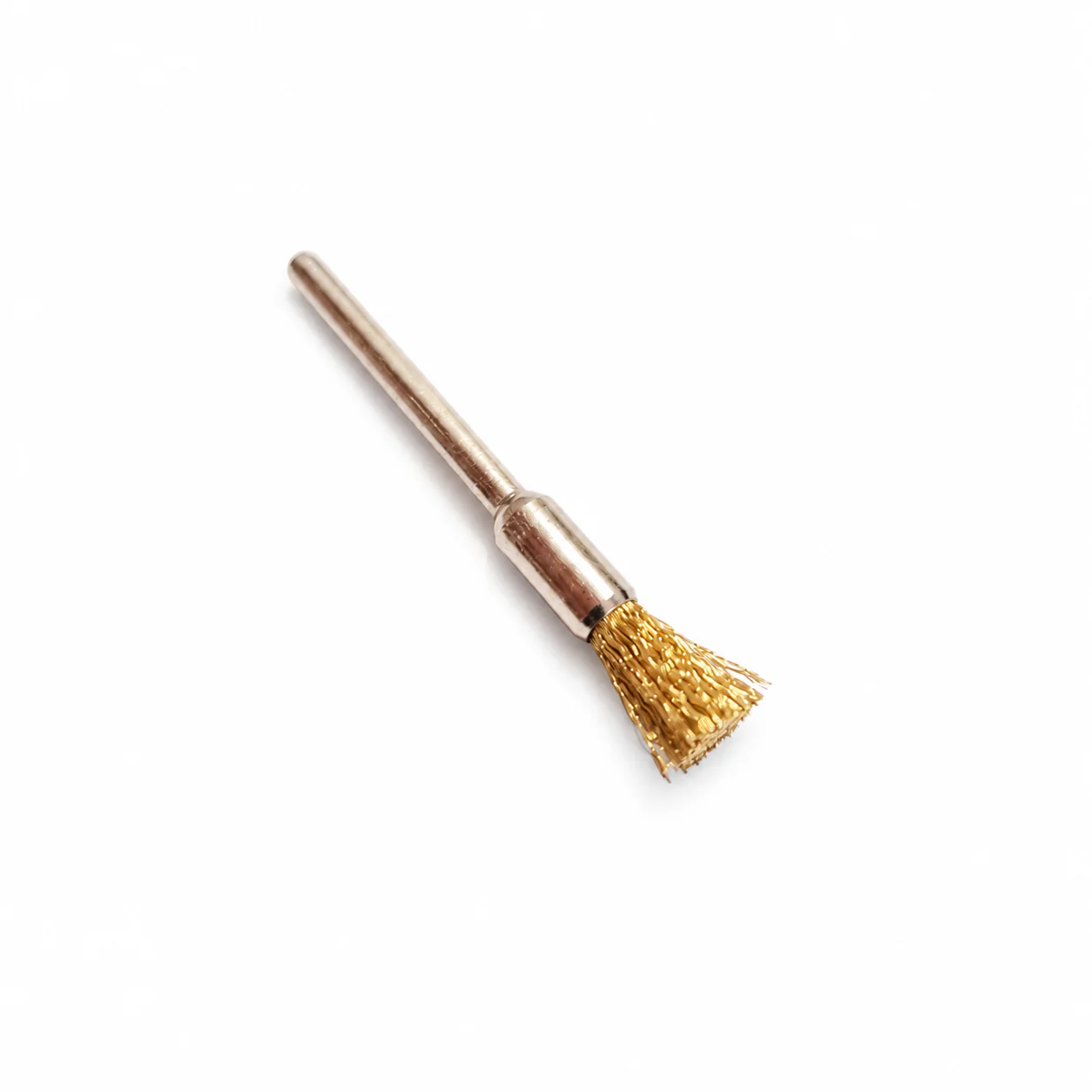
The ferrule supports the wire bundle and the shank provides mounting. None of their exact alloy grades can be established by colour.
If a requirement excludes contact with carbon-steel filaments, a brass coating does not turn the substrate into solid brass. If a process restricts copper-bearing material, both solid brass and a brass coating need to be considered against that restriction. Describe the restriction directly instead of asking for a vaguely named gold brush.
The distinction is also visible in PFERD's material categories, which separately identify steel, brass-plated steel and stainless wire. Their proprietary grades and operating claims belong to their own products. For your order, request the actual base material, coating and any grade evidence required by the application.
Does stainless wire mean that every part of the brush is stainless?
No. The fill specification identifies the filaments. A ferrule, twisted core, channel, face plate or connector can use another material. Inspect the actual arrangement to determine which of those parts could contact the workpiece during the intended operation, especially near recess walls or at the end of the tool's available reach.
An end brush illustrates the issue clearly. The filaments reach beyond a ferrule, but a narrow recess can bring the metal body close to its side wall. A roller can have end faces near a part edge. An internal brush can bring its leading core or sleeve into a restricted passage. Material selection should follow those possible contacts rather than stop at the fill name.
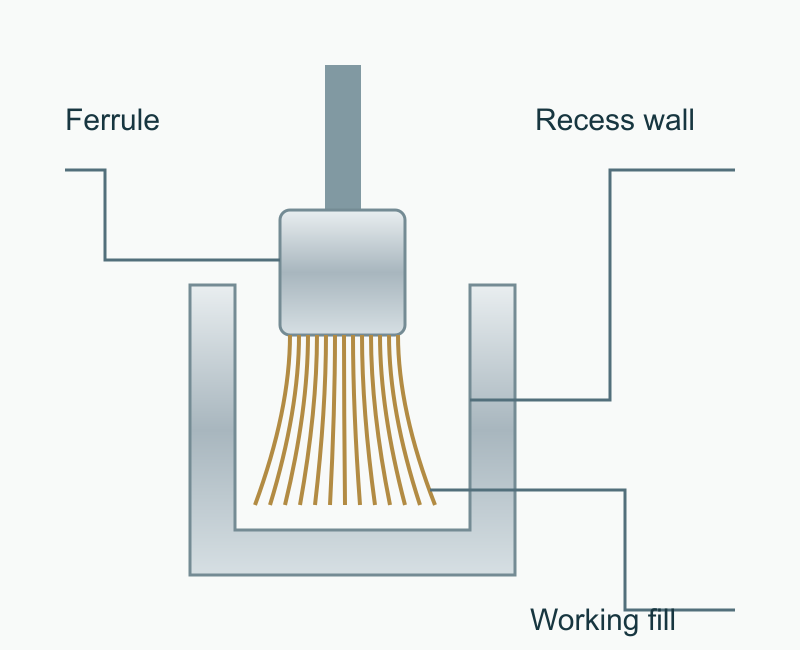
The working bundle and supporting metal body occupy different envelopes. Review the material and clearance of each part that can meet the workpiece.
PFERD's INOX-TOTAL guidance makes a useful distinction between stainless filaments and its all-stainless construction. It also identifies contact with steel brush components as a concern in stainless work. That is a reason to examine the complete tool, not a certification of another manufacturer's product.
For a Spirvobrush example, SB-TB-0029 lists stainless steel fill, while the exact alloy is selected with the order. Its twisted core and threaded sleeve are separately visible construction features. Ask for the required material details where the application depends on them; do not infer an all-stainless assembly from the fill description.
What contamination should I describe in the enquiry?
Translate the general word contamination into the actual concern. The issue may be transferred carbon-steel particles on stainless steel, copper-bearing contact, retained foreign particles, visible residue or interference with the next coating or surface-treatment step. Different concerns require different evidence.
For stainless fabrication, tool and handling history can matter as much as the new filament specification. For a process with a copper restriction, a brass candidate cannot be selected solely because it is relatively soft. For a coated component, a material-compatible wire can still alter the coating mechanically. Material identity, removal action and finished surface are separate questions.
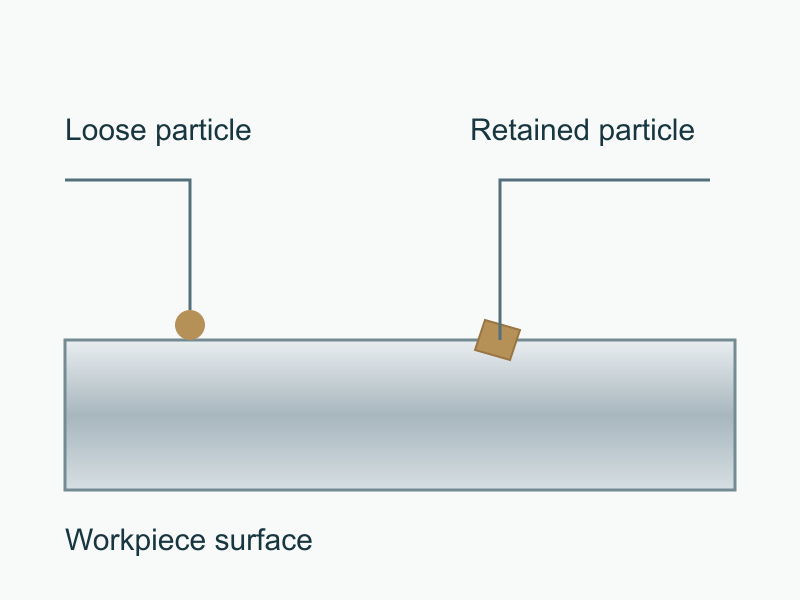
Surface-transfer section illustration: transferred material may remain loose or become retained at the surface.
State the workpiece grade and existing surface or coating, the material restrictions, the next operation and the required inspection method. If the concern is a customer-specified cleanliness requirement, supply the relevant requirement rather than expecting the brush supplier to reconstruct it from a metal name. The supplier can then identify suitable candidate constructions or explain which material details need to be specified.
Do not equate stainless steel with iron-free material. The relevant restriction is normally about an identified source or form of contamination, a grade requirement or a defined surface condition. Asking for an iron-free stainless brush is a different and potentially contradictory request from asking to avoid carbon-steel transfer. Use the process's actual terminology.
Can I reuse a stainless brush after it worked on another metal?
A brush has both a material identity and a use history. Filaments can carry material from an earlier job. A correct stainless-wire specification therefore does not make a brush suitable for every subsequent controlled stainless task after mixed-metal use.
PFERD's stainless guidance explicitly discusses mixed use on other metals. In practice, dedicate and identify tools according to the workpiece families and cleanliness controls required by the process. Keep the storage and handling arrangement consistent with that separation. A shared tray of visually similar brushes can defeat an otherwise precise purchase specification.
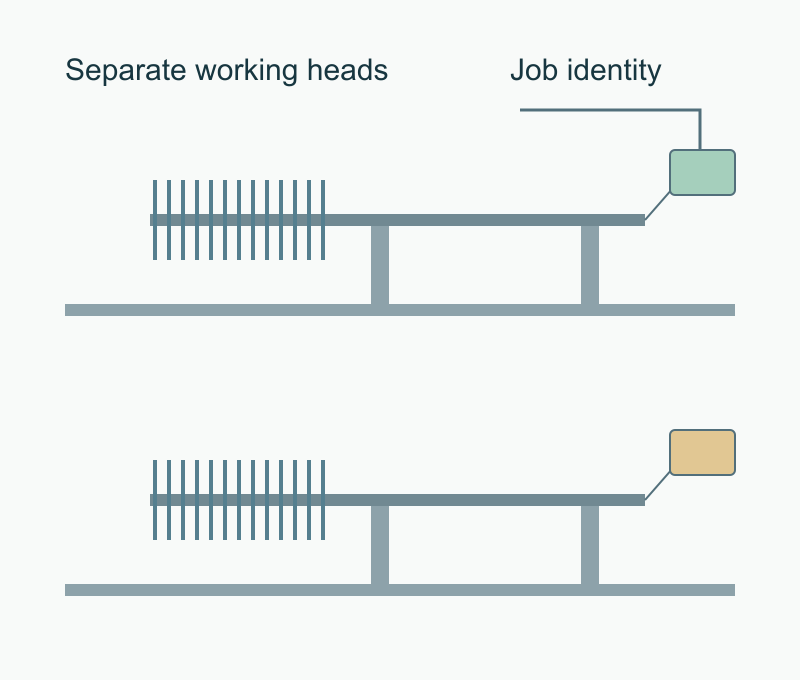
Physical separation and readable identity preserve the intended use assignment. Tag colour is an example of local organization, not an alloy identification standard.
This matters in a maintenance shop alternating carbon-steel fixtures and stainless components. The new brush may have been selected correctly, while a returned brush placed beside it has an unsuitable or unknown history. It also matters when a compact end brush moves between several small recess-cleaning jobs and looks clean after each one.
Use only a cleaning method that is suitable for the actual brush and the process requirement. A quick wipe or visual brightness cannot prove that a previously mixed-use tool meets a specified contamination condition. Where the process requires dedicated tools, preserve that assignment through use, cleaning, packaging and return to stores rather than attempting to infer suitability later.
If the surface looks clean, has the material question been resolved?
Not necessarily. Visual inspection can show residual particles, marks or discoloration, but it cannot establish every material or surface requirement. A successful removal demonstration does not supply a missing filament declaration. Likewise, a brush with the required material can still leave an unacceptable surface because its geometry or contact is unsuitable.
Stainless fabrication also has a process boundary worth keeping clear. Outokumpu's post-fabrication guidance explains that brushing can remove superficial contamination while leaving a chromium-depleted layer beneath an oxide or residual oxide that appearance does not reveal. Do not treat a brighter weld area as automatic evidence that every corrosion-related surface requirement has been restored. The required finishing treatment and evaluation belong to the actual component process.
For a detail-cleaning trial, evaluate representative parts using the intended tool construction and equipment conditions. Inspect the target removal, adjacent surface and the required cleanliness or material-related acceptance. If the process requires laboratory or other defined evidence, agree that method before interpreting a visual result as a pass.
A comparison between a brass roller, steel wheel and stainless tube brush would mix material, form and contact. It might help explain terminology, but it would not rank the metals fairly for one job. Compare candidate constructions that can perform the actual task, and keep their geometry differences visible. The abrasive and surface trial principles are useful when a comparison involves more than one changing feature.
Why can the correct wire material still mark the surface?
A material match resolves only one part of the selection. Filament diameter, free length, crimp or knot construction, density and the way the tool meets the workpiece also influence contact. Two brushes with the same declared metal can present very different working bundles. That is why a material declaration and a representative surface trial are complementary.
In a small recess, the flared tips may spread toward a side wall while the ferrule remains close to the entrance. On a narrow external edge, a broad working face may contact an adjacent finished region. In a tube, a wire head chosen for a deposit can encounter a protected internal finish along the same route. Identify those physical contacts before assigning a surface mark to the alloy alone.
When a trial leaves an unwanted mark, show its position relative to the target and the tool. Check whether the mark follows filament contact, a rigid component or trapped material. That observation guides the next candidate: another contact geometry, a different fill construction or a different process may be relevant. Simply replacing stainless with brass, or brass with nylon, introduces a material change without proving that the original contact problem has been solved.
Use the supplied tool-and-equipment instructions for actual settings. The purchase decision should preserve both the required material identity and the construction that produces an acceptable surface on the representative part.
What should the purchase description say to prevent the same ambiguity next time?
Use the complete fill name: base material and required grade, coating if present, wire diameter and relevant profile or arrangement. Add the other material requirements that follow from actual possible contact, along with the mounting and working dimensions. Specify the supporting evidence the application needs and how the supplied configuration will be identified.
For a miniature end brush, distinguish the wire from the ferrule and shank. For an internal brush, distinguish the fill from the core, leading end and connector. For a roller, include relevant end and core details. This makes the material question concrete without demanding information about unrelated parts that never affect the application.
A practical enquiry is: “This workpiece and next operation impose these material and cleanliness restrictions. The drawing shows the working region and nearby surfaces the brush body could approach. Please identify the filament base material and coating, relevant component materials and the proposed configuration for a representative trial.” State the dedicated-use and packaging needs where the process requires them.
If metal contact itself is unsuitable, ask whether a nonmetallic candidate can perform the task. It still needs a selection and surface evaluation; a different material category is not automatic permission. Carry the selected construction into the sample-to-order specification, and treat a later alloy, coating or body-material change as a named substitution. The result is an order based on the actual contact and contamination problem rather than colour or a commercial nickname.