
Wheel, Cup or End Brush: Choose the Contact Shape, Wire and Tool Connection
Choose wheel, cup or end wire brushes by access, deposit and protected finish. Compare knot and crimped cups, useful tip contact and exact tool connections.
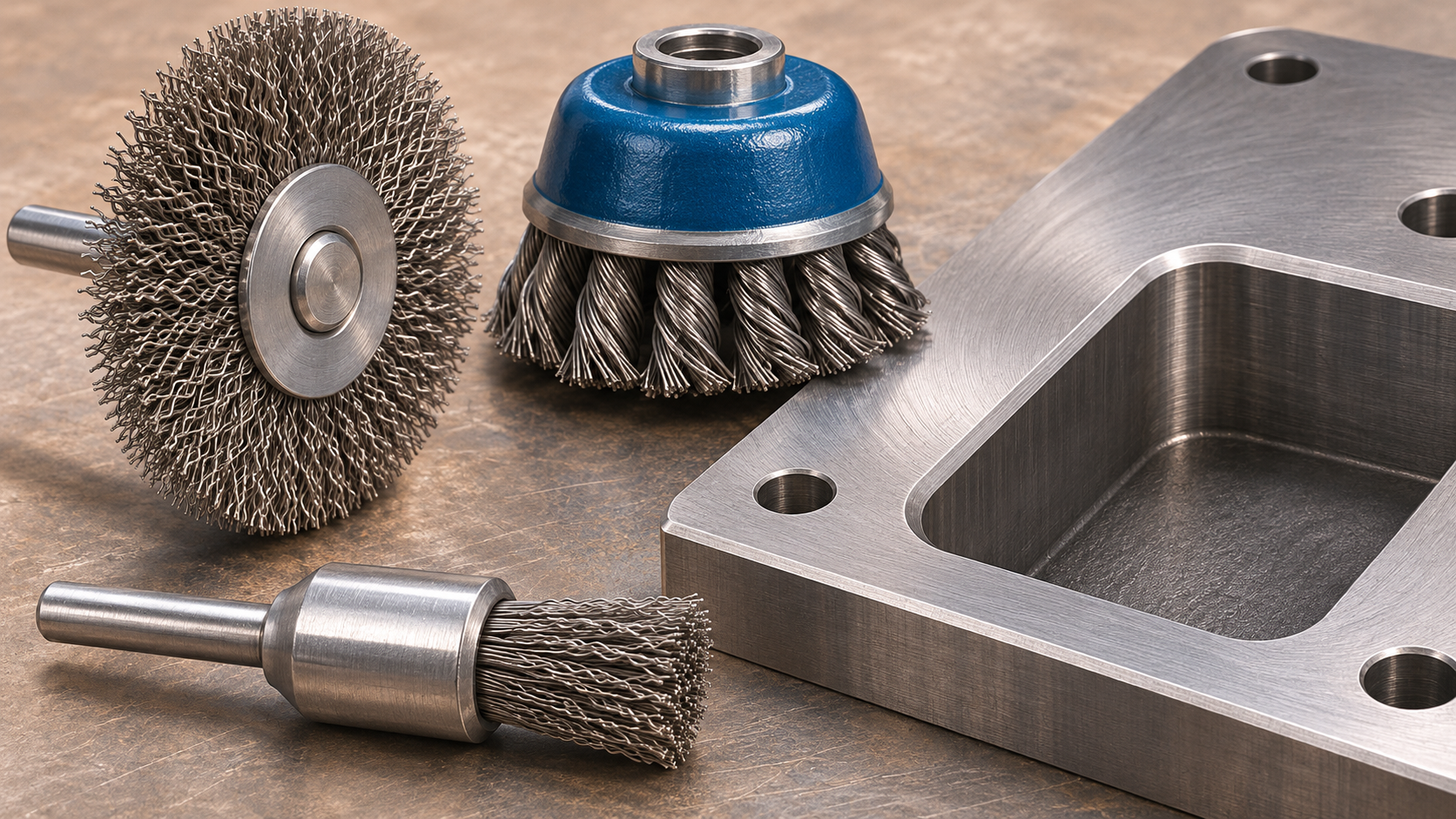
Choose a wheel, cup or end brush by the surface the wire tips must reach. A wheel presents its perimeter to an edge or narrow track; a cup offers a face for a broader exposed area; an end brush can enter a suitable recess. Then narrow the choice by deposit, base material, permitted surface change and the exact power-tool connection. Shape alone does not establish that a brush is suitable for your machine or your cleaning task.
The practical question is often more specific than “which wire brush is strongest?” A weld edge needs concentrated access, a rusty plate needs coverage, and residue at the bottom of a pocket needs clearance around the brush body. Buying the most aggressive-looking head can make the wrong part of the tool contact the work, leave a corner untouched or damage a surface that should remain intact.
Which shape reaches the work: wheel, cup or end?
A wire wheel normally works at its circumference. This can suit an exposed edge, a weld-cleaning track or another comparatively narrow accessible region when the selected wheel and tool permit the application. The space needed by the wheel body and arbor matters as well as its working diameter. A wheel that appears small enough in a front photograph may still be obstructed by an adjacent wall or fixture.
A cup presents a wider face and can be a candidate for an accessible plate or fabrication surface. Its nominal outside diameter does not guarantee a uniformly cleaned circle: construction, filament deflection, workpiece shape and the permitted approach affect the actual contact. On a narrow ridge, much of the cup can overhang the useful surface. Near a shoulder, its body may prevent the filaments from reaching the last part of the corner.
An end brush can be useful inside a suitable recess or confined area. Check pocket opening, depth, approach and body clearance together. A head that enters the mouth of a pocket may still fail to reach the floor, or it may touch a sidewall that must be protected. A small head is not automatically a solution to every internal corner.
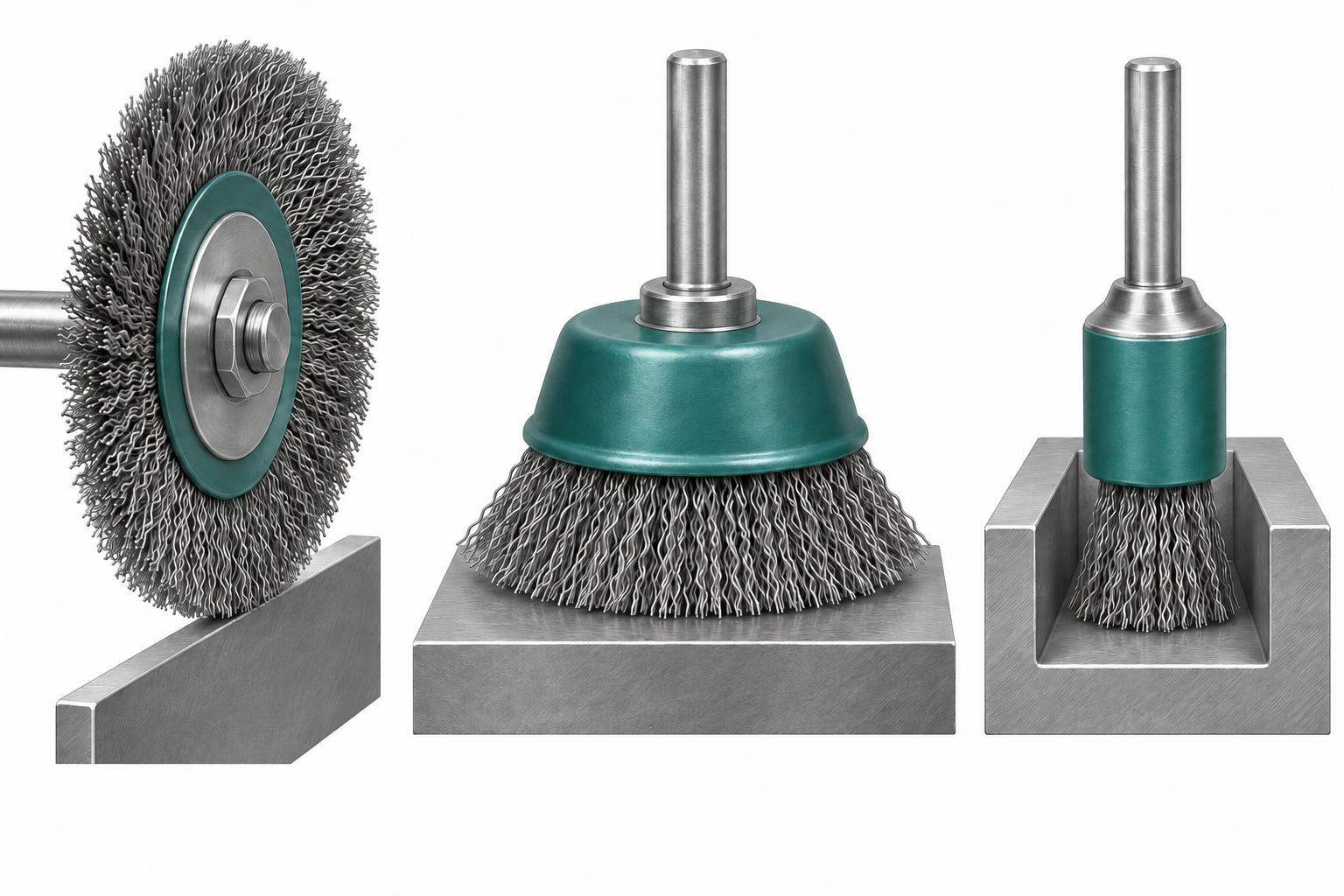
Contact-shape illustration: the wheel perimeter, cup face and end-brush tip approach different regions. Actual use still depends on the selected brush and tool instructions.
These are branches of the same selection decision, not three interchangeable product names. Weiler's wire-brush field guide similarly distinguishes wheel access, broad cup-brush work and confined end-brush applications. Use those distinctions to shortlist a shape, then check the specific assembly.
When should you consider crimped wire instead of a knot brush?
Crimped wire has a wavy individual form that provides flexibility within the fill. In a knot brush, groups of wires are twisted together, producing a more supported construction. A knot design is often considered when a more aggressive brushing action is required; a crimped construction can be useful where more flexible contact is wanted. Neither statement selects the brush on its own.
Individual wire diameter and free length also matter. All else comparable, heavier wire and shorter free length resist bending more than finer wire and longer free length. Knot configuration, fill density and working shape add further differences. A thick-wire crimped brush and a fine-wire knot brush cannot be ranked accurately from the words “crimped” and “knot” alone.
For loose rust on an accessible carbon-steel face, a more flexible candidate may remove the deposit while limiting unnecessary contact with the substrate. For adherent material on a robust fabrication, a more supported construction may be worth testing. If a coating, plating or thin edge must survive, that requirement can exclude an otherwise effective cleaning result. “It removes more” is useful only when the extra removal is wanted.
Do not respond to poor cleaning merely by pressing a flexible brush harder. Weiler's guide recommends selecting wire that performs the task without excessive pressure. If useful contact is present but the deposit remains, reconsider construction and the process. If the region is not reached at all, fix access before comparing wire aggressiveness.
Why are these two 50 mm cup brushes different purchases?
The SB-PW-0004 short twist-knot cup and SB-PW-0006 crimped cup both list a 50 mm outside diameter, a 6 mm straight shank and a 65 mm overall length. Those common dimensions help compare space and interface, but they conceal important working-face differences.
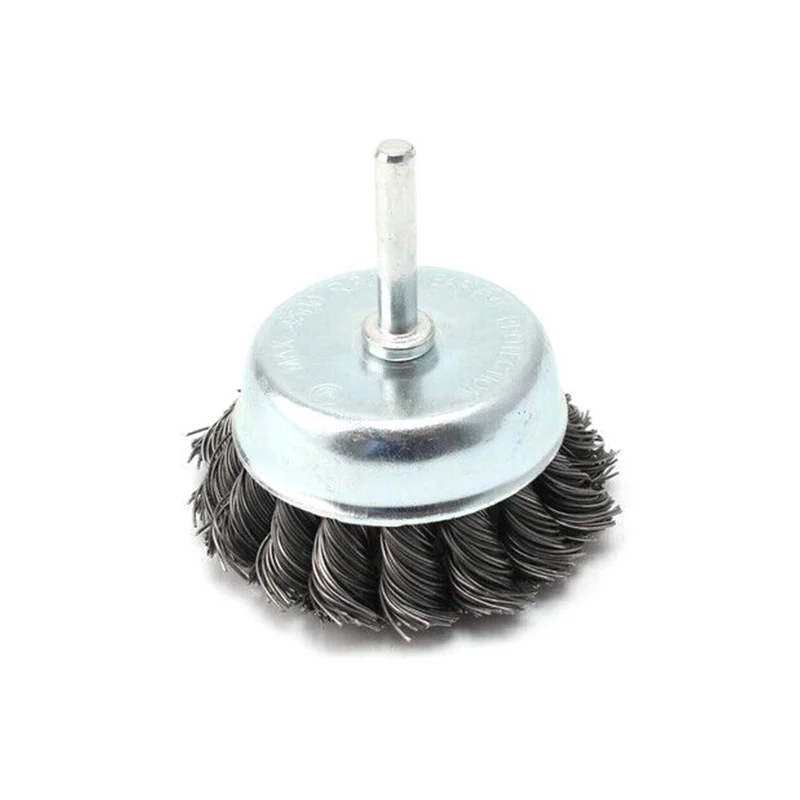
SB-PW-0004: 0.50 mm individual steel wire, a short twist-knot construction and 15 mm listed fill length.
The knot cup lists 0.50 mm individual wire and 15 mm fill length. The crimped cup lists 0.30 mm wire and 20 mm fill length. Construction, diameter and free length therefore all change together.
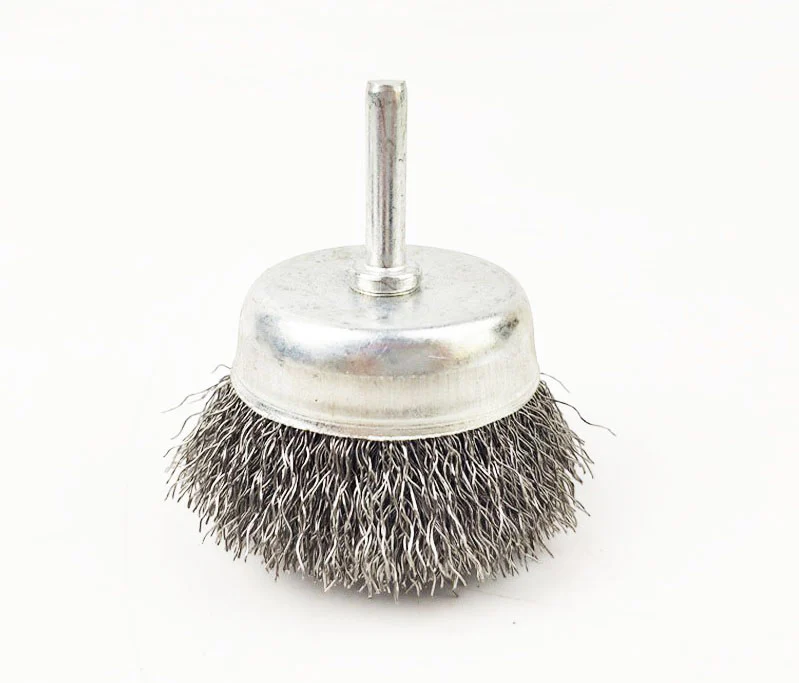
SB-PW-0006: 0.30 mm individual steel wire and 20 mm listed fill length, with a crimped rather than twisted fill.
If these two cups produce different results on a representative surface, the result compares two complete products. It does not isolate the effect of knotting, wire diameter or fill length. Their matching 50 mm size also does not mean that they have the same contact footprint under load.
For a reorder, specify the product reference and construction, not just “50 mm cup, 6 mm shank.” If the accepted job depends on the shorter, supported knot fill, the longer crimped cup is a change requiring evaluation. The reverse is equally true when the more flexible contact was important to preserving a surface.
Why does excessive pressure shorten useful wire-brush life?
The wire ends perform the intended brushing work. When contact becomes too deep, filaments can bend farther and their sides lie against the surface. Added force then increases deflection without necessarily increasing useful tip action. It can also change the footprint and make the brush more difficult to keep on the intended region.
Weiler's discussion of wire-brush life connects excessive pressure with overflexing and premature long-wire breakage. It also emphasizes the interaction among wire diameter, density and trim. This supports watching the contact behavior; it does not establish a universal force or service-life value for other brush models.
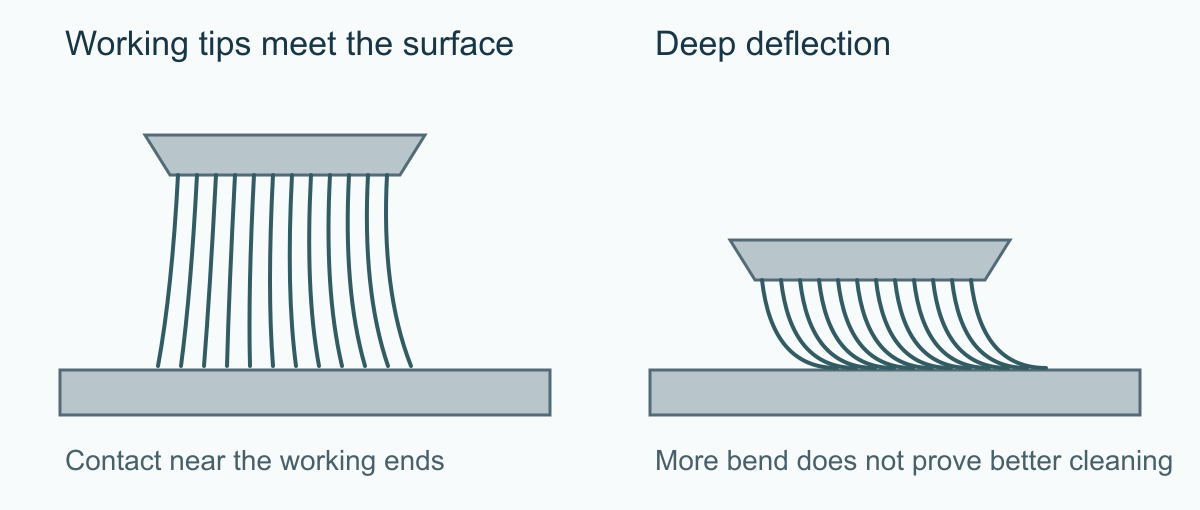
Contact sections: increased deflection can lay wire over the work instead of improving the action at its ends. These are explanatory shapes, not operating-force settings.
If an operator must keep pushing harder to obtain the previous result, several causes are possible. The deposit may have become more adherent, the brush may be worn or damaged, the geometry may no longer match the working area, or the original construction may be unsuitable. Check those conditions before treating extra pressure as the normal answer.
A broad cup used near a narrow shoulder illustrates the problem. Pressing harder on the flat face may increase contact there while the obstructed shoulder remains untouched. The useful change could be a different permitted approach or a separately selected end brush, rather than a stiffer version of the same cup. Damage, loose components or abnormal wire loss require the response specified by the brush and tool manufacturers, not an attempt to consume the remaining fill.
Does a matching shank or thread prove the brush fits the power tool?
No. A 6 mm shank identifies one interface dimension; it does not prove that every chuck or collet, spindle, guard arrangement and operating condition is compatible. Verify the exact holder capacity, required grip, clearance and tool instructions. Do not solve a mismatch by assuming an unapproved adapter makes the assembly equivalent.
A threaded cup is a different mounting construction from a straight-shank cup. Its thread form, diameter, pitch and engagement must match the specified tool connection. A wheel mounted through a bore introduces its own arbor, flange and retention requirements. These interfaces should not be merged into a single “fits grinder” description.
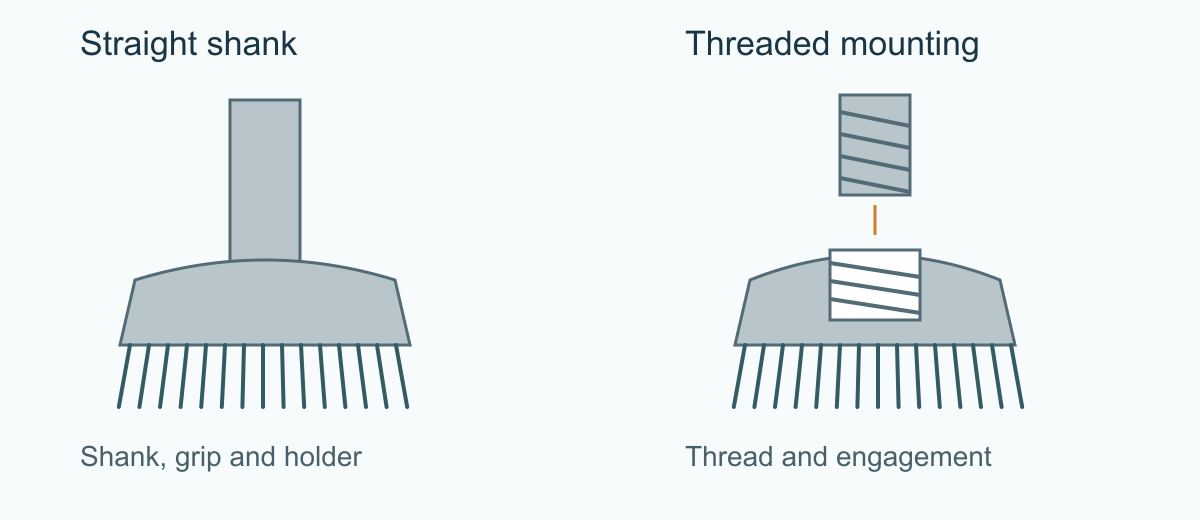
Mounting concepts: identify the connection actually supplied. A shank diameter and a threaded socket describe different assemblies.
The published Spirvobrush examples above do not state a numerical maximum operating speed. Obtain the rating and permitted-use information for the exact supplied product, then check it with the power tool and any holder or adapter. The tool's applicable speed must remain within the permitted limits of the complete assembly. A speed printed for another manufacturer's similar-looking cup is not evidence for this one.
A maximum rating is not an instruction to run at that speed. The useful process condition depends on the approved tool, brush construction and task. Norton provides a power-wire-brush use checklist covering condition and compatibility; use the actual product instructions to complete the selection, including the required protective arrangements.
Is a wire brush suitable for stainless steel or a finish that must remain intact?
The substrate changes the material decision. A carbon-steel wire brush used on carbon steel is not automatically an acceptable choice for stainless work. PFERD's INOX brush guidance discusses contamination from steel contact and from brushes previously used on other metals. Its dedicated construction also considers metal parts beyond the filaments.
For stainless work, identify the required brush material and control its prior use. A stainless-wire label alone does not answer every contamination question if another metal component can touch the work or the brush has already been used on carbon steel. Keep brushes intended for a controlled stainless application identifiable and separate from incompatible tasks.
For aluminum, plating, decorative finishes or a protected coating, begin with the permitted surface change. A brush that removes the residue can still leave unacceptable marks or remove material that should remain. Show the finish requirement and sensitive locations before selecting the wire and construction. A successful trial on an unfinished steel plate does not qualify the same brush for a finished aluminum component.
Cleaning before a later coating also needs a clear endpoint. Removing visible loose rust is not by itself proof that the surface meets the coating system's cleanliness or profile specification. Select and inspect against the actual preparation requirement rather than treating a brighter surface as the acceptance criterion.
How should you compare candidates on a real cleaning task?
For an exposed plate, identify the deposit and the complete area that must be cleaned. Compare candidates on representative, comparable starting surfaces. Check deposit removal and the condition of the underlying surface together. If one candidate cleans the flat face but leaves residue at a shoulder, its result covers only the face unless the job deliberately assigns the shoulder to another operation.
For a weld-cleaning track, include the actual adjacent geometry and weld condition. A wheel may offer access that a cup lacks, but the selected wheel still needs its own tool fit and application evaluation. A cup test does not establish wheel performance. For an open pocket, include the depth and wall protection requirement: reaching the floor while marking a protected wall is an unsuccessful combined result.
The power-brush task trial develops this comparison using the deposit, substrate and protected regions. Its purpose is to decide what each candidate can do in the intended task. It should not end with an unexplained ranking such as “heavy duty is better.” If neither candidate reaches the required region, change the geometry or operation rather than repeating a wire-only comparison.
What details make the next order repeatable?
Specify brush form, exact product reference, wire material, individual wire diameter, crimped or knot construction, free fill length, outside diameter and overall envelope. Define the supplied shank, thread or bore connection, and connect the exact product to its rating and permitted-use information.
Attach the application description: deposit, substrate, required area, protected finish and the accepted result. A useful request says, for example, that a cup must clean the accessible flat region of a carbon-steel fabrication while a shoulder is assigned to another tool. It does not silently promise one cup will reach every corner.
During use, evaluate brush condition and useful accepted work together. The power-brush reorder guide explains how to separate wear, a changed task and a proposed construction change. Repeat the accepted configuration when it still solves the same problem; reconsider the selection when the work or required result has changed.