
How to Trial a Power Brush for Rust and Residue Without Damaging the Part
Compare power brushes on real cleaning regions: open rusted faces, shoulder residue and protected lands. Define comparable inputs and decide the accepted task.
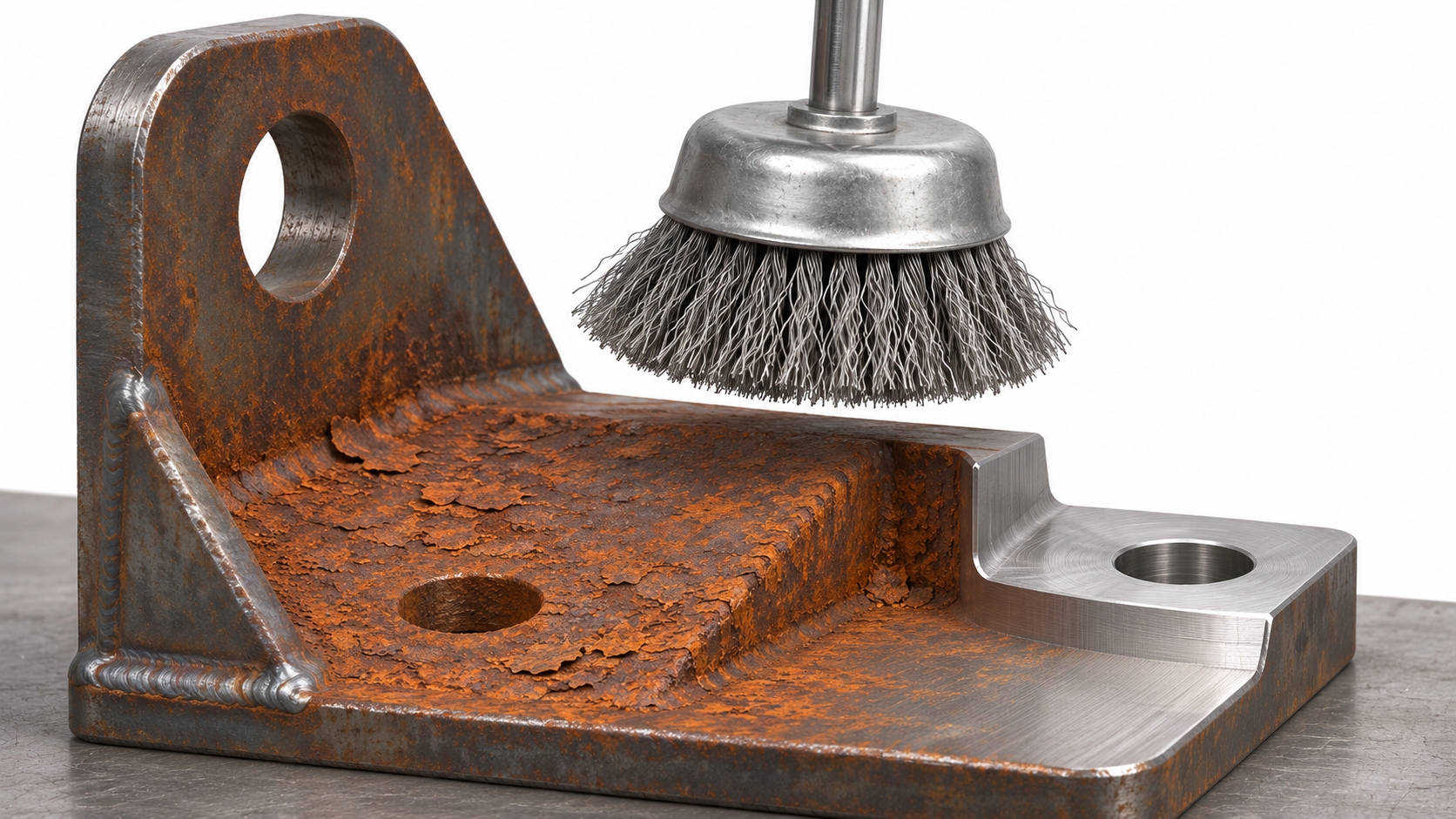
A useful power-brush trial answers two questions together: does it remove the unwanted material from every required area, and does the underlying part remain acceptable? Define the deposit, substrate, access and protected features before comparing samples. A brush that makes the central face look clean can still leave residue beside a shoulder or mark a locating land. Those are different outcomes with different purchasing consequences.
First complete the wheel, cup or end brush and tool-fit selection. The trial here begins with candidates whose exact configuration and permitted tool conditions are established. It does not supply an operating speed or make an incompatible brush eligible. Its purpose is to decide which candidate and process solve the actual cleaning task.
What exactly must come off, and what must remain?
“Remove rust” can describe very different starting conditions. Loose surface material on an accessible face does not present the same task as firmly attached material at an inside shoulder. Identify what is unwanted, where it is attached and what the part needs to do afterward. If the deposit is not identified, do not let a broad label such as “dirt” substitute for an understanding of the task.
Consider an uncoated carbon-steel fabrication with three regions. F is an open flat face carrying rust; R is residue beside a raised shoulder; S is a machined locating land that must retain its drawing requirements. F and R are removal tasks, while S is a retention requirement. Treating them separately makes it possible to explain a result instead of reporting only that the whole part “looks better.”
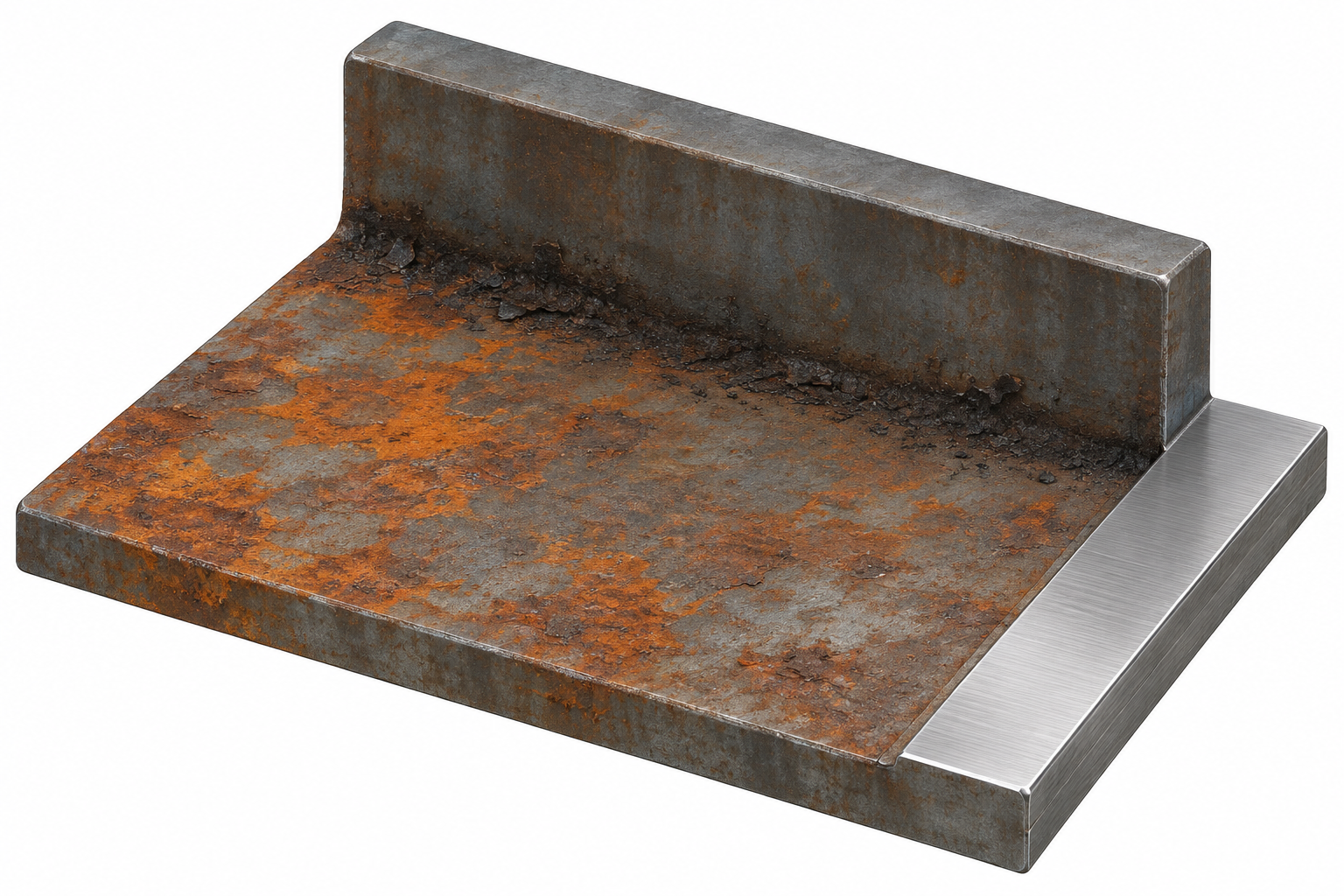
Task layout before cleaning: the open face, inside shoulder and machined land impose different access and surface requirements. This is a conditional workpiece illustration.
Specify the condition that counts as completion. For maintenance cleaning, that may be the defined removal and retained condition needed for the next operation. For coating preparation, the applicable coating-system requirements can demand more than visible loose-rust removal. For a locating land, the drawing may control geometry or finish. Use those actual requirements; this article does not create a universal roughness or cleanliness limit.
Also identify which faces may be contacted incidentally. A brush that reaches F may sweep across S on its way into or out of the region. The trial should include that real approach, not only a carefully isolated central patch that avoids the difficult boundary.
Why should the shoulder be a separate trial location?
A cup suitable for a broad exposed face can be obstructed near a shoulder. Its body, wire skirt and permitted approach together determine whether the working ends can reach the corner. If the last strip remains dirty, first ask whether useful contact reaches it. A more aggressive wire cannot remove material at a region the head never reaches.
The same issue occurs on a welded frame with a narrow cleaning track. A wheel can offer a different access path, while an end brush may be a candidate inside an appropriate recess. Those alternatives need their own compatibility and trial checks. A result obtained with a cup cannot qualify the other shapes simply because all three use steel wire.
For the fabrication example, there are two legitimate production aims. One process may allow a cup for F and a separately selected operation for R. Another may require one tool to finish both areas in one operation. The same trial outcome can be useful for the first aim and insufficient for the second. Decide this production constraint before choosing a winner.
If the corner is reachable but the deposit remains, construction and process conditions deserve investigation. If the corner is not reachable, revise the allowed geometry or divide the operation. Keeping those explanations separate prevents a sequence of increasingly stiff cup brushes from being ordered to solve a clearance problem.
Which product differences should the trial preserve?
Compare exact sample identities. The SB-PW-0006 crimped steel-wire cup lists 0.30 mm individual wire and 20 mm fill length. Its 50 mm outside diameter, 6 mm straight shank and 65 mm overall length define its nominal envelope and interface.
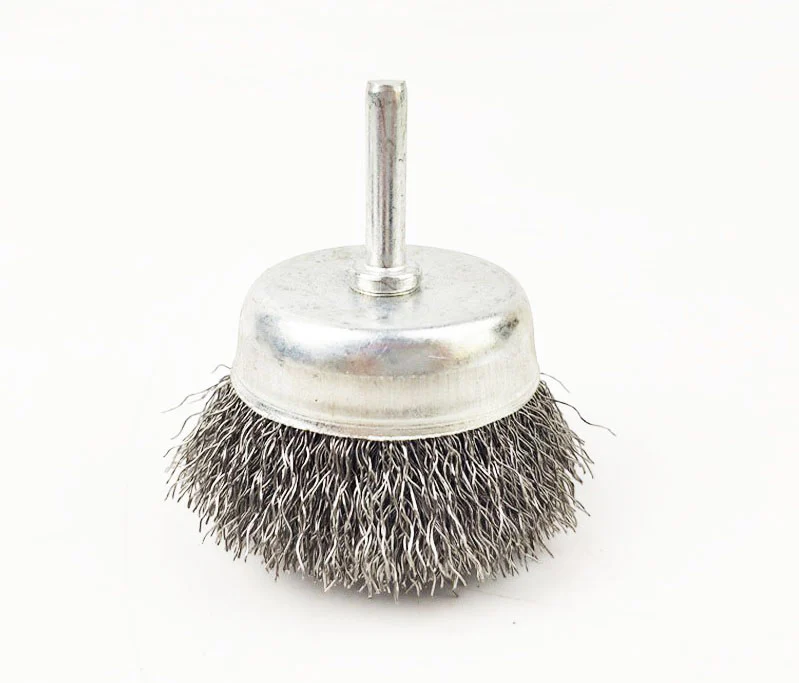
SB-PW-0006 identifies one construction to evaluate. The photograph does not demonstrate its result on the illustrated workpiece.
The SB-PW-0004 short twist-knot cup shares those three envelope/interface dimensions but lists 0.50 mm individual wire and 15 mm fill length, grouped into short knots. Knotting, wire diameter and free length change together.
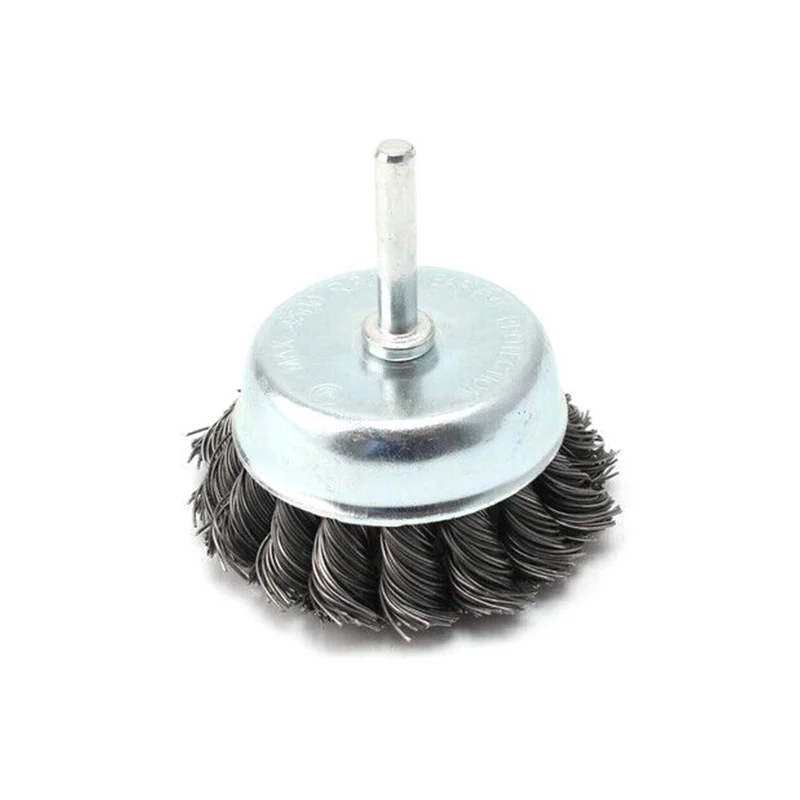
SB-PW-0004 is a different complete configuration, even though the nominal cup diameter and shank match the crimped example.
A trial between these products compares complete candidates. It cannot isolate a “knot effect” or prove that wire diameter alone caused a difference. Weiler's wire-brush field guide explains the relevance of construction, wire and trim. Use those variables to form a reasoned shortlist, then judge the complete part result.
The product pages do not state numerical maximum speeds. Obtain the exact supplied ratings and permitted conditions before operating either candidate. Do not fill that gap with the rating of another brand's 50 mm cup. If candidates require different permitted setups, identify both setups and compare their whole processes rather than claiming a single-variable experiment.
How do you make the starting surfaces comparable?
Use parts or suitable trial areas that represent the production range and begin in comparable condition. Include the difficult deposit location, the relevant geometry and the sensitive surface. A lightly rusted sample for one candidate and a heavily attached residue for another would compare starting conditions as well as brushes.
Before treatment, identify F, R and S on the actual part drawing or photographs. Show the deposit distribution and the condition of S. A locating land that was already marked should not be used to attribute every post-trial mark to the candidate brush; an unrecorded clean land also makes a later change harder to interpret.
When two areas of one part are used, account for their differences in geometry and deposit. Avoid treating them as equivalent merely because they share the same base material. Brushing one area can also change the adjacent area, so define the trial sequence and separation sufficiently to prevent the first operation from quietly preparing the second candidate's task.
Keep the inspection locations and requirements constant. Preserve the candidate, tool and holder identity, actual permitted setup and any intentional change between runs. The point is not to accumulate paperwork; it is to make a result such as “the corner remained dirty” explainable in terms of contact, starting condition and construction.
Does pressing harder make a weak candidate into a good one?
Not necessarily. Wire ends do the intended brushing work. Deep deflection can lay the wire sides against the surface and change the contact footprint without improving useful action at the tips. On the fabrication, that can increase contact on F or S while R remains obstructed.
Weiler's wire-brush life discussion connects excessive pressure with overflexing and premature long-wire breakage. It supports investigating contact behavior instead of treating extra force as a universal correction. Its published operating examples are not settings for the Spirvobrush candidates.
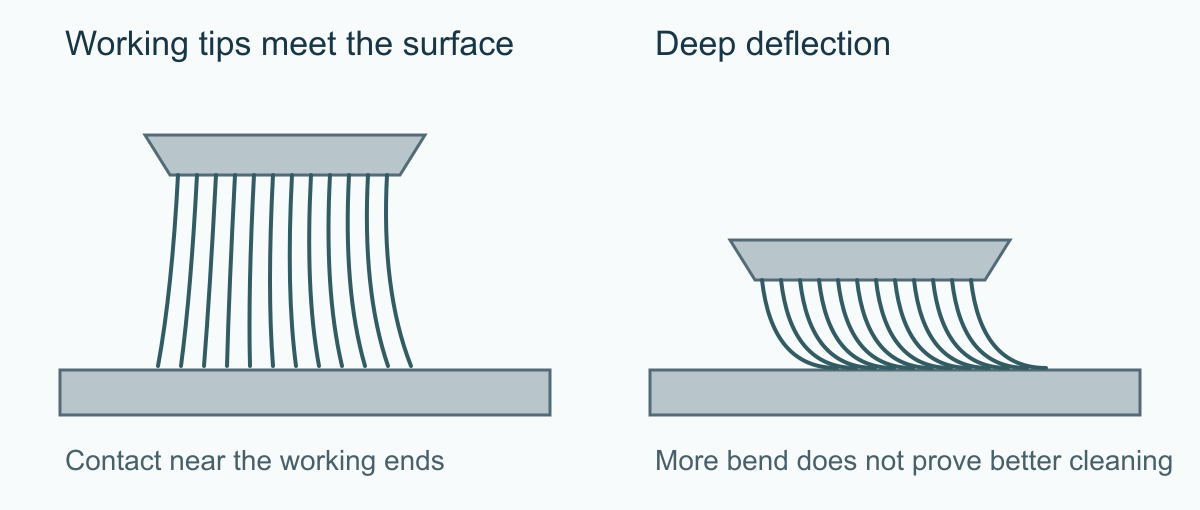
Contact principle: increased deflection is not evidence of improved removal. Evaluate the required region and the retained surface together.
If a candidate only works when used outside its permitted conditions, it has not passed. If the permitted process cleans F but not R, inspect the remaining deposit and access. If it reaches R but leaves unacceptable marks on S, the combined requirement still fails. A stronger cleaning action is not a successful result when the part loses a necessary function.
Use the actual brush and tool instructions for operation and condition checks. The trial should be performed by personnel competent for that equipment and task. Changing the test plan does not remove the need for the applicable protective arrangements and product limits.
What should the inspection say beyond “clean” or “not clean”?
At F, inspect whether the specified unwanted material has been removed over the required area, including boundaries. At R, inspect the difficult strip beside the shoulder rather than assuming it matches the open face. At S, apply the locating-land requirement even if the brush was only intended to clean nearby.
A photograph is useful for locating residue and showing visible changes. It does not by itself establish a dimensional limit, a specified surface condition or a coating-preparation endpoint. Match the inspection to the requirement. Where an inspection result is outside scope, retain that limitation rather than converting visual appearance into an unmeasured pass.
Distinguish remaining deposit from a changed substrate. A bright line may be newly exposed metal, an altered finish or another surface change; its meaning comes from the part and inspection method. Similarly, a dark region at the corner should be investigated as a particular location, not automatically called an acceptable shadow or a failed surface without checking.
Repeat the relevant comparison across representative conditions before selecting a production scope. A single favorable patch can establish a useful candidate; it cannot establish a life claim or guarantee every workpiece variation.
Which trial outcomes lead to an actual purchase?
If a candidate removes the required material at F and R but S fails its surface requirement, reject it for the combined task. Investigate whether a different permitted approach, protection arrangement or construction can meet all three requirements. Do not erase the locating-land criterion because the rust removal looks good.
If a candidate meets F and S but leaves R unresolved, it can be considered for the flat-face operation when production permits a separate solution for the shoulder. The order then names that role. If one brush must complete the whole task, the result is insufficient and the search continues.
If a separately evaluated operation resolves R while the first candidate consistently meets F and S, a two-step process may be the practical answer. Compare the complete work required, including the transition between tools, before assuming that one more aggressive brush would be cheaper or simpler.
If both candidates meet all required regions on comparable inputs, compare repeatability, useful accepted output and confirmed supply terms. The power-brush reorder guide explains how to count that output without treating repeated cleaning actions as extra accepted parts.
What changes if the next job uses stainless steel or a finished surface?
A carbon-steel trial belongs to that substrate and task. For stainless work, review brush material, other metal components that might contact the part and prior use. PFERD's INOX-TOTAL guidance discusses these contamination issues. The wire-material guide develops the purchasing implications.
For finished aluminum, plating or another retained surface, make the permitted change explicit and repeat the relevant application evaluation. A brush that cleaned an unfinished steel fabrication does not carry that result to the new finish. Changing substrate or surface requirements can justify a new trial even when the ordered brush is identical.
A completed trial should let the buyer make a precise request: supply this construction and interface for this deposit and accessible region, with this protected feature retained; assign the remaining shoulder operation separately if that is the accepted process. That is enough to distinguish a useful selected tool from a similar-looking cup that has never been evaluated for the job.