
Ordering a Replacement Belt Brush: Backing, Machine Path and Finished Loop
Identify a replacement belt brush by its running face, section, machine path and joint. Compare open lengths with finished loops and define the order.
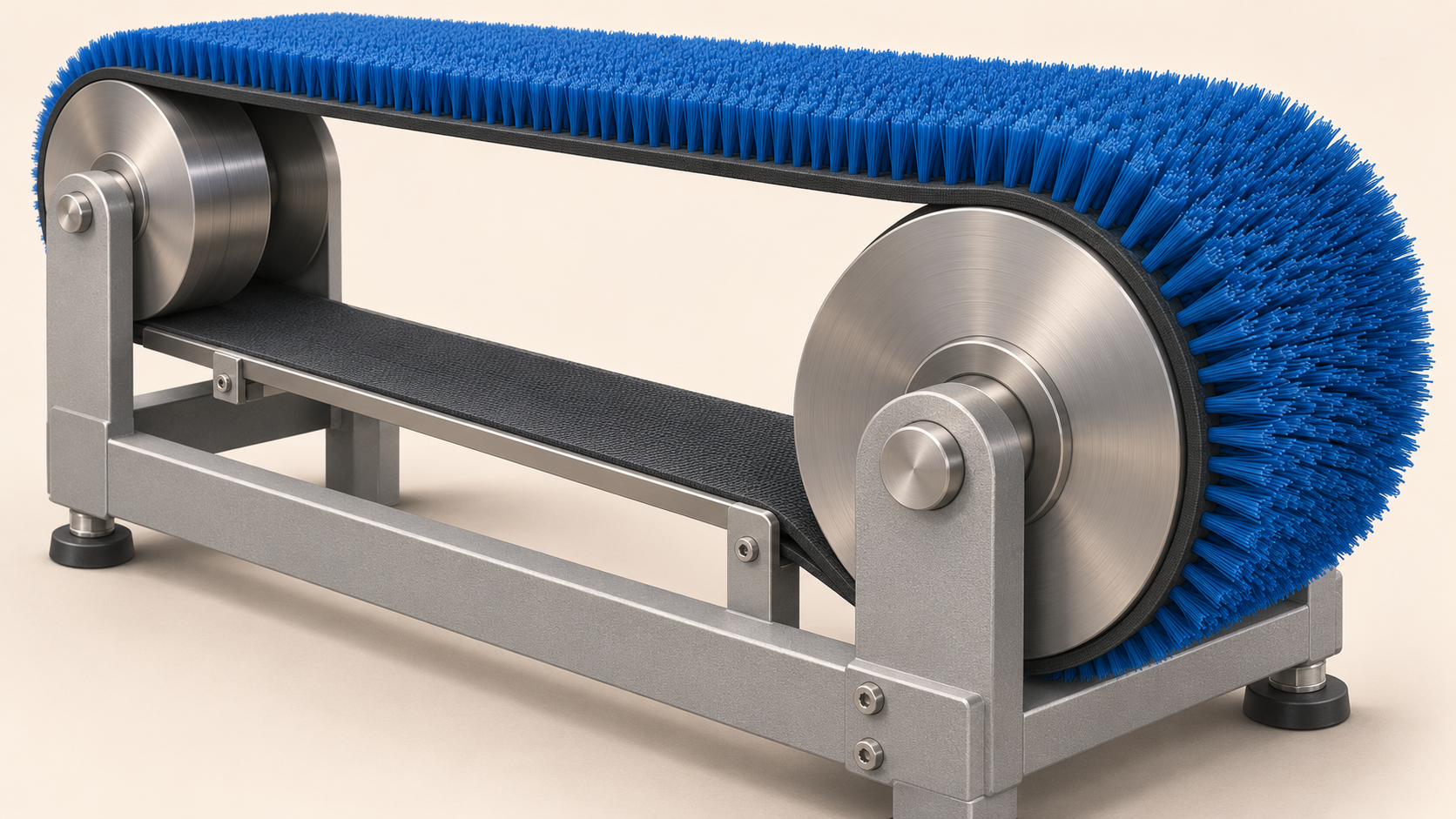
Identify the running face, the complete machine path and the required supply form before ordering a replacement belt brush. Width and overall length are not enough. A belt can carry the right blue Nylon tufts but have the wrong backing for the pulley, a joint that cannot pass the guide, or a finished loop that cannot be installed through the available access.
Start with two separate functions. The backing runs on the machine and carries the brush around its path. The bristles touch the workpiece, conveyor surface or supported product. Replacing one side of that arrangement without understanding the other is how a visually similar belt becomes an unusable spare.
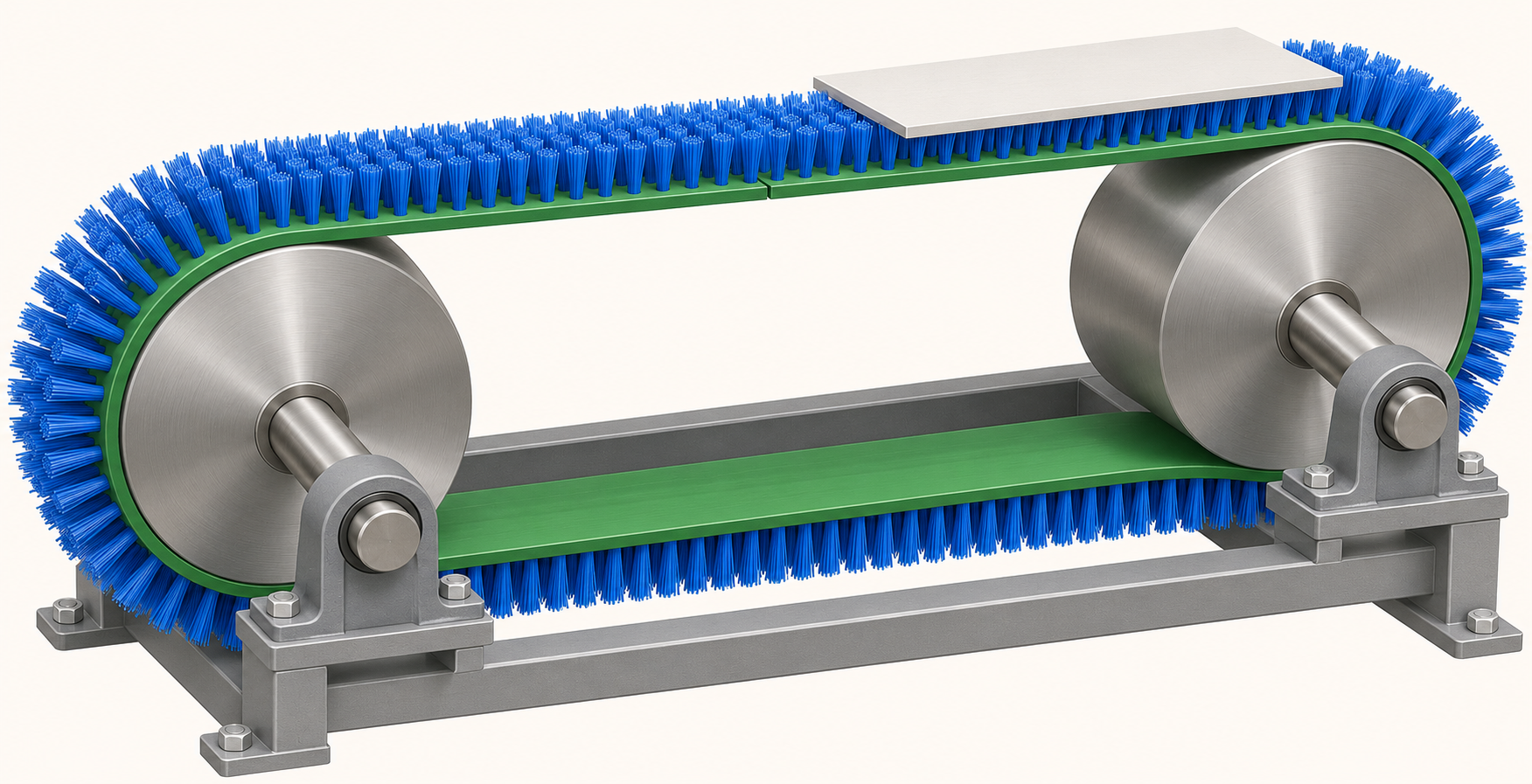
Belt-brush installation illustration. The backing contacts the pulleys; the bristles face outward on both working and return runs. This shows the route and access questions, not a specified machine or joint design.
How can I tell whether the old brush uses a flat, V-backed or toothed belt?
Inspect the surface that actually contacts the machine. A woven or flat running face, a V-shaped section and a toothed profile describe different interfaces. Photograph the rear face and an end section, then relate those views to the pulley or guide they run against. A top view of the brush shows the tufts but can conceal the feature that determines replacement compatibility.
A toothed backing must match its intended toothed interface; “same width” does not define the tooth pitch or form. A V-shaped backing must be described by its actual section, not by the overall width of the bristle band. For a flat belt, material, thickness, support surface and tracking arrangement still matter even though there are no teeth to count. Do not classify a dark backing from colour alone.
Mink's belt-brush range distinguishes flat, V-belt and toothed constructions. Its flat-belt construction also separates the running layer from the tensile layer. That is a useful explanation of why the back of a brush belt is an engineered part of the assembly. Mink's dimensions and operating settings belong to its own products; the replacement needs data for the actual proposed construction.
For the machine record, show the drive surface, every guide that contacts the back or edge, and any feature that controls tracking. A narrow side guide may limit usable belt width before the working area does. A textured rear surface visible in a photograph is not evidence that it can engage a toothed pulley.
Which belt-brush dimensions must match the guide and the working space?
The SB-BL-0001 narrow blue Nylon belt brush has a reference belt width of 30 mm, a 5 mm backing and 20 mm exposed trim, giving 25 mm overall section height. The page identifies a layered belt with a woven running face and multiple tuft rows. Length, material details and the end or joint arrangement are configured to the machine.
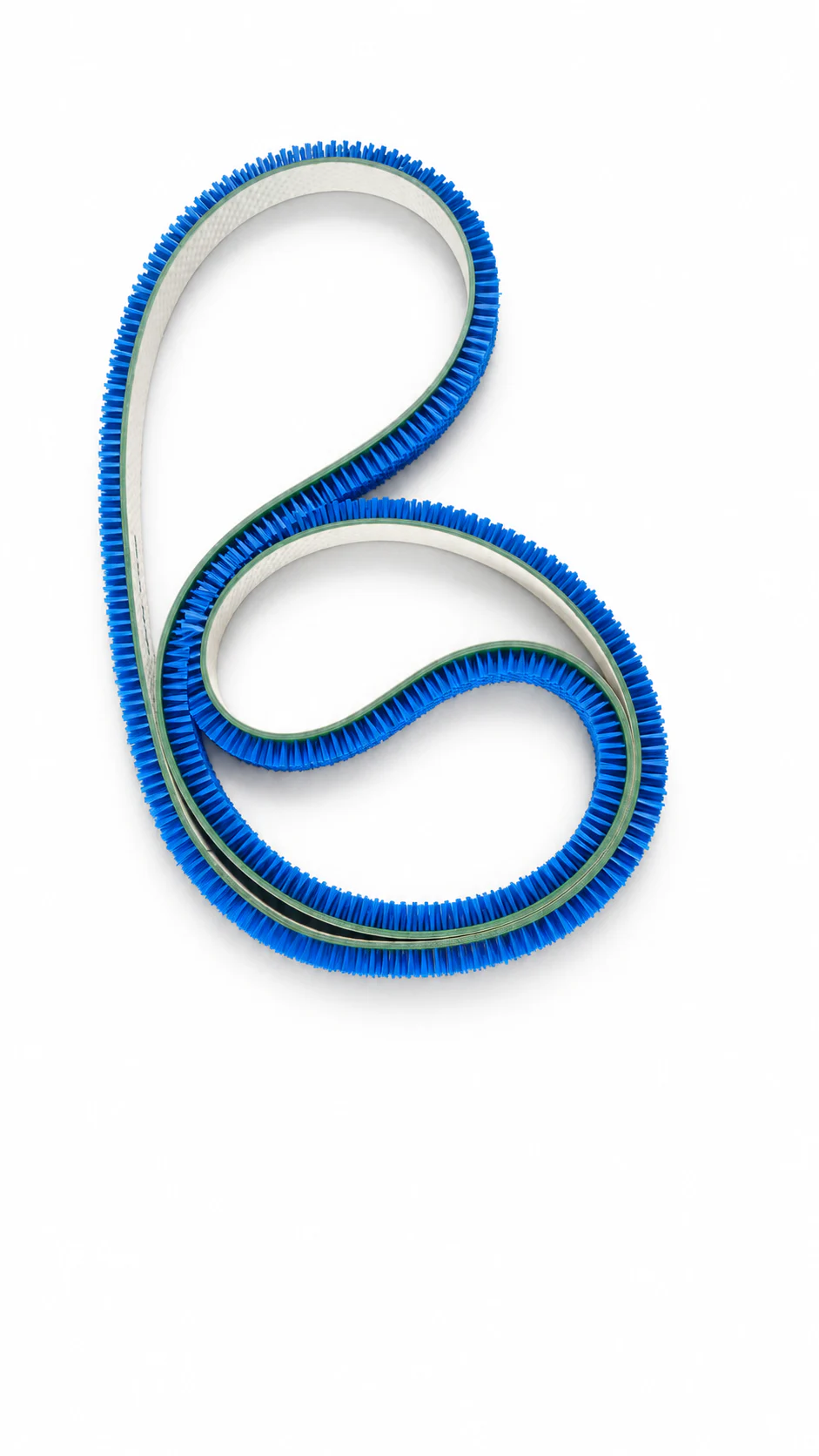
SB-BL-0001. The exposed rear face is part of the identification. The folded storage shape does not specify its operating loop or length.
The SB-BL-0002 wide blue Nylon belt brush has a 50 mm reference width, 4 mm backing and 20 mm trim, giving 24 mm overall height. Both references list 0.30 mm Nylon filaments. The wider belt is therefore slightly lower in overall section, despite sharing the same trim. Neither the colour nor one matching dimension makes the two interchangeable.
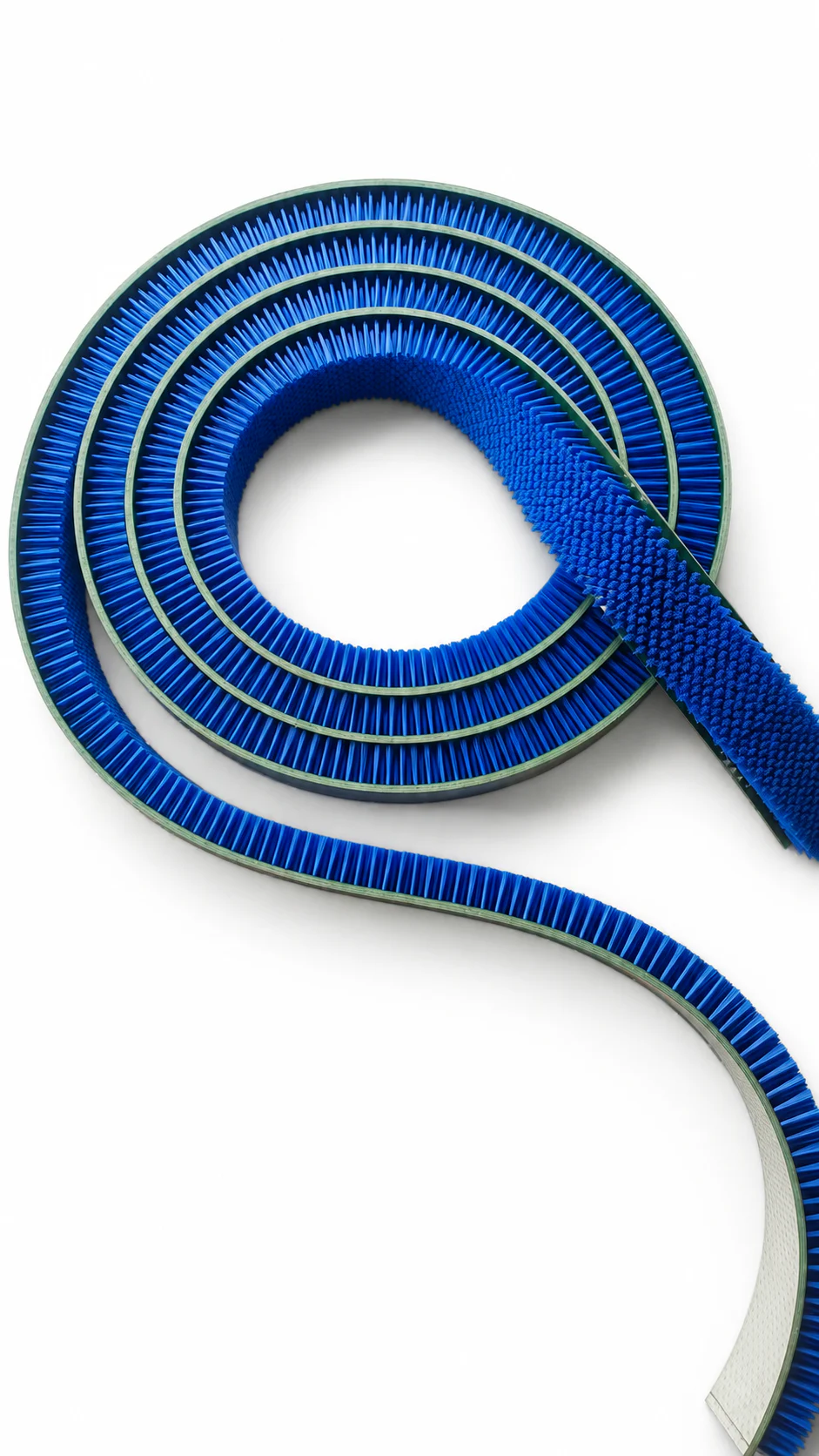
SB-BL-0002. The visible free end matters: the shown supply is open length. An endless arrangement and its joint require a separate definition.
Measure backing width, backing thickness and exposed fill separately. Then locate the available machine envelope from the same reference surfaces. A guide slot may constrain the backing, while a nearby guard constrains the tips. If a dimension is taken over worn or bent tufts, label that condition instead of treating it as the intended new section.
For example, a machine space is measured as 27 mm from the supporting surface to an obstruction, and a candidate has a 25 mm overall section. The arithmetic leaves 2 mm in that measured section. It does not approve the belt around an end turn, across a joint or under changing contact. Check where the tips and edges travel throughout the actual route. The 27 mm is a hypothetical machine measurement, not a clearance recommendation.
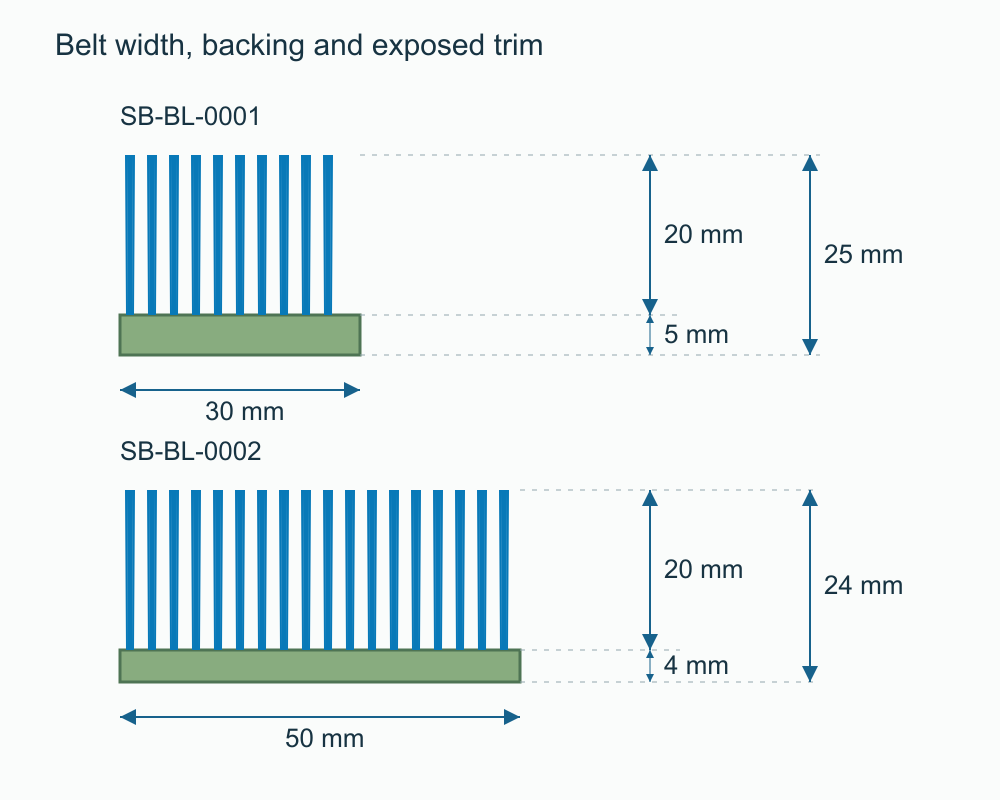
Reference sections: 30 × 25 mm overall for SB-BL-0001 and 50 × 24 mm overall for SB-BL-0002. The bristle-height dimension begins at the upper backing face.
Why does the supplier need the whole belt path?
The working straight run is only part of an endless installation. The belt also bends around end pulleys, returns through the machine and may encounter support rails or additional guides. A replacement can fit the open working area yet have inadequate space elsewhere. Draw all those elements, including which side of the belt contacts each one.
In a transverse cleaning arrangement, the brush belt can move across a conveyor surface and direct loose material toward one side. The working contact, collection side and lower return need to be understood together. A belt that fits the cleaning span but brings its tufts into a return-side obstruction is not a useful replacement. This is a circulating brush belt, not a cylindrical brush roller cleaning a conveyor.
In a narrow profile-cleaning station, a limited band follows an accessible edge or channel. The support or guide behind that band establishes where the bristles reach the product. Changing backing thickness can move the tips even when trim stays constant. The replacement enquiry should therefore include the guide section and the profile location, not just a request for a narrow brush.
In a workpiece-support or transfer arrangement, the tufted face carries or guides the product within the machine's support system. Two parallel brush belts may interact with one workpiece, so the belt paths and contact levels belong to the same layout. A single loose belt sample cannot establish the load sharing or product stability of the completed arrangement.
For each case, provide pulley and guide dimensions, the available adjustment, contact direction, operating conditions and relevant loading. The proposed backing, joints and fill must be considered together. The product pages do not publish a universal pulley diameter, tension or speed setting for every custom belt, so those settings must come from the specific brush and machine requirements.
Should I order open length, a prepared joint or a finished endless loop?
Choose the supply form around how the machine can be accessed. A finished endless belt may be appropriate where the machine permits the loop to be placed around the intended route. Where shafts, frames or fixed structures prevent that access, the maintenance plan may require an agreed joining arrangement. The fact that a product can be coiled for shipping says nothing about whether it arrives as an endless loop.
The SB-BL-0002 page explicitly describes open length, with end or joint configuration to order. Open length is therefore a meaningful quote scope; it is not a finished operating loop unless the required joining work is included. Ask who provides end preparation, any joining components, the joining operation and the dimensional check after joining.
A joint also has a working geometry. It may differ from the surrounding belt in thickness, local bending behaviour or tuft continuity. Show the nearest guides, pulley contact and working surface so that the proposed joint can be assessed in context. A gap between tuft groups at the connection could matter in a continuous wiping task even when the backing passes through the route.
Avoid specifying a preferred joint solely from a photograph of another belt. A connection suitable for one backing material may not define a suitable construction for another. Similarly, do not assume that an on-site joining method is available or permitted. Obtain the supplier's proposed joint drawing and the machine owner's installation requirements before committing to a supply form that depends on that work.
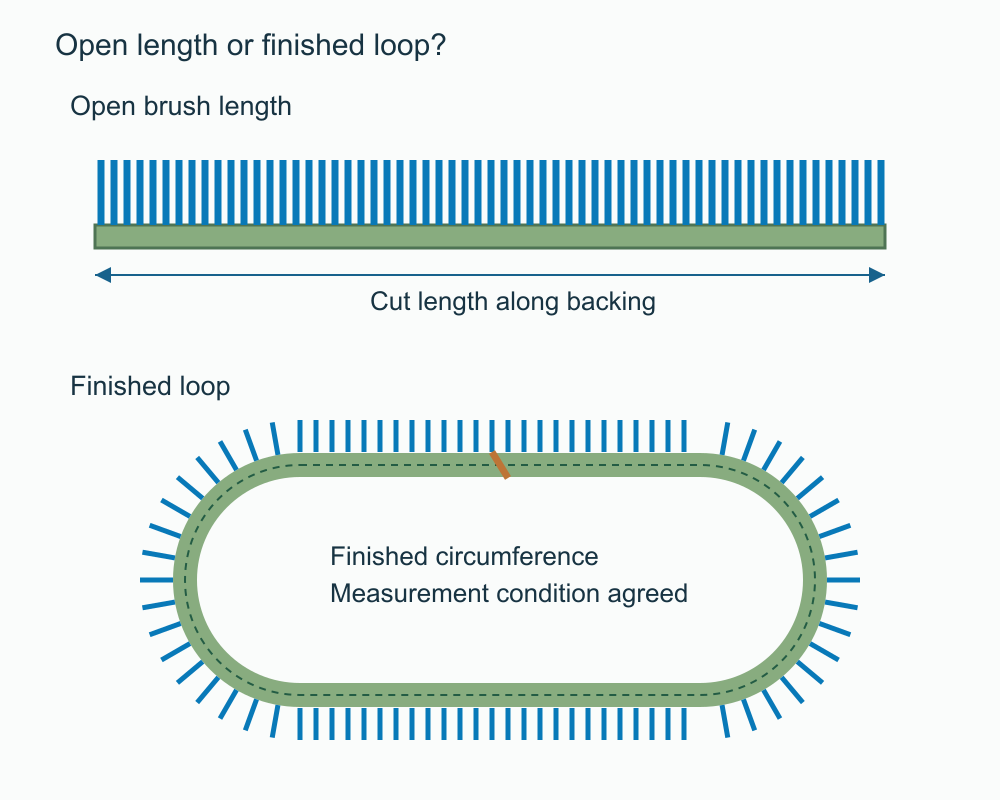
Open cut length and finished loop circumference describe different deliverables. A joining allowance cannot be inferred from this schematic.
Can I copy the length of the worn belt?
A removed belt is valuable evidence, but its measured condition needs explanation. Wear, stretch, a damaged joint or a changed adjustment position can separate the old measurement from the intended new configuration. Where an accepted drawing or previous order gives the length definition, use that as the starting point and reconcile it with the machine.
For open supply, state the required cut length measured along the specified backing reference. For an endless loop, agree how finished circumference is defined and measured, including the condition of the loop. A dimension over the tuft tips is different from a dimension along the belt backing. A storage-coil diameter measures neither.
If the accepted drawing is unavailable, send the complete path, the adjustment position used for measurement and the old belt's condition to the supplier. The technical review can then establish a new length definition. Do not shorten the measured old loop by an invented percentage or borrow pre-tension from an unrelated catalogue construction.
The distinction matters commercially. Suppose the installation needs three finished loops, each with an agreed circumference of 2.40 m. The finished-loop total is 7.20 m, but this is not automatically an order for 7.20 m of raw open strip. The proposed joint and end preparation determine what open material is required to produce each finished loop.
A clear order line is “three finished loops to drawing revision X, each 2.40 m at the specified measurement condition,” followed by the agreed section and joint. If the supplier provides prepared open lengths instead, the order must describe those lengths and the remaining joining responsibility. The quantity should not change silently from three usable assemblies to an unverified metre total.
What if the replacement fits the pulleys but cleans differently?
Mechanical fit closes only the machine-interface question. A different tuft layout, filament specification or trim can change where and how the brush contacts the product. Even a matching reference diameter of 0.30 mm Nylon does not define every material grade, tuft density or working contact condition.
For loose dust on a flat surface, coverage and the route by which particles leave the surface may control the result. At a profile edge, a wider contact band might reach the dirty region but also touch a protected film edge. In a support task, the concern may be stability or surface marking rather than removal. Describe the actual job rather than asking for a general “stronger” brush.
The belt-brush contact-layout guide develops that selection after the machine interface is understood. Keep the relevant workpiece and contact requirement with the replacement drawing. Otherwise a belt can be reordered accurately by length while losing the feature that made the previous version useful.
If a trial develops a local bump, rubbing or missed cleaning area, use the belt-trial troubleshooting guide. It separates a moving joint from a fixed machine station and from the working contact. That distinction prevents an edge-cleaning problem being answered with an unnecessary joint change, or a guide interference being answered by changing the bristles.
What should a complete replacement enquiry contain?
Provide photographs of the working face, running face, end section and existing connection, together with a machine-path sketch. Then identify these items explicitly:
Backing construction, section and required running interface.
Width, backing thickness, trim and tuft layout, with their measurement references.
Finished loop or open-length requirement and its measurement condition.
Joint/end preparation, installation access and who supplies the joining work.
Pulley/guide arrangement, adjustment and the actual operating environment.
Workpiece contact task and any protected surface or excluded area.
The supplier's response should tie those items to one proposed configuration. If a field differs from the accepted replacement, make that difference visible and use the substitution guide to decide what needs another comparison. A useful spare is the correct complete belt arrangement for its machine and task, not simply another length of blue brush.