
Belt Brush Contact Layout: Reach the Dirty Surface and Keep Clear of the Protected Edge
Choose a belt-brush contact zone from workpiece movement, target coverage and protected edges. Compare tuft layouts and define where removed debris should go.
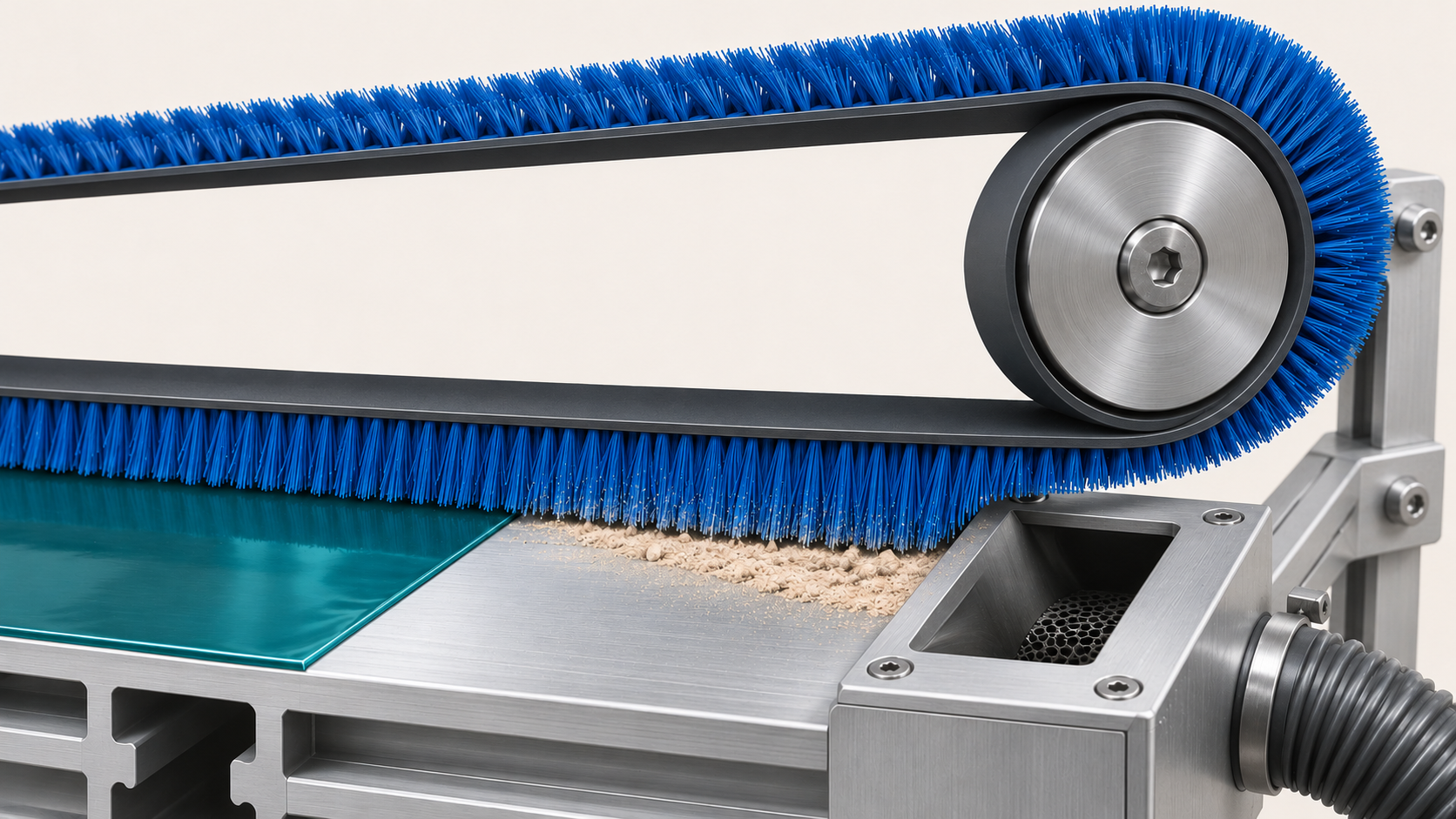
Choose the working bristle zone from the surface that needs contact, the surface that must remain untouched and the way the workpiece moves. Belt width alone cannot define that zone. The backing may be wider than the active tufts, the workpiece may shift within its guides, and bent filaments may reach beyond their free-tip outline.
For a cleaning task, also identify where the removed material should go. Moving dust from a target patch onto the next product is not a complete cleaning result. A useful candidate must combine coverage, suitable contact and a credible debris route within the existing machine arrangement.
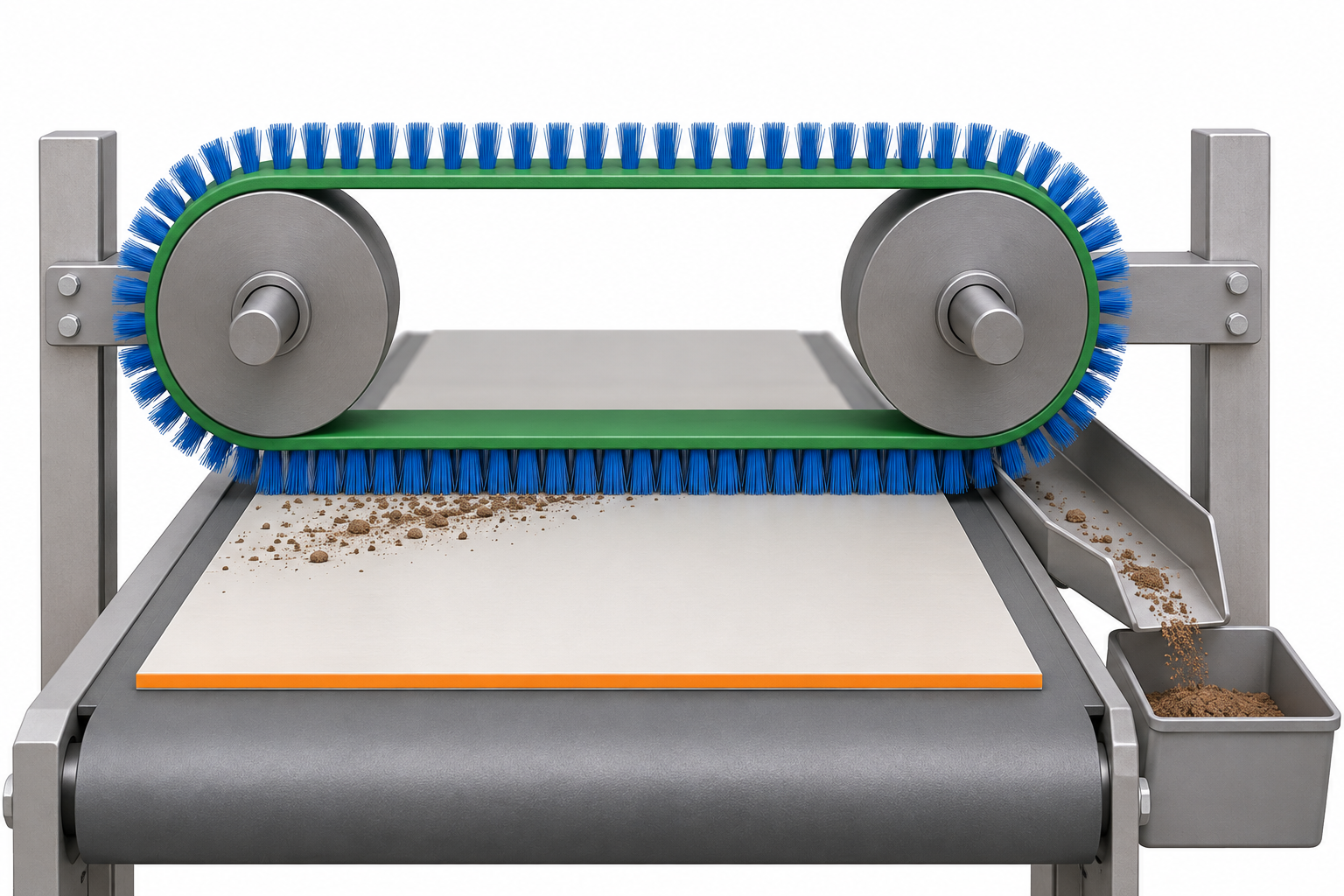
Transverse-cleaning station illustration. The circulating belt carries the bristles; its lower run contacts the work. The collection side is part of the layout, not an assumed consequence of choosing a larger brush.
Is the job cleaning, conveying or positioning the workpiece?
These functions can use similar-looking belt brushes but ask different questions of the fill. Cleaning requires useful contact with the residue and a way for that residue to leave. Conveying or support requires the intended product movement and suitable stability. Positioning may rely on distinct areas of contact instead of a continuous brush face.
Mink's flat-belt brush documentation describes transverse cleaning and conveyance, with configurable bristle arrangements. Its belt brochure also illustrates the role of directional and segmented filling. These are examples of matching the brush surface to a task, not evidence that one standard layout performs all three functions equally.
In a cross-cleaning station, a brush belt acts across a conveyor or product surface. The contact direction and the available exit side matter. In a guided profile-cleaning station, the brush may need to reach a narrow band beside a protected edge. Here, small changes in product position can be more important than total cleaning width. In a transfer or positioning arrangement, deliberate gaps or tuft segments may help the intended interaction, but those gaps can be undesirable in continuous wiping.
Name the main task before comparing materials. A belt proposed for light loose-particle removal has not automatically been selected for adhered residue, abrasive finishing or carrying the same workpiece. The required result belongs to the actual application.
How wide should the active bristle band be?
Start with the target region on the workpiece, then put it into the machine's position range. The active band must reach the target at each required position without entering any excluded region. This is a geometry problem before it becomes a material choice.
Consider a guided profile whose target band occupies x = 4 to 22 mm at its nominal position. The x-coordinate is measured across the contact zone from one fixed machine datum. If the profile can move 2 mm either way, the full target envelope is x = 2 to 24 mm. That envelope combines the extreme positions; it is not a wider dirty strip on every individual part.
Suppose a protected edge starts at x = 28 mm nominally. With the same sideways position range, its nearest location is x = 26 mm. The brush therefore needs to cover through x = 24 mm while staying clear of the protected region beginning at x = 26 mm. These are example dimensions for explaining the decision, not dimensions assigned to a Spirvobrush product.
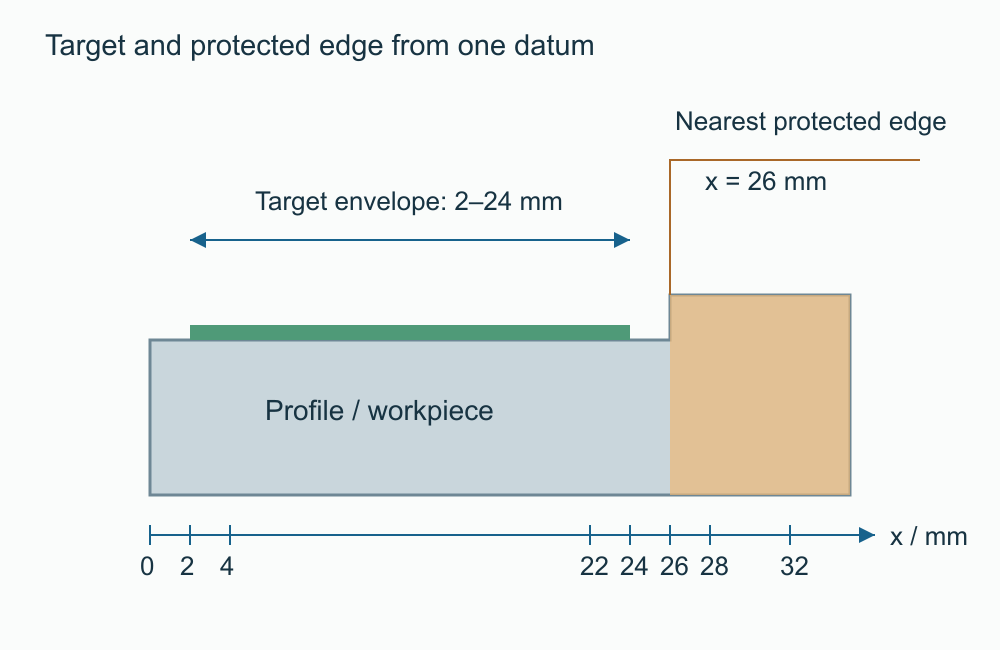
Example geometry in machine coordinates. The target envelope ends at 24 mm and the nearest protected edge begins at 26 mm. Position variation belongs in the layout before the brush is ordered.
Now compare three hypothetical observed contact bands under defined candidate conditions:
Candidate contact band | Coverage of the 2–24 mm target envelope | Relation to the protected region at 26 mm |
|---|---|---|
A: 4–22 mm | Misses 2 mm at each extreme of the envelope | Does not reach the nearest protected boundary |
B: 1–25 mm | Covers the complete envelope | Leaves a nominal 1 mm separation |
C: 1–27 mm | Covers the complete envelope | Enters the excluded region by 1 mm |
A is too narrow for the stated position range. C reaches the target but violates the geometric exclusion. B can advance to further comparison, but its 1 mm separation is not an approved clearance: positioning uncertainty, contact spread, workpiece variation and the relevant acceptance requirement still need to be resolved.
This example deliberately describes contact bands, not nominal backing widths. A catalogue width does not demonstrate the operating footprint of deflected filaments. Establish that footprint using a suitable assessment for the actual surface and setup.
What makes the contact band different from the backing width?
Tuft locations determine where bristles start. Free trim, filament properties, contact direction and engagement affect how those bristles bend and where they touch. Empty margins or gaps between tuft rows can also matter. A belt's outer backing edges are therefore useful mounting references, but they are not a complete map of working contact.
The SB-BL-0001 narrow blue Nylon belt brush lists a 30 mm reference width, 20 mm trim and 0.30 mm filaments, arranged in multiple tuft rows. Its page allows the tuft layout and spacing to be configured. Those details identify the candidate; they do not establish a 30 mm continuous effective cleaning band on every surface.
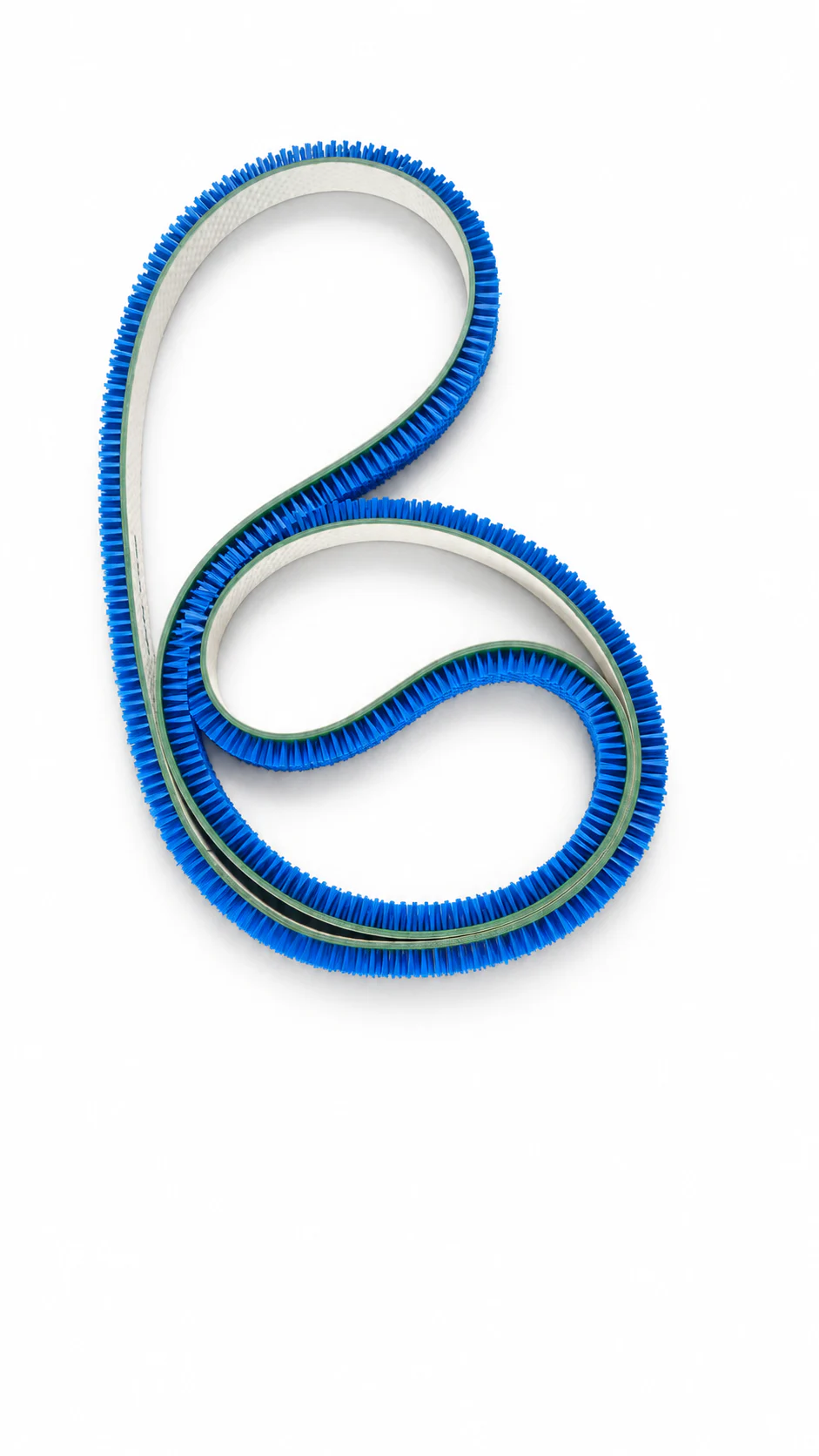
Individual tuft groups are visible on SB-BL-0001. Their free arrangement is one input to contact; the loaded contact region must be assessed for the actual workpiece.
The 50 mm-wide SB-BL-0002 reference also lists 20 mm trim and 0.30 mm Nylon, but a different width and backing thickness. Selecting the wider reference may enlarge the potential contact area, yet it can also affect the machine envelope and protected regions. “More width” is not a complete response to one missed edge.
Where the workpiece has a groove, step or curved face, show that section. A flat projected band can conceal a recessed surface that the tips do not reach, or a raised edge that takes contact first. The product shape, not only a plan-view width, determines whether a candidate reaches the intended region.
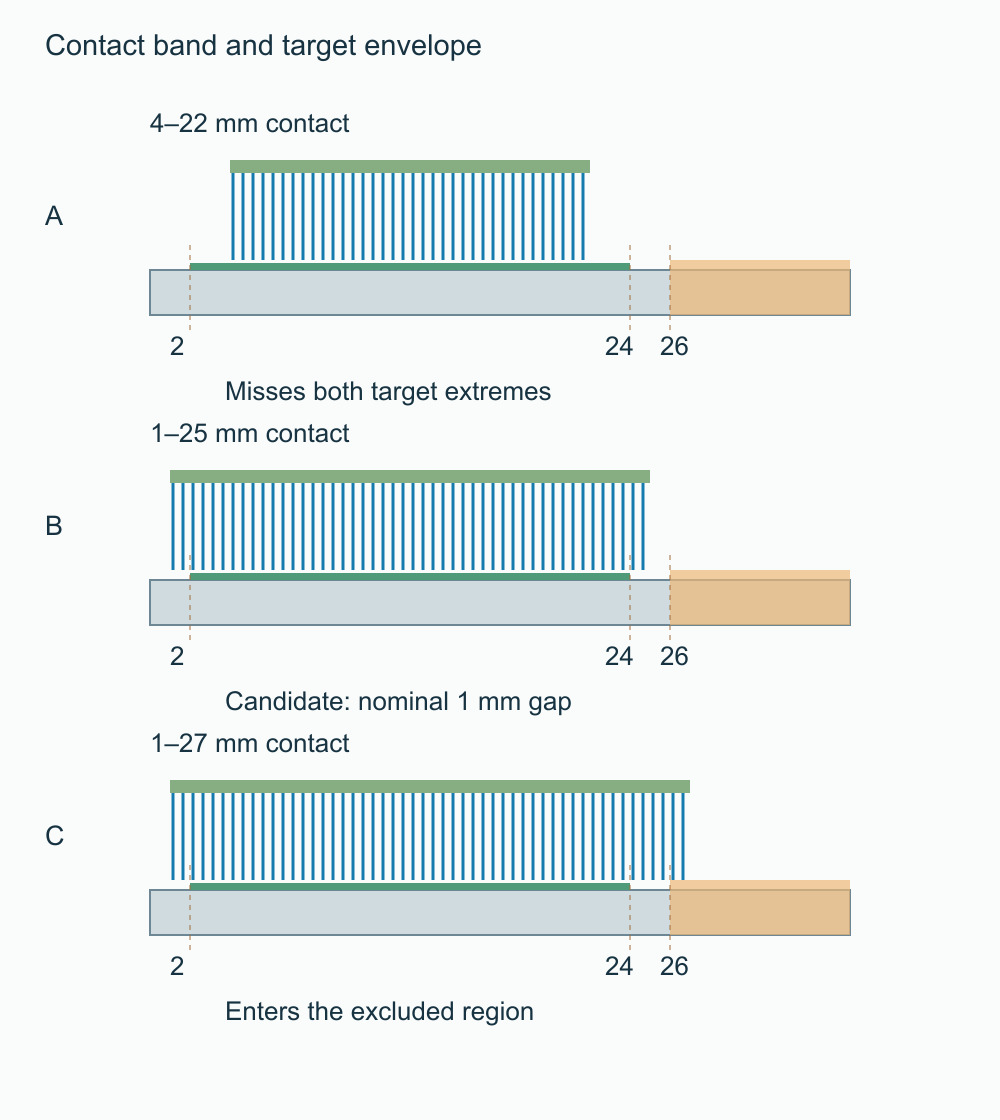
The three sections use the same example target and exclusion boundary. A misses coverage; C touches the excluded region; B remains a candidate requiring the real contact and uncertainty checks.
Where will a transverse brush belt send the debris?
Trace the path from the original residue to the intended collection point. The contact should move material toward an accessible destination, and the surrounding machine must allow it to leave. A sidewall, adjacent product or poorly placed opening can interrupt that path even when the first contact appears effective.
For dry loose particles on a broad conveyor surface, identify the collection side and inspect whether material remains at the edge or returns to the useful surface. For a shaped profile, a brush may remove material from an exposed flat but move it into a neighbouring recess. The observation should distinguish the cleaned target from the newly contaminated region.
Residue type also changes the task. Loose dust and granular fragments do not behave like a film that adheres to the surface. State what the residue is, where it originates and whether it is dry, damp, oily or sticky. A different material or contact arrangement may be needed, but a stronger brush should not be prescribed from the word “dirty” alone.
Consider the complete belt cycle. Material retained among the tufts can travel into another part of the route. The machine's collection and brush-cleaning provisions therefore belong in the application discussion. This does not imply a universal self-cleaning method or a permission to add one; it explains why the return path is relevant to the cleaning result.
If the surface looks clear directly after contact but material appears downstream, compare those locations under the same observation conditions. Otherwise the candidate can appear successful only because the inspection stops before the debris arrives at its new destination.
Should I change filament material, trim or tuft spacing first?
Start with the failure to be corrected. A missing geometric region points first to location and reach. Contact marks on a protected surface call for examination of where and how contact occurs. Residue left within a reached region asks a different question about the brushing action and the residue itself.
Filament material is only one variable. Diameter, free length, tuft density and pattern also affect the contact. Shortening trim can reduce reach while changing bending behaviour. Increasing the amount of fill may change coverage and the available space between tufts. Changing several of these together creates a different complete candidate, so a better result cannot automatically be credited to material alone.
SEALEZE's filament-selection guidance separates properties such as abrasion, recovery after bending and behaviour in wet conditions. That distinction is useful when describing a belt-brush task too, although its material descriptions do not specify the performance of a Spirvobrush belt assembly. Include the actual cleaning medium, temperature and moisture condition when asking for a proposal.
For example, a dry-dust comparison cannot establish the same result after the process changes to damp residue. A candidate that avoids marks on an unfinished profile may still require a different assessment on a sensitive coating. Keep the surface and incoming residue representative of the purchase's intended scope.
How should I compare two contact candidates without confusing the result?
Use the same defined target, protected region and incoming workpiece condition. Identify the complete candidate: backing and support, fill material, filament diameter, trim, tuft pattern and the relevant permitted setup. Then distinguish three outcomes: target coverage, cleaning result within the covered region, and effect on the protected or contacted surface.
Suppose B from the geometry example covers the full target but leaves some residue in a recess. It has answered the width question, not the cleaning-action question. A revised section or contact arrangement may be needed to reach inside that feature. If C cleans the target but marks the protected edge, greater removal has not made C acceptable for that job.
A practical comparison also includes the relevant product positions and entry/exit situations. Looking only at a central stationary contact can miss an edge that arrives first or shifts later in the route. The machine owner determines the permitted procedure and criteria for the actual application; this article does not set a general speed or interference depth.
If candidates require different permitted setups, compare them as complete configurations. That can still answer which proposal works for the job, but it does not isolate the effect of one filament property. Use the trial-failure guide if the comparison reveals route rubbing or a joint disturbance instead of a contact issue.
What contact information should accompany the belt-brush order?
Send a workpiece section and plan with the required contact band, excluded surface and position range. Describe the residue and its intended destination. Name the support and guide that establish the brush-to-part relationship, then state the proposed fill configuration and relevant environmental conditions.
For the 2–24 mm example, the next enquiry should ask for a candidate that covers that envelope while respecting the nearest protected boundary at 26 mm. It should not request a “24 mm brush” without explaining the datum or assume that B's nominal 1 mm separation is sufficient.
The replacement-belt guide carries the machine interface, length and joint. Keep this contact definition with it so that future orders preserve both sides of the arrangement. The useful result is a brush surface that reaches the right place, produces the required effect and sends the removed material somewhere acceptable.