
Belt Brush Trial Failures: Is the Problem at the Joint, the Guide or the Workpiece?
Locate belt-brush trial failures by the moving joint and fixed machine station. Distinguish pulley and guide interference from missed workpiece coverage.
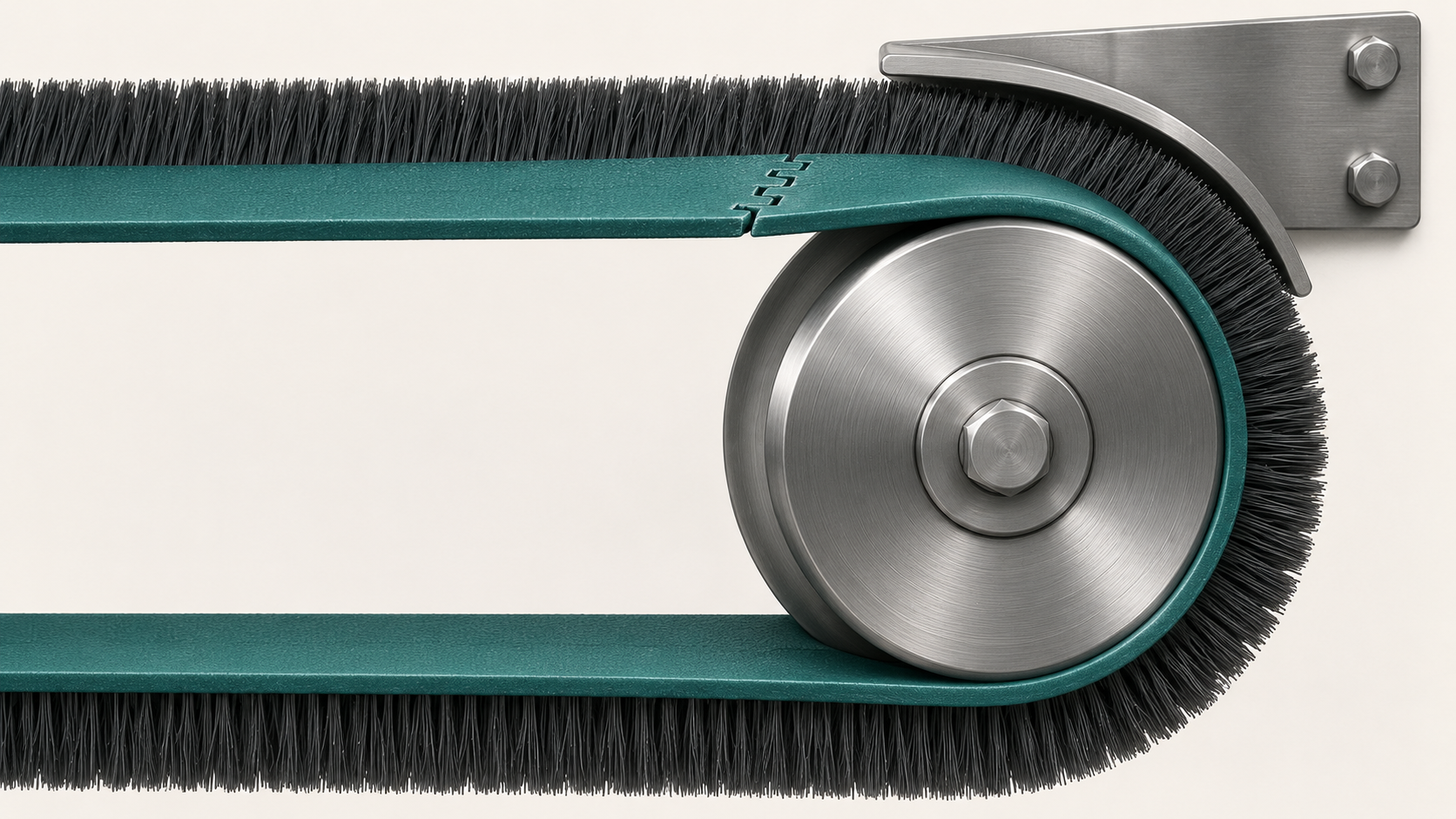
Locate the symptom in two ways: where it occurs on the machine, and which part of the moving belt is there when it happens. A bump at an end pulley can involve the joint, that pulley interface or both. A belt that runs smoothly but leaves a dirty edge has a different problem. These observations lead to different replacement decisions.
The useful question is not simply whether the trial passed. It is what physical relationship failed: the belt against its route, the joint passing a particular feature, or the bristle face against the workpiece. Keep those questions separate long enough to identify a change that addresses the symptom.
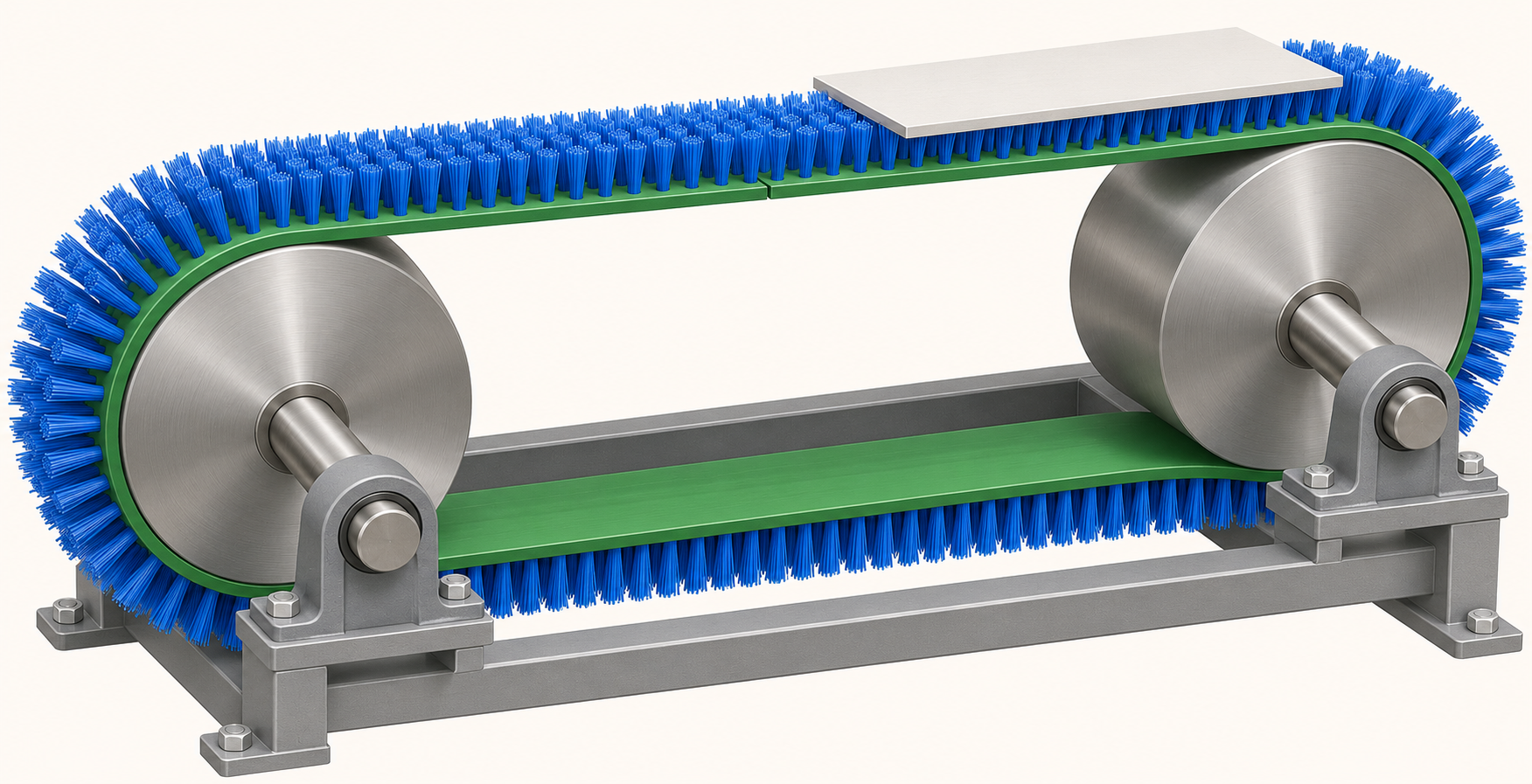
Full-route illustration. Include the return and both end turns when investigating a replacement; the working straight run is only one part of the installation.
Does the disturbance follow the joint or stay at one machine location?
Give the connection a moving identity, such as J. Give fixed stations separate names: W for the workpiece contact, R1 for one return feature and R2 for the other. These are observation references, not additional parts to fit to the machine. Use the equipment's approved observation arrangements; close inspection and handling belong under the required isolation procedure.
If a disturbance occurs whenever J reaches R2, both identities matter. The connection may have a local geometry that interacts badly with R2, but the observation alone does not prove that the joint is defective. Another pulley or guide may accept the same region without a symptom. Compare the proposed joint drawing with the particular interface where it fails.
If different sections of the belt show the same disturbance at R2, the pattern points toward a feature associated with that station. A local obstruction, support transition or incompatible contact geometry needs examination. It would be premature to order another copy of the same joint merely because the bump is periodic.
Conversely, if the symptom travels with the same region through several locations, investigate what is distinctive about that belt region. The joint, a damaged backing section or a local tuft difference may deserve attention. Repetition helps locate the relationship; it does not replace the inspection that establishes the cause.
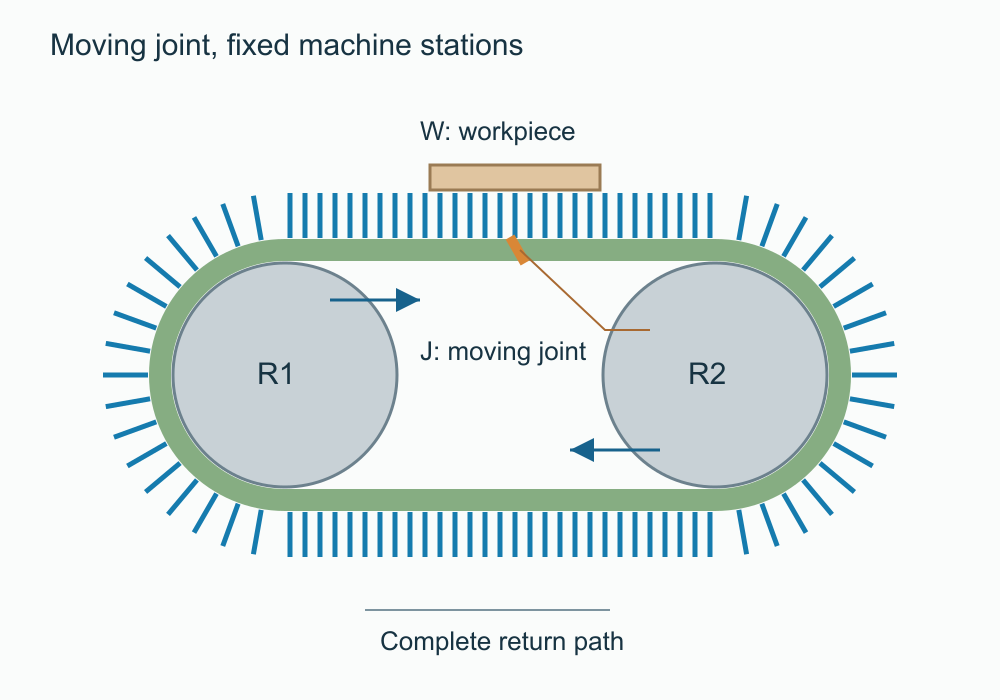
J moves with the brush belt. W, R1 and R2 remain attached to machine locations. Record the pair together when interpreting a recurring symptom.
What should I inspect when the joint lifts or bumps at a pulley?
Compare the connection region with the adjacent belt. Relevant differences can include local thickness, alignment of the joined edges, the way the backing bends and the continuity of the tufted face. Which difference matters depends on what the joint contacts at the troublesome location.
At a pulley, the backing must follow the curved route. A local connection can behave differently from the surrounding flexible length. At a nearby guide, an increase in thickness or a displaced edge may instead be the important feature. A raised appearance at one instant is therefore an observation to explain, not a reason to prescribe a universal tension adjustment.
Consider a replacement on which J passes one end turn without a visible disturbance but rises at R2. The useful supplier enquiry includes the joint section, its orientation, the R2 profile and the space around the joint during that turn. A short video from the approved observation position may help locate timing, while photographs taken in the proper stopped condition can explain the surfaces involved.
Ask the supplier and machine owner to compare the proposed joint with the actual route. Possible outcomes include revising the connection, revising an incompatible route detail where the machine permits it, or selecting a different complete backing/joint configuration. The right answer is not automatically “make the joint thinner”: a dimensional change can also change the connection's construction and suitability.
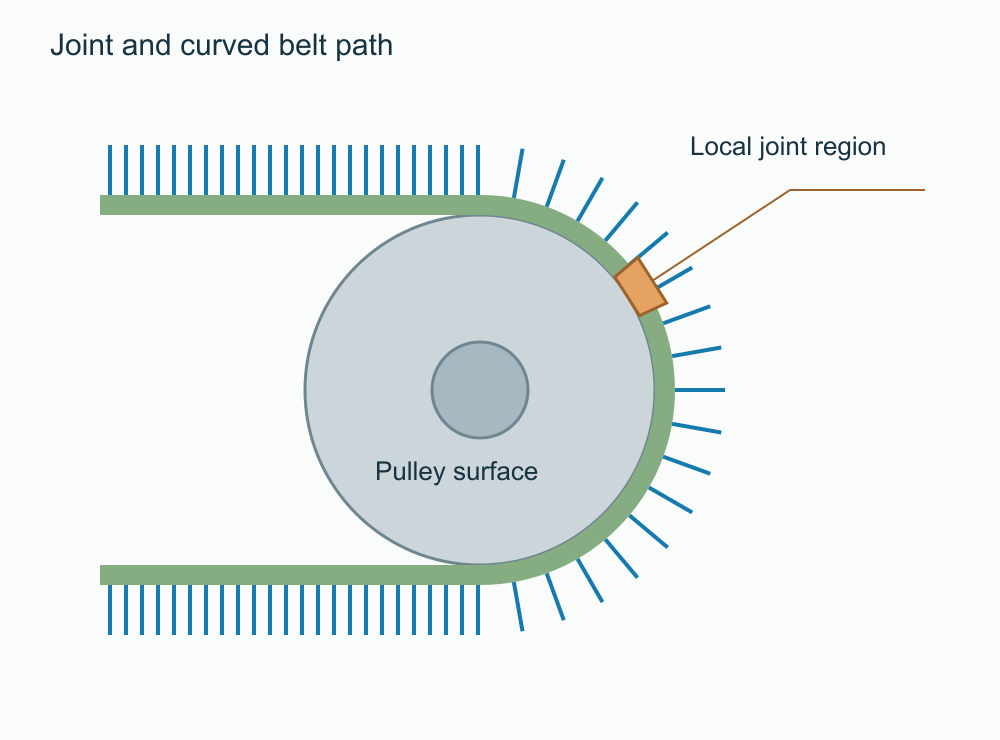
Joint-and-pulley section. The enlarged connection is deliberately visible to explain the interface under review; its shape and thickness are illustrative, not a recommended joint.
The replacement specification guide establishes the required running face and supply form. Return to that definition when a connection changes. A trial repair that produces a different connection should not disappear into an order still naming the earlier joint.
Why does the belt rub a guide even though its nominal width matches?
Nominal width is only one part of the fit. The actual backing section, receiving guide profile, local alignment and any connection that passes through the area affect contact. A 50 mm belt is not defined completely by writing “fits a 50 mm path.” The relevant drawing must show where the machine supports it and where clearance is required.
The SB-BL-0002 wide blue Nylon belt brush has a reference 50 mm width, 4 mm backing and 20 mm trim. Its supplied open length and ordered end configuration remain separate fields. A buyer investigating a replacement needs those backing and connection details as well as the brush height.
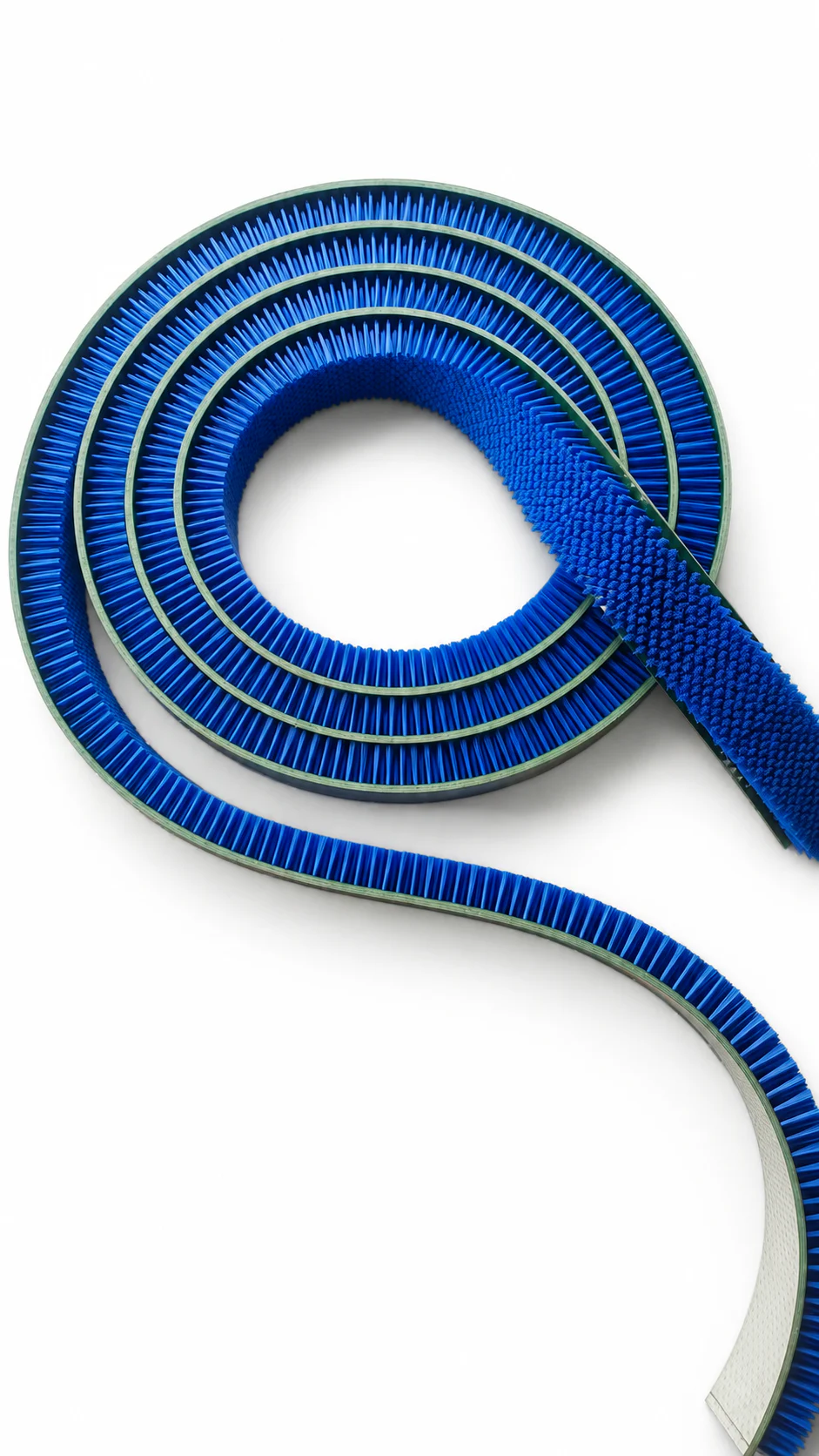
The exposed backing and free end help identify the interfaces. The coiled product photograph does not establish compatibility with a particular guide or pulley.
Look for the location and direction of physical evidence under the permitted inspection procedure. A repeated witness line along one edge, a mark on the rear face and damage confined to the connection represent different contact locations. They can narrow the inspection, but a witness mark alone does not establish the full operating cause.
A guide transition can also matter even when its long straight section appears suitable. The belt may meet a local edge at entry, pass a fastening detail or move from supported to unsupported backing. Show that transition in the enquiry instead of providing only a distant photograph of the whole machine.
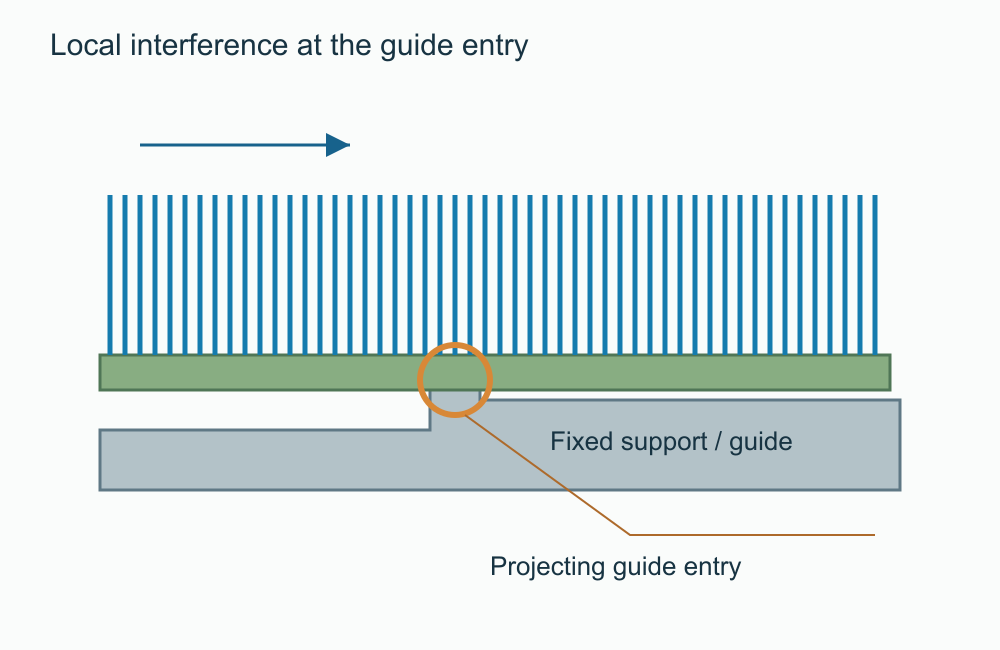
Local guide-entry illustration. The highlighted area is a possible contact location to investigate. It does not mean every side guide should be removed or enlarged.
Do not answer edge rubbing by immediately changing the bristle material. That may leave the contacting backing unchanged. Equally, do not move a guide merely because it leaves a mark: the guide may perform a necessary tracking or support function. The review must preserve that function while resolving the incompatible contact.
What if the belt runs smoothly but misses a workpiece edge?
A smooth route shows that the observed machine interaction is different from a contact-coverage problem. It does not show that the brush reaches every required region. Check where the working bristle band lies relative to the target surface through the allowed workpiece positions.
In a profile-cleaning job, the part may shift sideways within its guides. A band that covers the nominal centre position can leave a narrow edge untreated at one extreme. Widening the fill might solve that coverage problem, but it could also reach a protected film edge. The contact-task guide compares those competing boundaries.
In a transverse cleaning station, loose material may move off the target patch but remain on the neighbouring surface or return downstream. That is a debris-destination problem, not proof that the joint is wrong. Inspect the route from the original residue location to the intended collection area.
In a product-transfer arrangement, the symptom may instead be instability or a surface mark. A smooth-running belt has not established suitable support for every workpiece. Compare the contact footprint, fill configuration and load situation associated with the symptom rather than importing a cleaning criterion into a support job.
Should I change tension, pulley size or bristle height first?
Start with the identified interface, not a favourite adjustment. Tension and pulley size belong to the specific belt construction and machine. Bristle height belongs to both the contact task and the available envelope. Changing one can affect more than the location where the symptom was noticed.
Mink's belt-brush documentation separates technical data by belt construction. That is a reason to request the applicable limits for the actual candidate, not to borrow a value from a different product. The Spirvobrush reference page asks for the machine layout and conditions; it does not offer one universal setting that fixes all replacement trials.
If the backing rubs a fixed guide, reducing trim alone does not remove that contact. If the joint raises the local envelope, changing all the tuft rows may miss the relevant geometry. If the working band misses a surface while the route is satisfactory, modifying the joint is unlikely to answer the actual coverage question.
Where several changes are necessary, treat the result as a changed configuration. A different backing, connection and contact setting tested together can provide a useful complete solution, but it cannot establish that one isolated change caused the improvement. Preserve enough identity to order the same combination again.
How do three different trial observations change the next purchase?
Consider an enquiry for loop L-A, with joint drawing J-02 and route drawing M-04. Using these example identities, consider how the following possible observations would change the replacement decision.
Observation | What it directs you to inspect | What the next request should contain |
|---|---|---|
J rises when it passes R2; adjacent belt sections do not show that event | Joint geometry against the R2 interface | Joint section, R2 profile, contact timing and the proposed revision |
Several belt sections rub at the same guide entry | Fixed entry geometry and the passing backing envelope | Guide-entry section, exact backing definition and relevant witness locations |
Route is satisfactory, but the required product edge remains untreated | Workpiece position and working fill coverage | Target region, protected region and a revised contact candidate |
For the first case, a supplier might propose J-03 while retaining the accepted belt section. The next sample must actually contain J-03, and the affected route positions need checking. For the second, a machine-side detail may be the proposed change; purchasing should not silently order a different belt simply because the work is urgent. For the third, the request belongs to the fill/contact configuration, with the already satisfactory route kept in view.
If a change has consequences elsewhere, include those locations in the comparison. A connection that passes R2 but creates a discontinuity at the working contact has not resolved the whole task. A wider fill that reaches the target but touches a protected edge has introduced a different failure.
What information makes a failed-trial enquiry useful?
Send the actual configuration and the symptom location together: belt section and running face, joint/end drawing, complete route, relevant workpiece and the point at which the problem appears. Include photographs or observations that distinguish the moving belt region from the fixed station.
Describe what remained satisfactory as well as what failed. That helps avoid replacing every feature when the evidence concerns one local interface. It also prevents a successful straight run being used to dismiss an unresolved return or contact problem.
The purchasing outcome should be a named revised part or assembly that addresses the identified relationship. When a replacement proposal changes the accepted construction, the substitution guide helps keep the alternative's scope clear. A failed trial becomes useful when it narrows the next physical change, rather than producing another order for a belt that merely looks similar.