
Industrial Brush Spares: Will the Right Replacement Be Ready for the Shutdown?
Plan compatible brush spares by usable date. Check complete changeout parts, reserved stock, coil packing condition and split receipts before adding another order.

Plan usable brush replacements by the date they are needed, with the exact configuration and complete changeout scope attached. Enough pieces in stores and on order do not prevent a shortage if some are reserved, damaged, incompatible or released after the shutdown starts.
The useful purchase decision is often more specific than “buy more spares.” It may be to bring one existing item forward, obtain a missing companion part, correct the delivered configuration or protect a long coil so it arrives usable. Start with what the maintenance job can actually install.
What counts as one usable spare for this maintenance job?
A spare is a compatible replacement unit in an acceptable condition, available for the named task. A brush category, photograph or similar overall size is not enough to establish that identity.
The SB-SC-0019 brass inward coil gives a concrete example. Its reference has 175 mm overall axial length, 50 mm coil outside diameter, 17 mm pitch, 5 mm free bristle opening, 0.20 mm brass wire and a 3.8 × 3.9 mm galvanized-steel channel. The channel ends and support arrangement also matter when replacing a retained coil.

SB-SC-0019 product reference. Match the approved coil identity, including its end and support details; the free opening is not a universal rod-fit instruction.
A shorter coil with the same outside diameter may not occupy the same holder. A different pitch changes where the turns sit along the axis. A different free opening or fill changes the contact candidate even if the body enters the support. These distinctions determine whether a stock item can be allocated, not just how it is described in the store list.
Where geometric suitability is unresolved, use the inward-coil sizing guide before counting the item as a replacement. The availability calculation begins with a compatible configuration; it cannot turn an unassessed substitute into one.
Is the brush alone enough to complete the changeout?
Check the actual maintenance bill of materials and retained-component condition. A replacement coil may reuse the holder and fixing parts. If those retained parts are missing or unsuitable, a released coil alone does not make the job ready.
For a sleeve roller, the corresponding question concerns the shaft, end retention and any required adapter. For a split assembly, it may concern the matching segment set. For an inward coil, the mounting space, access route and retained end-location features can determine whether the planned work is feasible.
Do not assume every required component is consumed at every change. Separate the reusable parts that must be available from the new parts the job actually needs. If a new holder is genuinely required, add it with its own identity and date rather than hiding it inside a brush quantity.
Also distinguish maintenance jobs from brush units. One job may consume more than one brush, while another may replace only a local element. Convert each job into the compatible quantities before adding demand over time. The example below uses one brush per listed requirement solely to keep the arithmetic visible.
Why can six physical brushes mean only four available?
Physical possession and free allocation are different states. An approved correct spare already reserved for another job is not free for the next shutdown. A quarantined item with unresolved condition or identity is not a usable spare merely because it occupies a shelf.
Consider an illustrative plan with six physical brushes of one configuration. One is quarantined and one is reserved for another job, leaving 6 − 1 − 1 = 4 free released brushes. A confirmed order contains four more, planned to complete receiving checks and become usable in week 3.
The quarantine reason should be specific enough to resolve: a damaged channel, uncertain part identity or a required disposition are different cases. The planner should know which issue prevents use, without assuming every held item can be recovered in time. Reallocating a reserved spare also moves a shortage risk to the other job unless that job's need changes.
Keep alternative configurations in separate groups until their compatibility is established. A store total combining several inward coils can conceal a shortage of the one end arrangement required at the affected machine.
How can the total be enough but week 2 still be short?
For a four-week planning example, assume the maintenance schedule specifies the following seven replacement requirements.
Period | Opening projected balance | Usable receipts | Demand | Closing projected balance |
|---|---|---|---|---|
Week 1 | 4 | 0 | 2 | 2 |
Week 2 | 2 | 0 | 3 | −1 |
Week 3 | −1 | 4 | 0 | 3 |
Week 4 | 3 | 0 | 2 | 1 |
Free opening stock plus incoming supply is 4 + 4 = 8, while demand is 2 + 3 + 0 + 2 = 7. The eventual balance is one, but week 2 has an uncovered requirement. The projected −1 represents backlog, not negative physical stock. The week 3 receipt first covers that carried requirement.
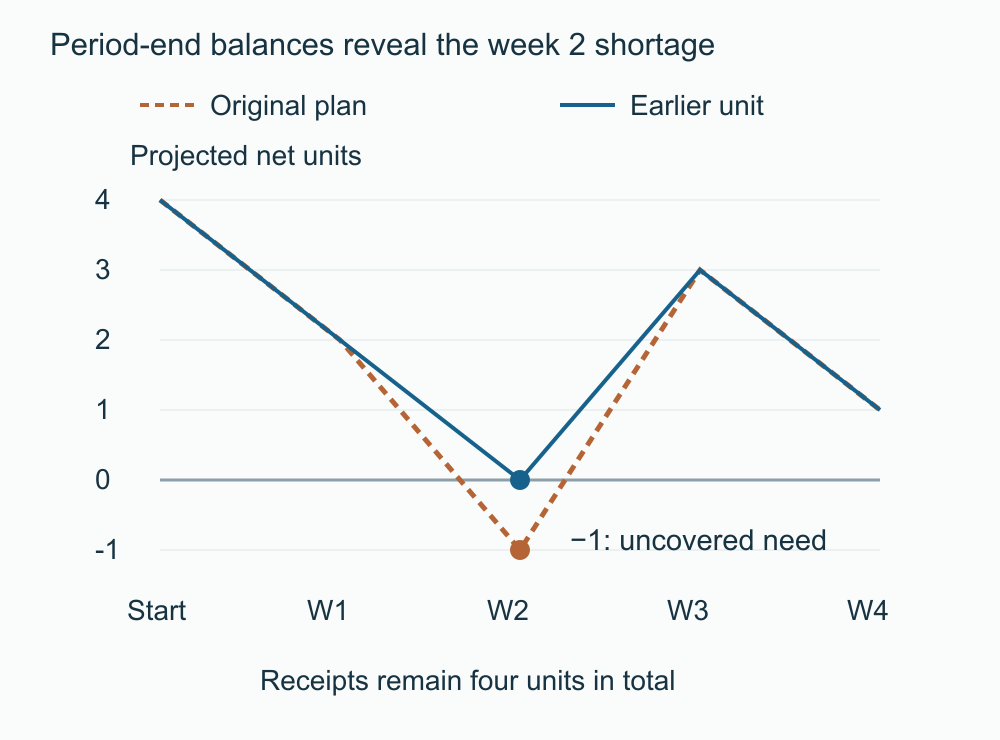
Conditional quantity plan. The revised line brings one of the existing ordered units into week 2 and leaves three for week 3; it does not add another unit to the order.
A weekly bucket is only sufficient when it resolves the actual due dates. If receipt and shutdown occur in the same week, compare their day and relevant time or sequence. An arrival after the work starts cannot cover it just because both events share a week label.
The schedule is not executable as originally written. It also contains no additional emergency reserve or demand from another configuration. Add those requirements explicitly when the maintenance owner identifies them; the final balance of one should not silently be assigned several purposes.
Can an earlier split shipment solve the shortage without increasing quantity?
First examine whether one of the four already ordered brushes can be delivered, checked and made usable before the week 2 requirement. If that is feasible, the other three remain assigned to week 3.
Period | Opening projected balance | Revised usable receipts | Demand | Closing projected balance |
|---|---|---|---|---|
Week 1 | 4 | 0 | 2 | 2 |
Week 2 | 2 | 1 | 3 | 0 |
Week 3 | 0 | 3 | 0 | 3 |
Week 4 | 3 | 0 | 2 | 1 |
Receipts still total 1 + 3 = 4. All seven requirements are covered and the ending balance remains one. This is a timing change to an existing commitment, not a new purchase of five incoming brushes.
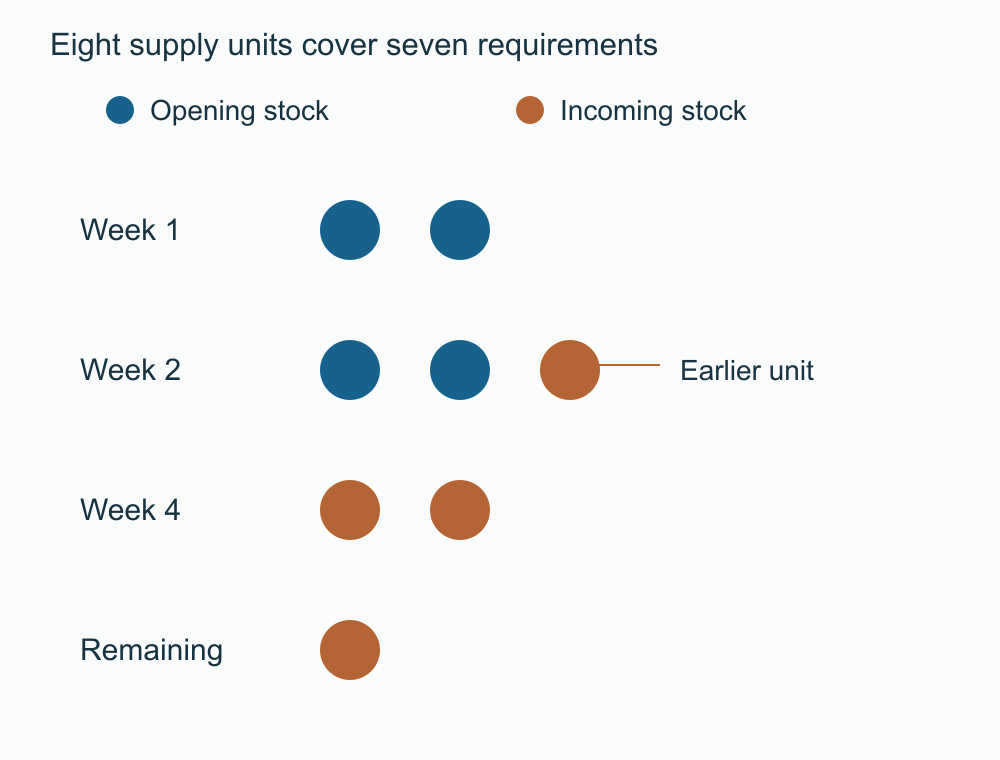
Allocation under the revised plan: four opening units and four incoming units cover the seven requirements. The early incoming unit is assigned to week 2, not counted again in week 3.
If an earlier split is unavailable, an additional compatible unit usable before week 2 can close the shortage. With the original four still arriving in week 3, the ending balance becomes two. Compare that additional commitment with a feasible maintenance-date change or another accepted supply route.
Do not count an expedited new unit and an early unit from the existing order as the same remedy. Each has a different effect on total purchases and the final balance. Keep the supplier's revised quantities attached to the individual release dates.
What date should the supplier actually be asked to meet?
Separate production completion, dispatch, physical arrival and the date the item can be used after the required receipt checks. The maintenance need is the final one. An earlier dispatch can help, but it does not itself close a usable-date shortage.
For the coil example, incoming checks can include the correct configuration, axial form, channel ends, pitch relationship and packing condition as required by the accepted specification. If a discrepancy needs a decision, the item remains unavailable until that decision permits use.
There is no universal inspection allowance to add to every brush delivery. Use the actual receiving work, resources and escalation route. A small early shipment arriving when nobody can inspect it may still miss the maintenance need.
Ask the supplier for the exact part and quantity in each proposed shipment, the expected arrival basis and remaining uncertainty. Internally, establish whether the required receiving and preparation work can finish before the due event. The inward-coil changeout guide connects the available replacement with the physical maintenance task.
How can packing damage turn an on-time coil into a late spare?
A long coil must preserve its axial form and the position of its turns. If handling changes that form, the delivery can be on time while the part is not ready to install. Ends can also catch on adjacent pieces, and local fill can be displaced.
The SB-SC-0019 page specifically asks for support along the metal channel and separation between adjacent coils during handling. Specify the actual protective arrangement with the supplier for the ordered size and transport. A generic carton count does not describe how the part's working geometry is protected.
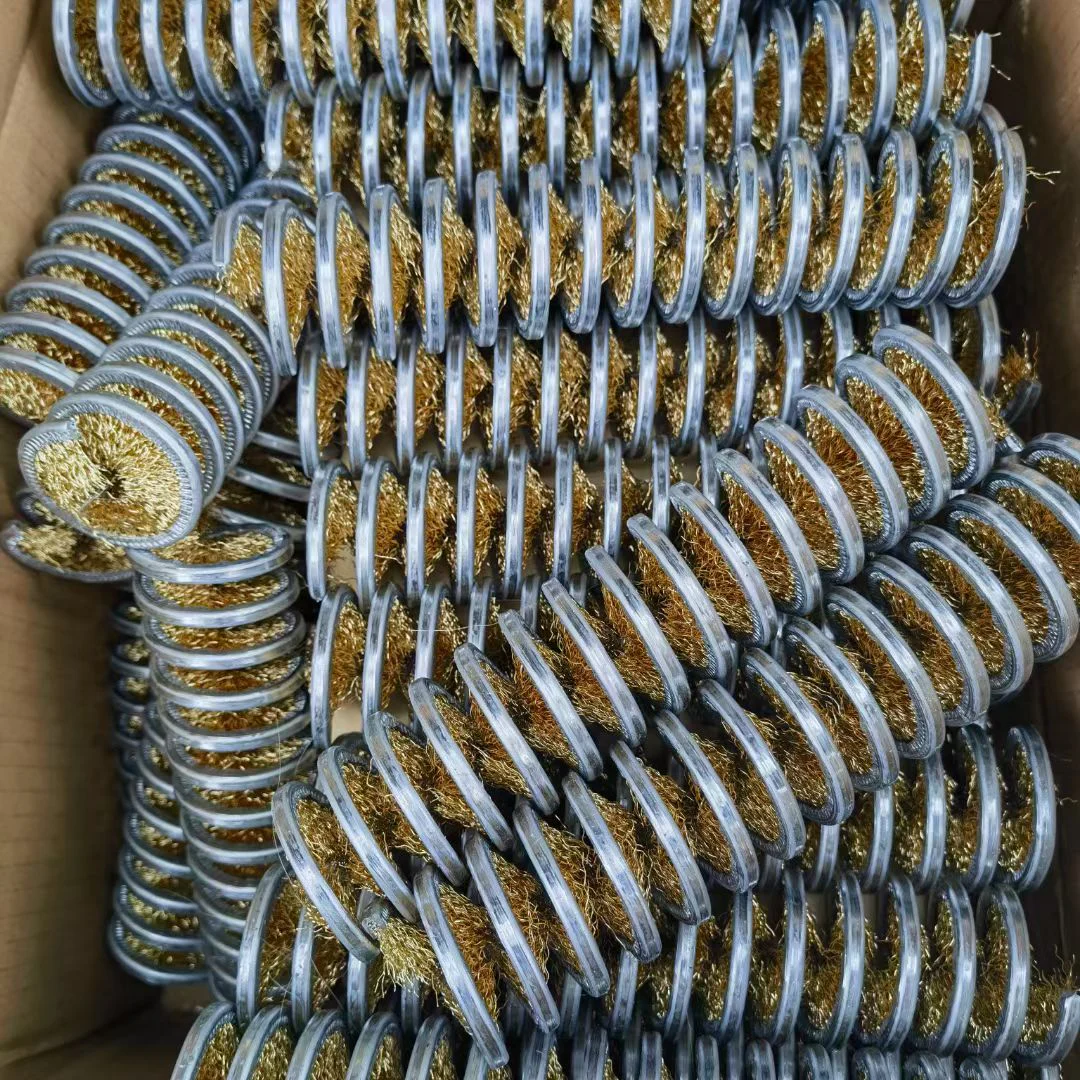
Manufacturer's same-family carton reference. The actual order needs an agreed protection and identification arrangement; a packing photograph alone does not establish the condition or release of a delivered spare.
At receipt, distinguish a dimensional discrepancy from apparent handling damage and preserve the relevant identification. Do not restore a distorted coil by improvising a change to its length or pitch and then treat it as the accepted part. The supplier and responsible technical owner need to resolve the condition against the actual specification.
Storage should preserve the same identity and protected geometry until use. An initially accepted item can become unsuitable if its ends or fill are damaged later. The allocation sheet should reflect current condition, rather than treating the original receipt decision as a permanent guarantee.
How much extra reserve should be kept?
Choose reserve quantities from the real consequence and uncertainty of the maintenance task. Relevant factors include the variability of demand, replenishment uncertainty, compatibility across machines and the work required to recover from a missing spare. A fixed percentage of seven does not answer those questions by itself.
A part used on several compatible machines may serve a shared pool if allocations remain clear. A position-specific end arrangement may need its own reserve even when a visually similar coil is plentiful. A complete assembly held for rapid changeout also has a different commitment from a loose brush that still needs other parts or preparation.
Test the reserve against the date of an extra requirement. In the split-shipment example, the week-2 closing balance is zero and the week-4 closing balance is one. One additional compatible changeout after the week-3 receipt would use the remaining unit and leave zero at week 4; a second additional changeout would leave a one-unit shortfall. But even the first extra job would be uncovered if it occurred after week-2 demand and before the week-3 receipt. A one-unit month-end balance therefore does not protect every date in that month. These are stress cases applied to the stated plan, not a recommended stock level.
For the worked plan, the immediate action is to obtain one usable unit before week 2, preferably from the existing order if that timing is feasible. Preserve the remaining three units' dates and identify any separately required reserve. The resulting purchase plan should show exact spare identity, complete changeout needs and dated quantities that the maintenance team can actually use.