
Ordering Cut Strip Brushes: How Many Finished Pieces Will the Stock Produce?
Calculate usable cut strip brushes from stock lengths, end preparation and cutting loss. Specify finished ends, separate remnants, holder scope and matched packs.
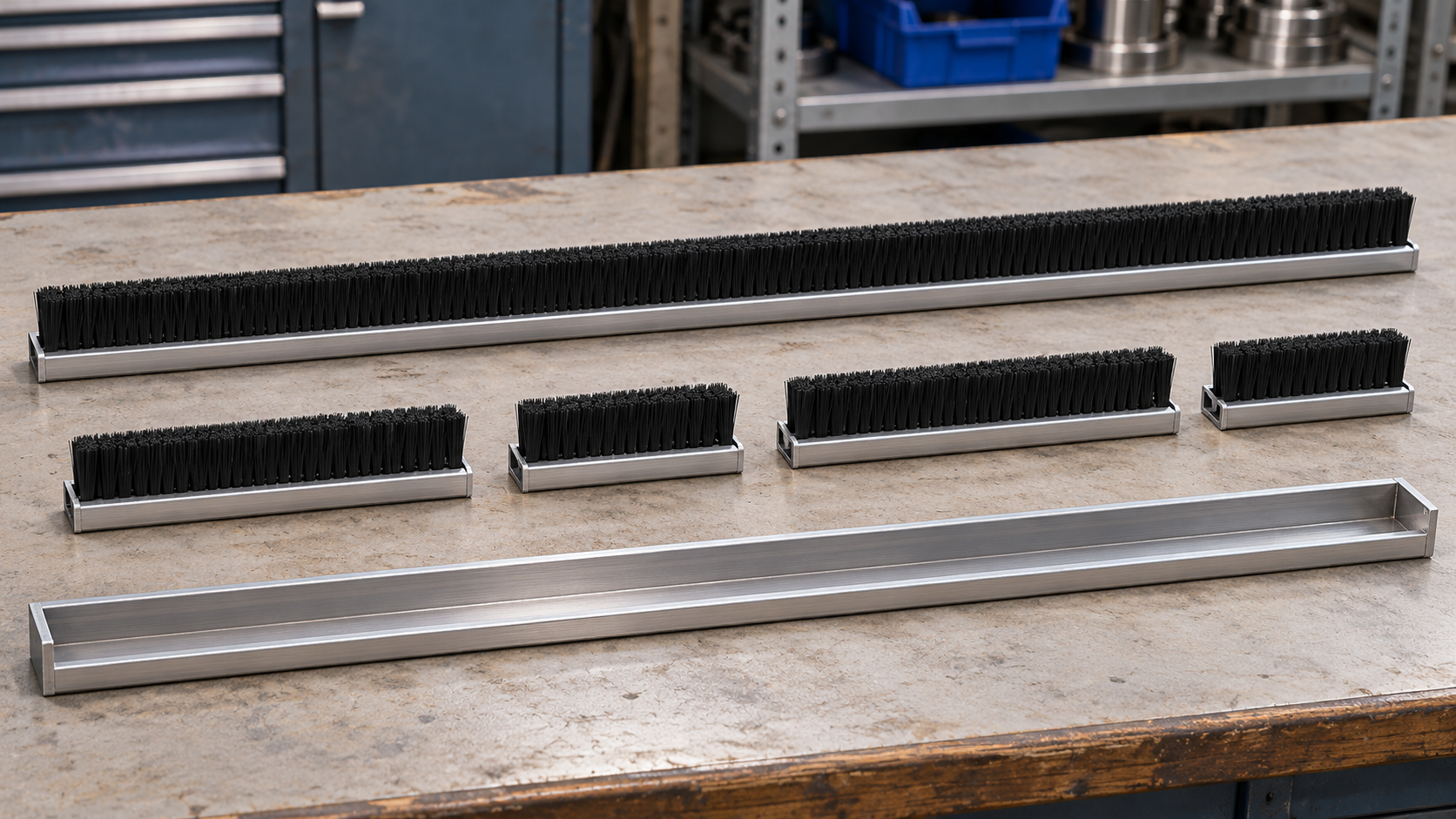
Start with the finished sections required at the machine, then prove the cutting pattern. Total metres can be sufficient while the stock still cannot produce enough uninterrupted pieces. The order also needs the finished end condition, matching holder scope and packing contents, because length alone does not make a usable strip brush.
For example, six 650 mm positions need 3900 mm of finished brush. Four 1200 mm stock lengths contain 4800 mm, but each can provide only one uninterrupted 650 mm section. More gross material than the net requirement does not solve the missing pieces.
Should I buy finished lengths or stock for local cutting?
Choose the supply form according to who can deliver the required finished condition. Finished supply puts the length, end treatment and part identity into the supplier's delivery scope. Stock supply leaves cutting and end finishing with another party, who needs a suitable process for that actual construction.
For repeated machine-opening replacements, finished labelled sections can reduce the work left at installation. For a workshop with an established process and several changing lengths, stock may be practical if its usable length and cutting requirements are known. For a long uninterrupted working edge, continuous supply may be relevant, but its handling and permitted joints must be explicit.
Do not compare these offers on metres alone. A finished strip quotation and an unprocessed stock quotation include different work. The lower material price may leave end finishing, inspection, identification and disposal of remnants outside the price being compared.
The required deliverable is the starting point: a piece that can be installed against its drawing, or stock that a defined process can turn into those pieces. If the local process cannot establish the required end condition, request finished supply rather than moving an unresolved manufacturing task to the installation team.
What does the product's reference length actually mean?
The SB-ST-0012 black crimped nylon strip lists a 500 mm reference length, 60 mm fill height, 8 mm channel height, 6 mm channel width and 0.50 mm filaments. Its overall height is 68 mm. The page allows different cut lengths and asks for the required end finish.
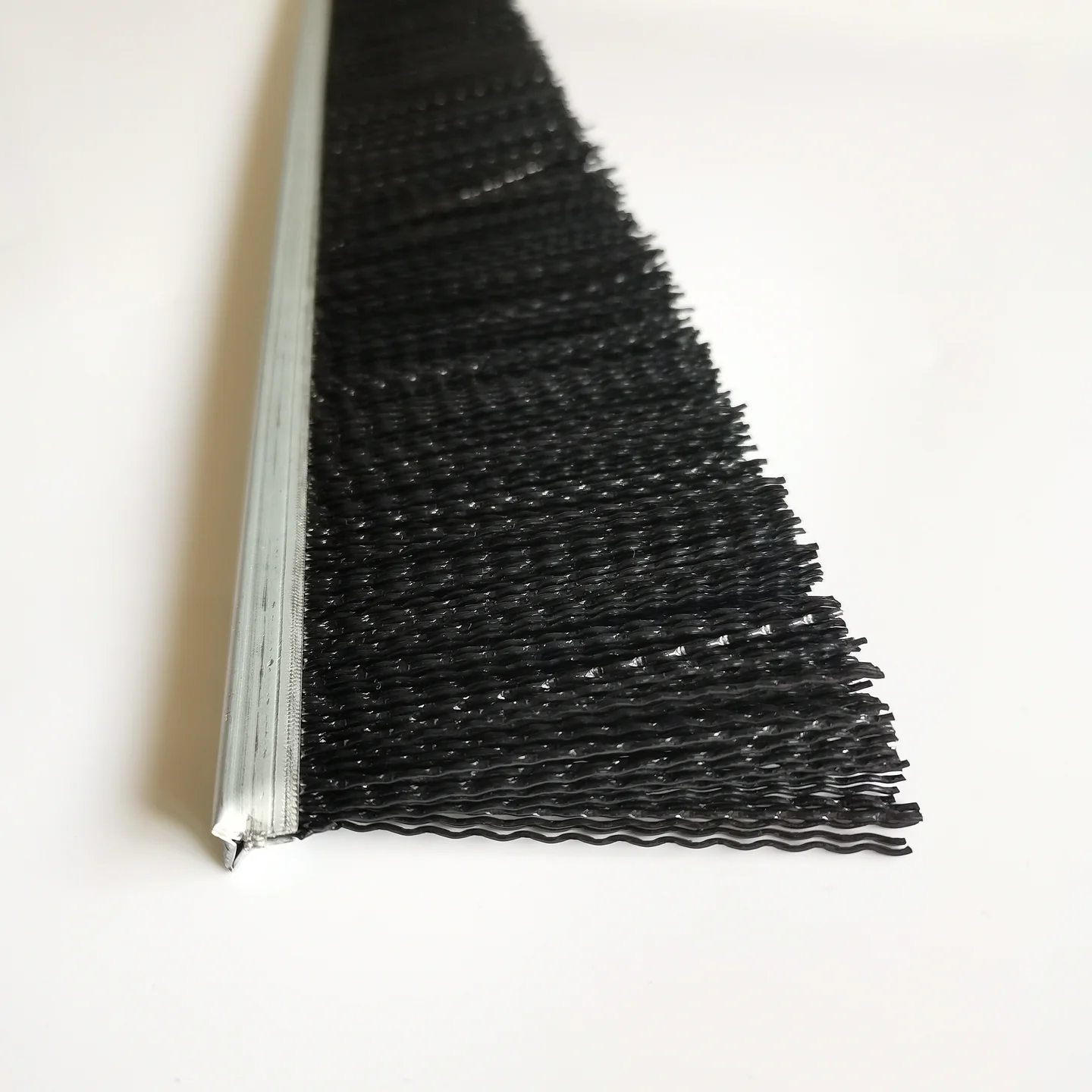
SB-ST-0012 product reference. The metal backing and its ends belong to the finished section; the nominal brush length does not describe every end or mounting requirement.
The 500 mm reference is not a requirement to join shorter pieces when the machine needs 650 mm. It also does not establish available stock lengths, a cutting loss, or a standard number of pieces per pack. Those are order-specific supply questions.
The channel brush and its mounting holder are separate objects. If a holder is required, give its section, mounting and length rather than assuming it is included with the brush. SEALEZE's holder range, for example, distinguishes brush-section fit from flange and mounting choices within its own system. Matching a brush length does not establish holder compatibility across suppliers.
Which finished lengths must stay as separate order lines?
List each required length and quantity, with the channel and fill configuration. Keep different end treatments, orientations or locating features separate even when the lengths match. The question is whether the pieces are truly interchangeable at their destinations.
For a simple conveyor-edge brush, several identical straight sections may serve equivalent positions. For a door or cover perimeter, a left section and a top section can need different end relationships or holder orientations. For a formed arc, the finished curve and endpoints make it a different deliverable from straight stock; use the formed-strip drawing guide.
State whether joints are permitted in the working span. Two short pieces adding to the required length are not equivalent to one uninterrupted piece when the joint is unacceptable. A continuous holder does not automatically make a joint in the brush field acceptable either.
Where segments are allowed, define their end relationship and the location of the joint relative to the task. A narrow component crossing the joint, an ordinary opening barrier and a stationary edge wipe may expose different weaknesses. The installed seal guide addresses the coverage and movement check for sealing tasks.
How do I prove a mixed-length cutting plan?
Use actual stock and process inputs. Consider a conditional project requiring six 650 mm sections and six 400 mm sections of the same configuration, without joints. Net finished length is 6 × 650 + 6 × 400 = 6300 mm.
For this example only, each stock length is 1200 mm, with 1180 mm usable after end preparation. The agreed cutting pattern consumes 3 mm for each separated finished piece. These are planning assumptions, not universal cutting instructions or published supplier capability.
One stock length produces a 650 mm section and a 400 mm section. The finished output is 1050 mm; two separations consume 6 mm; the remaining usable piece is 1180 − 1050 − 6 = 124 mm.
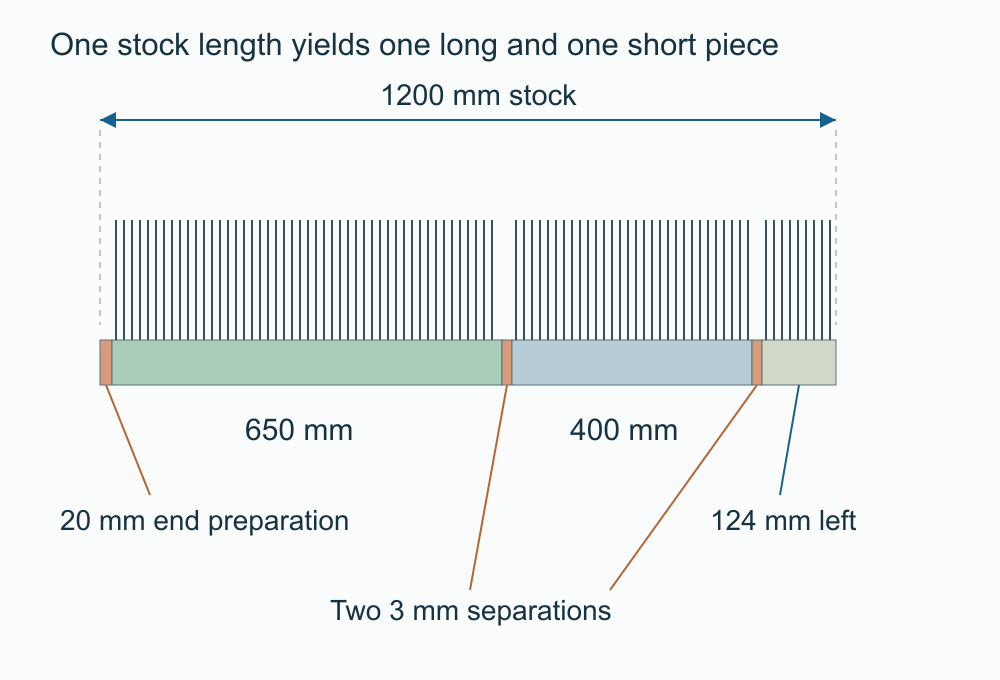
Illustrative stock pattern. The thin separation losses are identified with callouts; their width is exaggerated for visibility. The values, rather than the visual scale, define the calculation.
Quantity in this example | Result |
|---|---|
Stock lengths | 6 × 1200 = 7200 mm gross |
Finished long sections | 6 × 650 = 3900 mm |
Finished short sections | 6 × 400 = 2400 mm |
Separation loss | 6 × 6 = 36 mm |
End preparation | 6 × 20 = 120 mm |
Remaining pieces | 6 × 124 = 744 mm total |
The complete balance is 6300 + 36 + 120 + 744 = 7200 mm. Six stock lengths also follow from the long-piece requirement: two 650 mm pieces would need 1300 mm before cutting losses, exceeding the 1180 mm usable length. The shorter sections fit alongside the six long sections in the selected pattern.
If usable stock, end preparation or separation loss changes, calculate again. Do not keep the old stock quantity simply because the finished-length schedule is unchanged. The cutting party should confirm the actual pattern and the result it can supply.
Why is 744 mm of remainder not another 650 mm spare?
Because it is six separate 124 mm remnants. Adding their lengths produces an accounting total, not a continuous piece. None can fill the 650 mm position without a joint, and the example explicitly excludes joints.
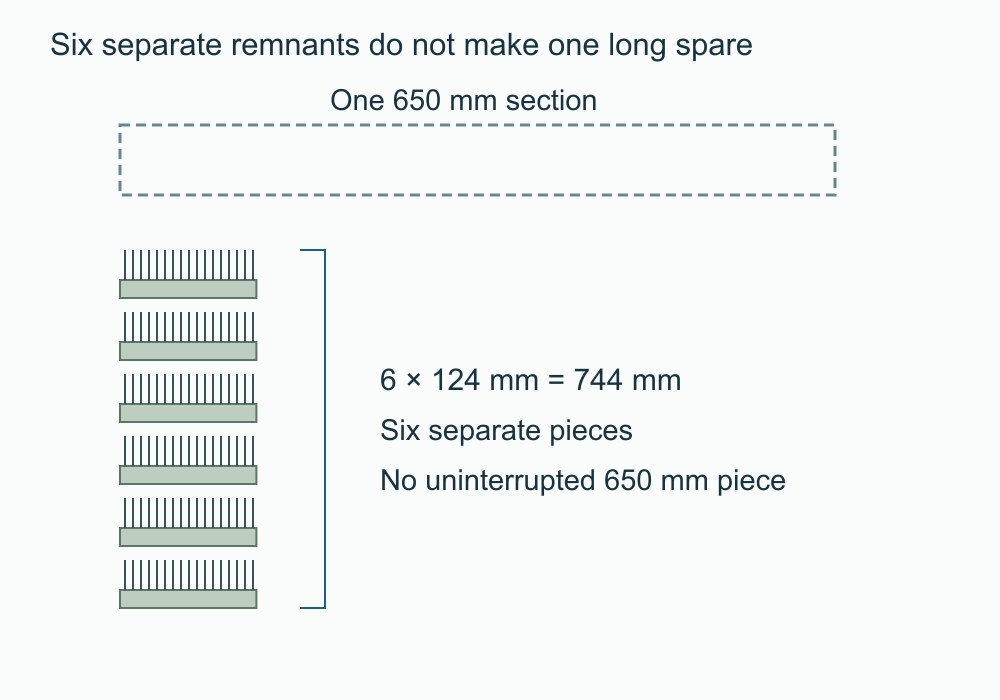
Separate remnants remain separate objects. A total greater than the long-part length does not create an uninterrupted replacement.
A remnant may be usable for another identified task if its configuration, length and finished condition suit that task. That is a separate decision, not an automatic credit against this installation's spare requirement.
Add trial pieces and spares to the finished-piece schedule before recalculating the stock plan. The six-stock pattern above produces exactly twelve required sections and no spare. A percentage added to total metres can still fail to create the particular spare length needed.
This matters when maintenance requires one uninterrupted long section but production uses a mix of short lengths. The most valuable spare is defined by its compatible position and finished condition, not by the amount of miscellaneous material left in a bin.
What must be correct at the cut end besides length?
The end must preserve the construction's required retention and fit. A channel that is distorted, a sharp unwanted projection, an opened end or locally displaced fill can create a different problem from an incorrect cut length. The appropriate end treatment depends on the actual product and agreed process.
Inspect the metal end and the adjacent filament field separately. A visually square backing does not prove the fill remains retained as required. A full-looking brush face does not show whether the end can enter its holder or sit against the intended stop.
For a sliding holder, compare the finished channel end with the insertion and retention arrangement. For a joined working edge, compare the end field with the next section so the intended coverage is preserved. For a section near a moving sheet, consider whether the finished backing or local fill presents an unwanted contact at that location.
The supplier should define the acceptable end configuration and any relevant verification. Do not infer a permitted saw, cutting location or retention repair from a generic product photograph. This is a finished-condition requirement, not a universal cutting procedure.
Should the brush and holder joints occur in the same place?
Treat the two joint layouts as related but separate. The holder locates and retains the brush; the brush field performs the contact task. A joint in one does not automatically require a joint in the other, and neither arrangement should be assumed without checking the selected construction.
A long holder may carry several brush sections for local replacement. Alternatively, holder sections may need separate mounting because of access or the available structure. In either case, identify how brush ends remain located and how the working field behaves at the joint.
If a proposal changes from one uninterrupted brush to several short sections to use available stock, it changes the installation question. Compare the revised joints with the actual workpiece route or opening. Do not present the proposal as an equivalent cut plan until those differences have been resolved.
How should the pack be labelled so installation receives a usable set?
For the mixed-length example, one installation pack could contain one 650 mm section and one 400 mm section. Six such packs contain the twelve required pieces. A pack label should identify both parts and their quantities; “six packs” alone says nothing about the contents.
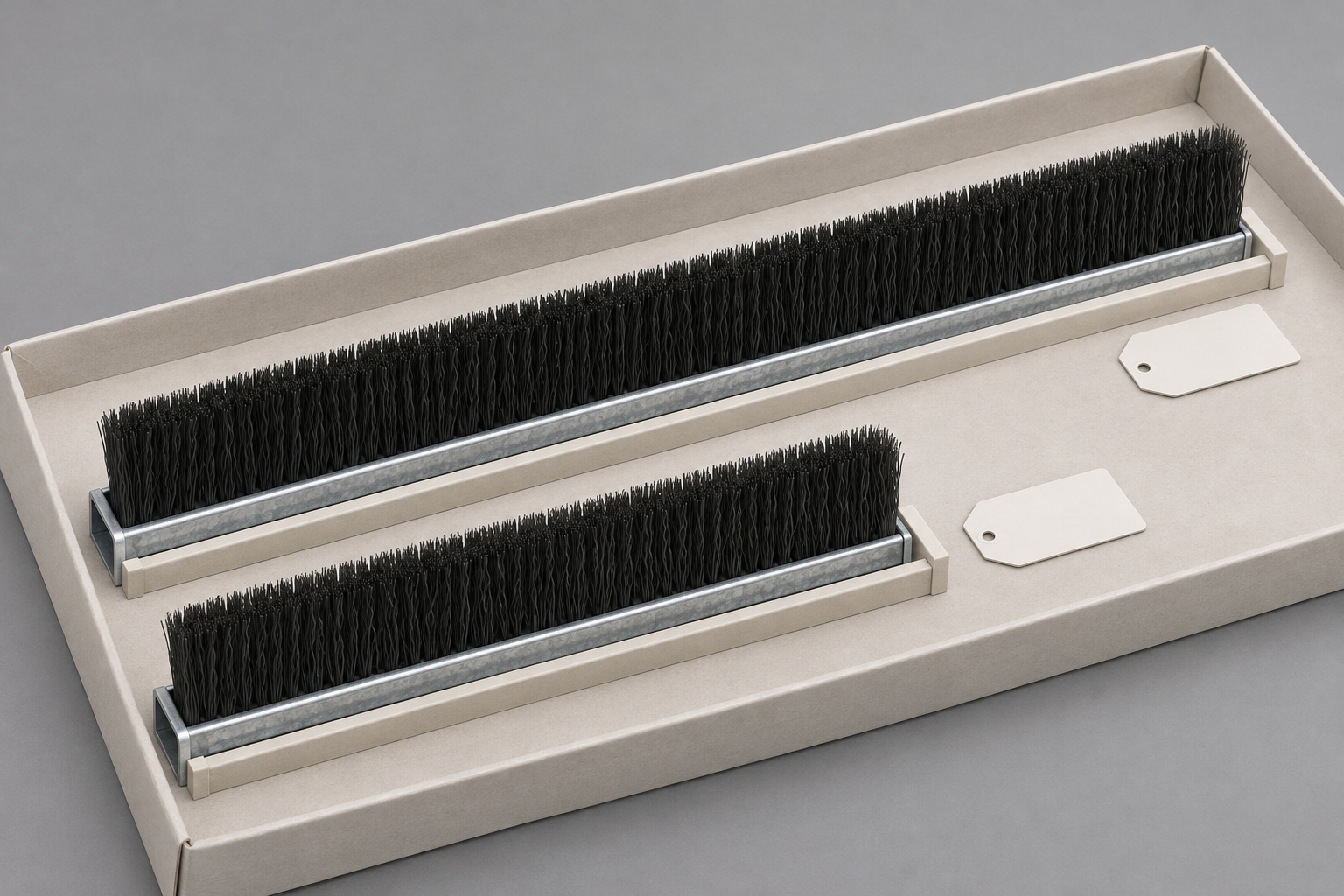
Matched-pair packing illustration. The backing is supported and the fill is kept clear of direct restraint. Exact packaging and dimensions follow the ordered parts and transport requirements.
Packing by length can also work. Each package should state the finished part identity, length, quantity and order line, with position information where parts are not interchangeable. Keep any sample or spare separate from the count required for the planned installation.
At receipt, compare the mix as well as the total. Twelve short pieces do not satisfy an order for six long and six short ones. Inspect the channel straightness, ends and local fill condition so handling damage is not confused with a design problem during fitting.
The finished enquiry should therefore attach the piece schedule, configuration and end requirements, specify brush and holder scope, and identify whether stock cutting or finished delivery is being purchased. A feasible material balance and clear pack contents turn quoted metres into the parts the machine actually needs.